Oxidation & Reduction
Oxidation & Reductionvideo
Oxidation & Reduction
Redox reactions
Oxidation and reduction take place together at the same time in the same reaction
These are called redox reactions
Oxidation can be defined as:
The gain of oxygen
The loss of electrons
An increase in oxidation number
Reduction can be defined as:
The loss of oxygen
The gain of electrons
A decrease in oxidation number
Names using oxidation numbers
Transition elements can bond in different ways by forming ions with different charges
When naming, the charge on the ion is shown by using a Roman numeral after the element's name
e.g. iron can form ions with a 2+ charge, called iron(II) ions or a 3+ charge, called iron(III) ions
The Roman numeral is the oxidation number of the element
When iron reacts with oxygen to form iron oxide, the formula depends on the oxidation state of the iron ions
The compound where iron has a 2+ charge has the formula FeO and is called iron(II) oxide
The compound where iron has a 3+ charge has the formula Fe2O3 and is called iron(III) oxide
Oxidation and reduction in terms of oxygen
Oxidation is a reaction in which oxygen is added to an element or a compound
Reduction is a reaction in which oxygen is removed from an element or compound
Example: Identifying the loss and gain of oxygen in an equation
zinc oxide + carbon → zinc + carbon monoxide
ZnO + C → Zn + CO
In this reaction, the zinc oxide has been reduced since it has lost oxygen
The carbon atom has been oxidised since it has gained oxygen
Oxidation and reduction in terms of electrons and oxidation number
Redox reactions can also be defined in terms of electron transfer
Oxidation is a reaction in which an element, ion or compound loses electrons
The oxidation number of the element is increased
This can be shown in a half equation, e.g. when silver reacts with chlorine, silver is oxidised to silver ions:
Ag → Ag+ + e-
Reduction is a reaction in which an element, ion or compound gains electrons
The oxidation number of the element is decreased
This can be shown in a half equation, e.g. when oxygen reacts with magnesium, oxygen is reduced to oxide ions:
O2 + 4e- → 2O2-
Example: Identifying Redox Reactions
zinc + copper sulphate → zinc sulphate + copper
Zn + CuSO4 → ZnSO4 + Cu
The ions present (with state symbols) in the equation are:
Zn(s) + Cu2+(aq) + SO42-(aq) →Zn2+(aq) + SO42-(aq) + Cu(s)
The spectator ions (those that do not change) are SO42-(aq)
These can be removed and the ionic equation written as:
Zn(s) + Cu2+(aq) → Zn2+(aq) + Cu(s)
By analysing the ionic equation, we can split the reaction into two half equations by adding in the electrons to show how the changes in charge have occurred:
Zn(s) → Zn2+(aq) + 2e-
Cu2+(aq) +2e- → Cu(s)
It then becomes clear that zinc has been oxidised as it has lost electrons
Copper ions have been reduced as they have gained electrons
Identifying Redox Reactionsvideo
Identifying Redox Reactions
Oxidation Number
The oxidation number (also called oxidation state) is a number assigned to an atom or ion in a compound which indicates the degree of oxidation (or reduction)
It shows the number of electrons that an atom has lost, gained or shared in forming a compound
The oxidation number helps you to keep track of the movement of electrons in a redox process
It is written as a +/- sign followed by a number (not to be confused with charge which is written by a number followed by a +/- sign)
E.g. aluminium in a compound usually has the oxidation state +3
A few simple rules help guide you through the process of determining the oxidation number of any element
Table of Rules for Assigning Oxidation Numbers
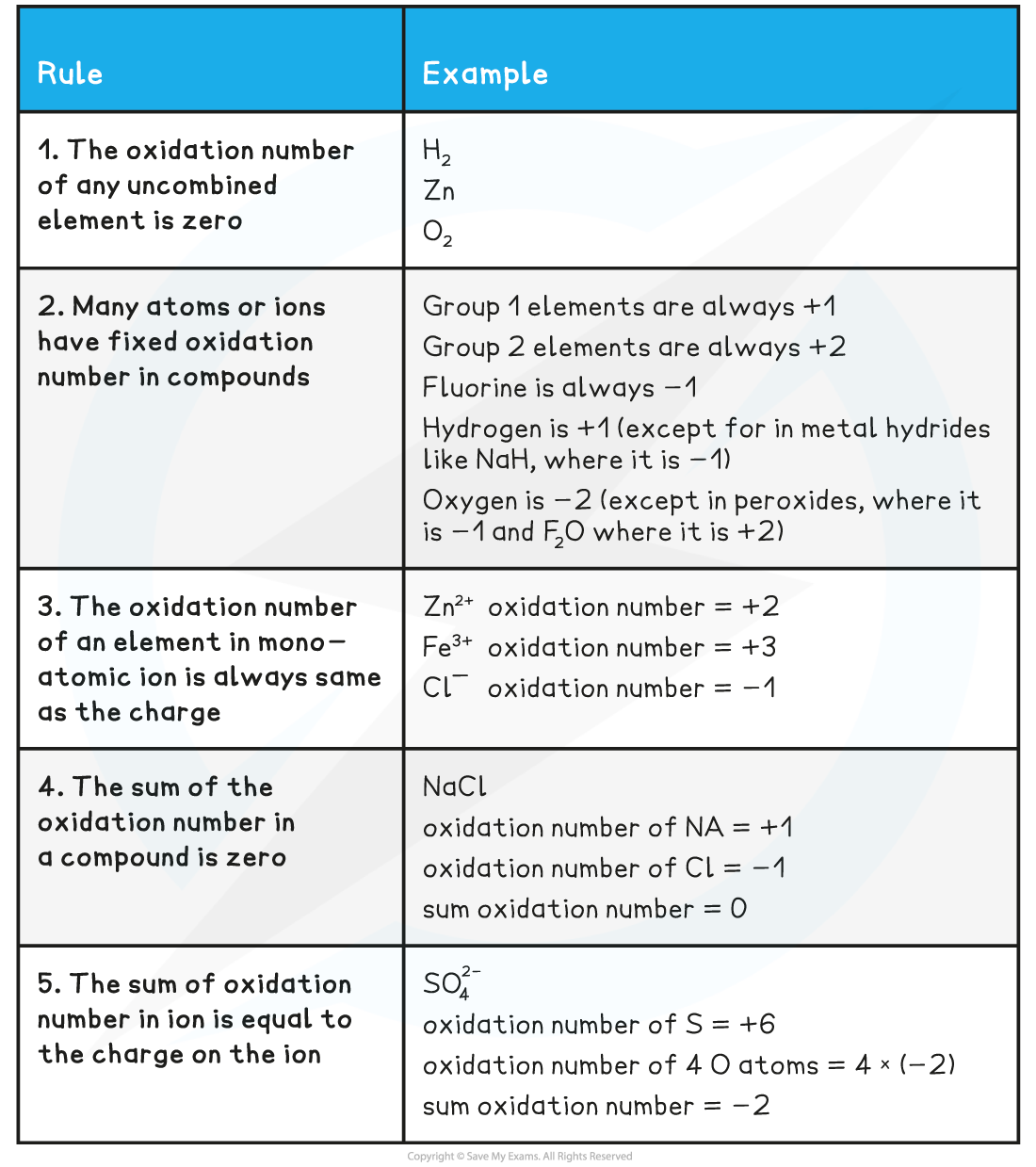
Redox reactions can be identified by the changes in the oxidation number when a reactant goes to a product
Identifying Redox Reactions by Colour Changes
The tests for redox reactions involve the observation of a colour change in the solution being analysed
Two common examples are acidified potassium manganate(VII), and potassium iodide
Potassium manganate(VII), KMnO4, is an oxidising agent which is often used to test for the presence of reducing agents
When acidified potassium manganate(VII) is added to a reducing agent its colour changes from purple to colourless
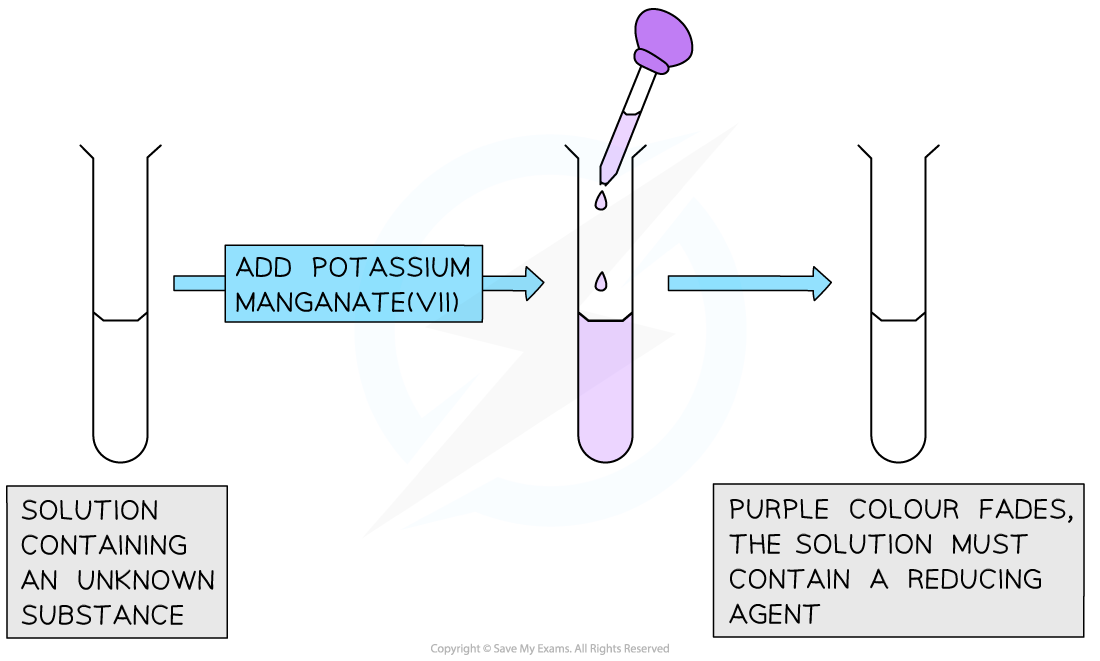
Diagram to show the colour change when potassium manganate(VII) is added to a reducing agent
Potassium iodide, KI, is a reducing agent which is often used to test for the presence of oxidising agents
When added to an acidified solution of an oxidising agent such as aqueous chlorine or hydrogen peroxide (H2O2), the solution turns a red-brown colour due to the formation of iodine, I2:
2KI (aq) + H2SO4 (aq) + H2O2 (aq) → I2 (aq) + K2SO4 (aq) + 2H20 (l)
The potassium iodide is oxidised as it loses electrons and hydrogen peroxide is reduced, therefore potassium iodide is acting as a reducing agent as it will itself be oxidised:
2I- → I2 + 2e-
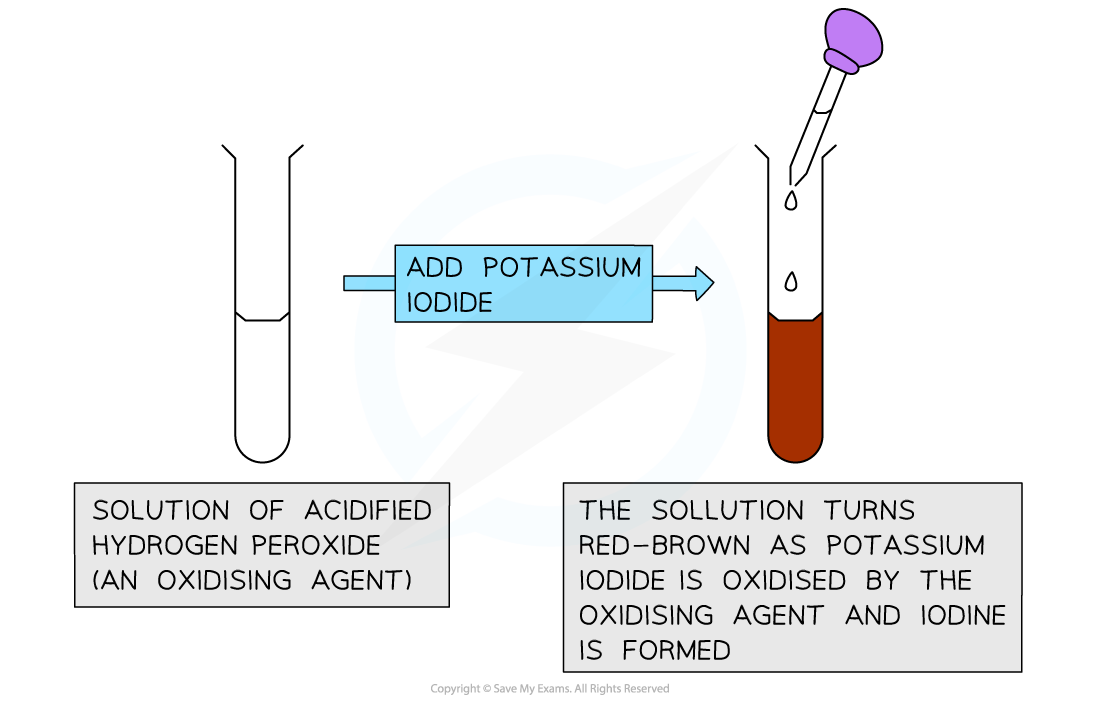
Diagram to show the colour change when potassium iodide is added to an oxidising agent
Oxidising & Reducing Agents
Oxidising & Reducing Agents
Oxidising agent
A substance that oxidises another substance, and becomes reduced in the process
An oxidising agent gains electrons as another substance loses electrons
Common examples include hydrogen peroxide, fluorine and chlorine
Reducing agent
A substance that reduces another substance, and becomes oxidised in the process
A reducing agent loses electrons as another substance gains electrons
Common examples include carbon and hydrogen
The process of reduction is very important in the chemical industry as a means of extracting metals from their ores
Example
CuO + H2 → Cu + H2O
In the above reaction, hydrogen is reducing the CuO and is itself oxidised as it has lost electrons, so the reducing agent is therefore hydrogen:
H2 → 2H+ + 2e-
The CuO is reduced to Cu by gaining electrons and has oxidised the hydrogen, so the oxidising agent is therefore copper oxide
Cu2+ +2e- → Cu