Data Packets
Data Packets
Data Packets
What are packets?
Packets are small 'chunks' of data that make up a larger piece of data that has been broken down by the TCP protocol so that it can be transmitted over the internet
TCP stands for Transmission Control Protocol and is used for organising data transmission over networks
Small 'chunks' of data are easier and quicker to route over the internet than big 'chunks' of data
Routing involves finding the most optimal path over a network
Data can include anything from text, images, audio, video, animations, etc, or any combination of these
What do packets contain?
A packet consists of:
Header | Payload | Trailer |
|---|---|---|
Source IP address | Actual data being transported | Additional security information |
Destination IP address | End of packet notification | |
Packet number (1 of 5 etc.) |
To transmit the message “This is a message :)”over the internet, TCP might break the message down into 4 packets
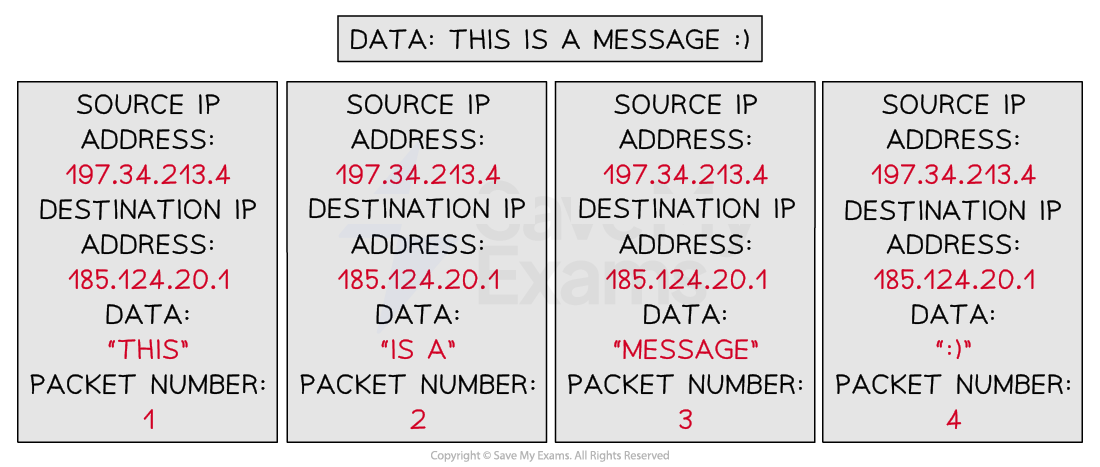
Each packet contains a:
source IP address
destination IP address
payload (the data)
a packet number
Error checks make sure that when a packet is received there is minimal or no corruption of the data
Corruption is where packet data is changed or lost in some way, or data is gained that originally was not in the packet
Read error detection methods for more detail on how data packets can be checked to ensure corruption is avoided/minimised