Things Fall Apart: Plot Summary
It is best to understand the order and key plot points to understand the overall structure of the novel, and how it conveys Achebe’s ideas.
Below you will find:
Plot storyline
An overview of the novel
A plot summary broken down into sections of the novel
Things Fall Apart: Plot Storyline
Things Fall Apart: Plot Storyline
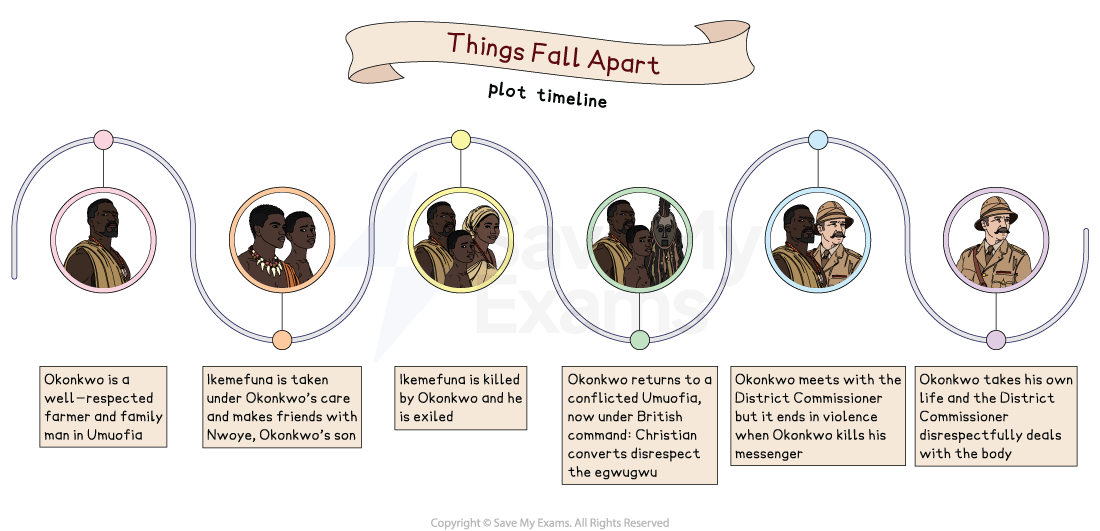
Things Fall Apart: Plot Summary: Overview
Overview
The novel’s protagonist, Okonkwo, is a respected member of the Umuofia Igbo clan, despite his father’s bad reputation and poverty. Okonkwo has grown up to be strict and unforgiving, and expects a lot from his own son, 12-year-old Nwoye.
Okonkwo helps settle a dispute with the neighbouring village of Mbaino, which gives Umuofia a teenage boy, Ikemefuna, and a young virgin girl as compensation for the murder of a clansman's wife. The girl is given to the murdered woman's husband, and Ikemefuna goes to live with Okonkwo's family, where he becomes close to Nwoye. Later, Okonkwo is told that the Oracle demands Ikemefuna’s life, but that he is not to be involved in his killing. Nevertheless, Okonkwo betrays and kills Ikemefuna. Already under the village’s judgement, Okonkwo accidentally kills the son of a respected elder during a funeral ceremony. As punishment, he is exiled for seven years.
Despite his comfortable settlement in Mbanta, he is dissatisfied with his new life. However, when Okonkwo returns to Umuofia, the community is under colonial rule. Missionaries encourage the residents to convert to Christianity, and religious beliefs in the village clash. When a convert disgraces a sacred Igbo tradition, the clansmen burn his church and are subsequently arrested and tortured. During a village meeting to discuss how to respond to the colonisers, Okonkwo kills a court messenger who tries to break it up. When the clan refuses to support his action, Okonkwo realises they will not resist the new order, and, in despair, he takes his own life. As the clan cannot bury Okonkwo traditionally, the District Commissioner deals with the body. The novel ends portraying the disrespectful manner with which he carries this out.
Things Fall Apart: Plot Summary: Chapter-by-chapter plot summary
Chapter-by-chapter plot summary
Part 1: Chapter 1
Okonkwo, the protagonist, is respected in the clan as a fierce warrior, successful farmer, and family man with three wives
Okonkwo’s hatred towards his father’s weaknesses has made him severe:
His father, a musician, had much debt and did not provide for his family
Chapter 2
After a dispute in Mbaino, Okonkwo returns with a woman and teenage boy:
The scared boy, Ikemefuna, is taken in by Okonkwo’s family
Okonkwo’s harsh treatment of his wives and son is judged by the village
Chapter 3
The story returns to Okonkwo’s childhood to describe his father, Unoka
An Oracle explains that Unoka is doomed for not working hard
After Okonkwo’s father’s death, a farmer supports Okonkwo, and he builds a farm
Chapter 4
The village begins to lose respect for Okonkwo because of his arrogance:
At a meeting he insults a man, and the clan turn on him
During the traditional Igbo Week of Peace, Okonkwo beats his third wife:
He is punished by the clan and required to offer a sacrifice to atone for breaking the Week of Peace
Chapter 5
By the time of the Feast of the New Yam, Okonkwo’s aggression is worsening:
He beats and shoots his second wife, Ekwefi, although he misses
The story relates their initial meeting at one of the festival’s wrestling matches
Chapter 6
The village come together to watch a wrestling match and Ekwefi, who is sitting with the women, speaks with the priestess Chielo while sitting with her own daughter, Ezinma
Chapter 7
Ikemefuna grows closer to the family and Nwoye
An elder tells Okonkwo that the Oracle has ordered Ikemefuna’s death, adding that Okonkwo is too close to the boy to carry it out:
Okonkwo ignores this warning and kills him in the forest
Nwoye is distressed that his father has abandoned him and his friend
Chapter 8
Okonkwo complains about his children, but his friend Obierika challenges his severity
During a traditional ceremony, the elders discuss strangers with “white skin”
Chapter 9
Ekwefi alerts Okonkwo that their daughter, Ezinma, is very sick
Okonkwo prepares her medicine and supports his wife
Chapter 10
A traditional Igbo trial takes place in the village
The nine egwugwu, masqueraders representing spirits, rule that a husband must take back the wife he has beaten and be more respectful
Chapter 11
Chielo informs Ekwefi that an Oracle, Agbala, wants to see Ezinma
Ekwefi follows Chielo who carries Ezinma off to the Oracle’s cave
The journey is long, but when Ekwefi arrives at the cave, Okonkwo is there
Chapter 12
Although there is much festivity in the village the next day, Okonkwo, Ekwefi, and Chielo are exhausted from their night journey:
Ezinma is put to bed, and they help with preparations
Chapter 13
At the funeral of Ezeudu, the oldest man in the village, Okonkwo’s gun accidentally goes off and kills Ezeudu’s son
As this is a serious crime against the Earth goddess, the clan exiles Okonkwo and his family for seven years
They go to Mbanta, his mother’s village
Chapter 14
Although Okonkwo and his family are welcomed and his uncle helps the family, Okonkwo struggles to accept his exile
He is offered advice by his uncle: he should consider himself lucky
Chapter 15
Obierika visits Okonkwo in Mbanta and relates the colonists’ slaughter of the Abame clan
They discuss an Oracle’s warning that white men will come like “locusts”
Chapter 16
Two years later, Obierika visits Okonkwo again, this time with news that missionaries have arrived in Umuofia
He discusses Nwoye’s interest in Christianity, but Okonkwo will not discuss it
Chapter 17
Missionaries arrive in Mbanta and begin to encourage the villagers to convert
Nwoye goes to the church, and, on his return, Okonkwo beats him for it
Chapter 18
The villagers begin to worry about the changes the missionaries bring:
When a python (a sacred animal) is reportedly killed by a Christian convert, tensions rise
Okonkwo urges the elders to insist the missionaries leave but they let it pass
Chapter 19
As Okonkwo prepares for his return to Umuofia, he is unsettled, but he hopes that things will go back to the way they used to be before his exile
Chapter 20
Okonkwo’s return to Umuofia is disappointing when he sees it has changed:
The village is governed by a District Commissioner
Obierika tells Okonkwo that they have no chance against the men with guns
Chapter 21
As British culture supersedes the Igbo culture, the village is pleased with the improved trade and education:
Mr Brown advises the elders that reading and writing is key
Okonkwo becomes increasingly frustrated with Nwoye who goes to school
Chapter 22
During a ceremony, a convert, Enoch, disrespects an egwugwu
The clan leaders burn the church in retaliation for Enoch’s offence
Chapter 23
Okonkwo and the elders go to the District Commissioner’s office
Once there, they are arrested, tortured, humiliated, and released after the clan pays a heavy fine
Chapter 24
The next day, an angry Okonkwo and villagers gather to plan their resistance
When a messenger instructs them to disband the meeting, Okonkwo kills him
But his shocked clansmen surrender and let the other men leave freely
Chapter 25
When the District Commissioner comes to arrest Okonkwo, Obierika takes him to a tree where Okonkwo has hanged himself
Obierika tells the commissioner to deal with Okonkwo’s body as Igbo beliefs disavow suicide
The District Commissioner describes the event as British “pacification”