StudyDeck

Introduction to Vectors

Exam code: 4037
Written by: Ashika|Reviewed by: Caroline Carroll|Updated 2 July 2026

Basic Vectorsvideo

Basic Vectors

Basic vectors

What is a vector?

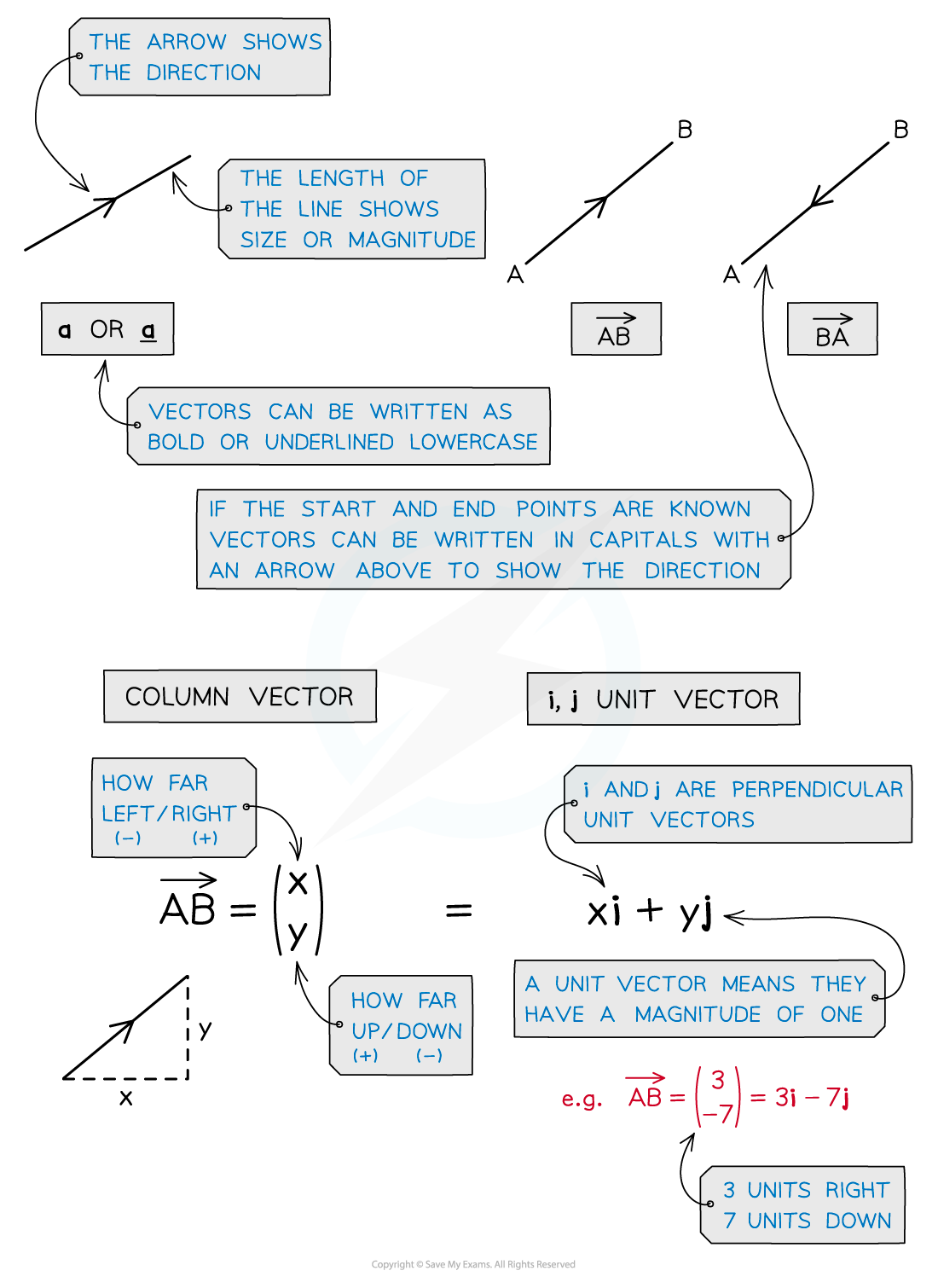
  • Vectors represent a movement of a certain magnitude (size) in a given direction

    • For example: two objects with velocities of 7 m/s and ‑7 m/s are travelling at the same speed but in opposite directions

  • You should have already come across vectors when translating functions of graphs

  • They appear in many contexts of maths including mechanics for modelling forces

  • A vector in two directions has components in the direction of the x- and y- axes

    • Vector quantities can have positive or negative components

  • Vectors can be represented in different ways such as a column vector or as an i and j unit vector

  • Some examples of vector quantities you may come across are displacement, velocity or acceleration
Basic Vectors Diagram 1, AS & A Level Maths revision notes

Magnitude of a Vector

Magnitude of a vector

How do you find the magnitude of a vector?

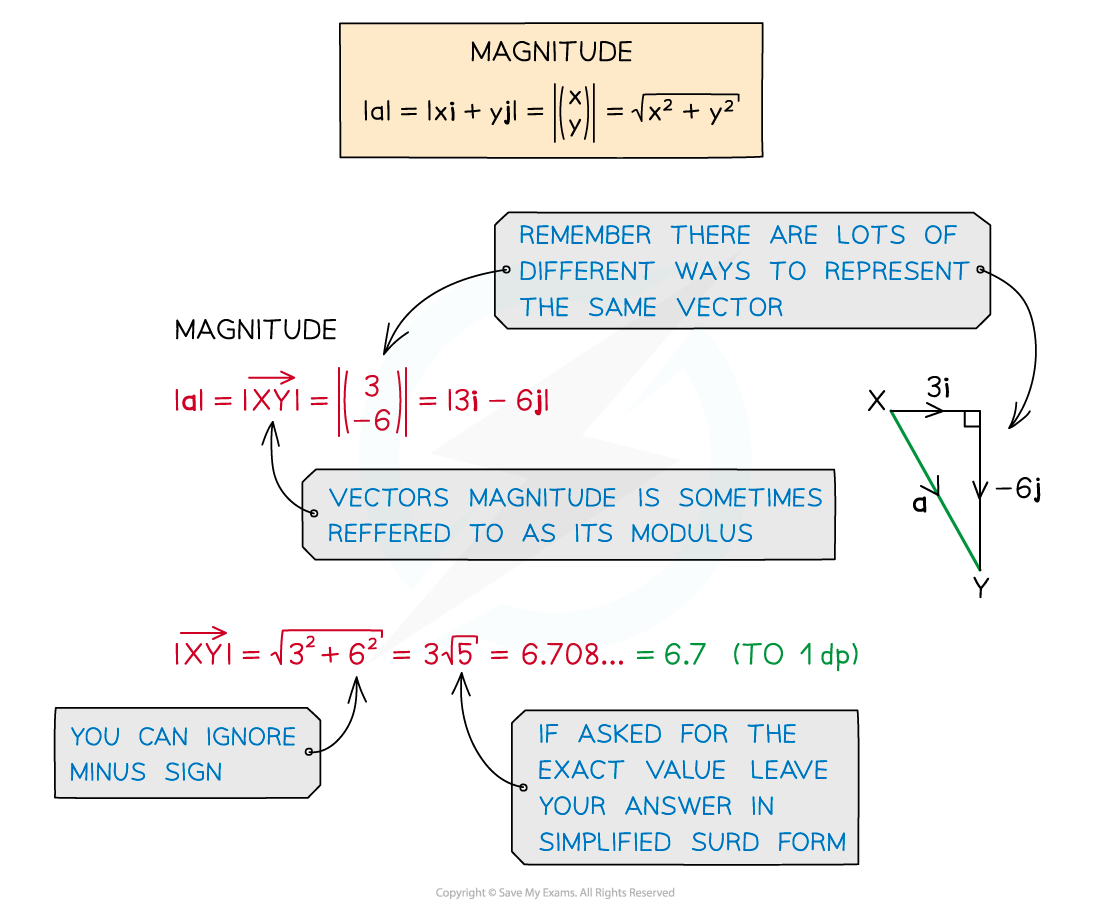
  • The magnitude of a vector tells us its size or length

  • The magnitude of the vector AB→{"language":"en","fontFamily":"Times New Roman","fontSize":"18"} is denoted AB→{"language":"en","fontFamily":"Times New Roman","fontSize":"18"}

    • The magnitude of the vector a is denoted |a|

  • The magnitude of a vector can be found using  Pythagoras’ theorem

  • The magnitude of a vector v=v1i+ v2j{"language":"en","fontFamily":"Times New Roman","fontSize":"18","autoformat":true} is found using

    • v= v1 2+ v2  2{"language":"en","fontFamily":"Times New Roman","fontSize":"18","autoformat":true}

    • where v= v1v2{"language":"en","fontFamily":"Times New Roman","fontSize":"18","autoformat":true}

Magnitude Direction Diagram 1a, AS & A Level Maths revision notes

What is a unit vector?

  • A unit vector has a magnitude of 1

  • The vectors i{"language":"en","fontFamily":"Times New Roman","fontSize":"18","autoformat":true} and j{"language":"en","fontFamily":"Times New Roman","fontSize":"18","autoformat":true} are unit vectors

    • the direction of i{"language":"en","fontFamily":"Times New Roman","fontSize":"18","autoformat":true} is in the positive x{"language":"en","fontFamily":"Times New Roman","fontSize":"18","autoformat":true}-direction

    • the direction of j{"language":"en","fontFamily":"Times New Roman","fontSize":"18","autoformat":true} is in the positive y{"language":"en","fontFamily":"Times New Roman","fontSize":"18","autoformat":true}-direction

  • To find a unit vector in the direction of a given vector divide the vector by its magnitude

Position Vectorsvideo

Position Vectors

Position vectors

What is a position vector?

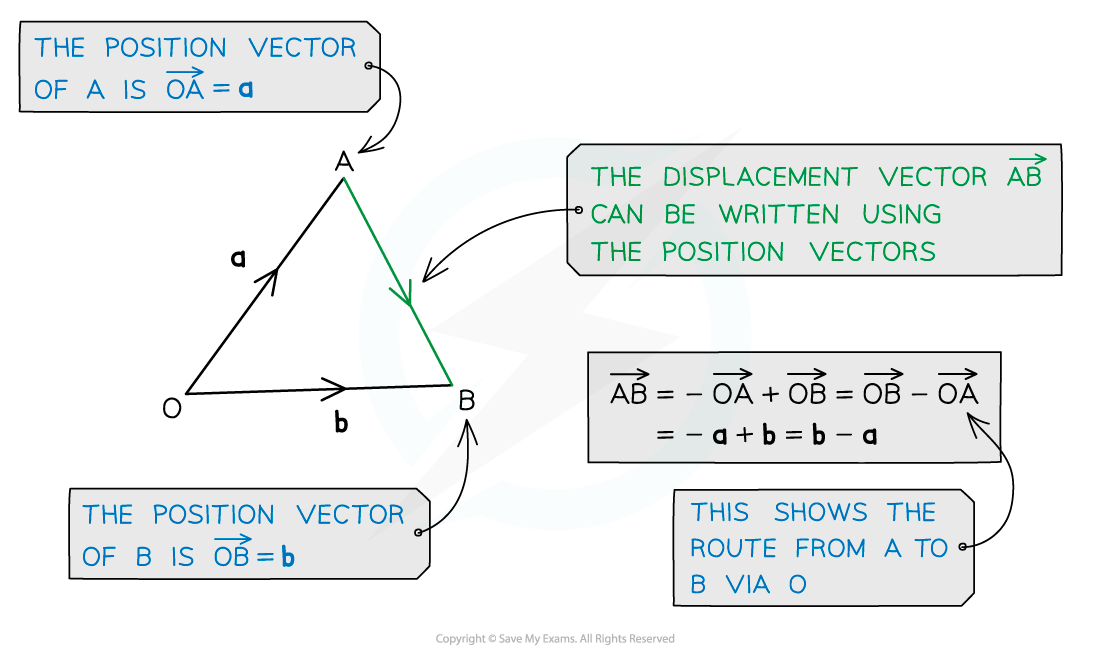
  • Position vectors describe the position of a point in relation to the origin

  • They are different to displacement vectors which describe the direction and distance between any two points

  • The position vector of point A is written with the notation a = OA→{"language":"en","fontFamily":"Times New Roman","fontSize":"18"} 

    • The origin is always denoted O

  • The individual components of a position vector are the coordinates of its end point

    • For example the point with coordinates (3, -2) has position vector 3i – 2j
 

new-11-1-4-position-vectors-diagram-1

How do I find the distance between two points using vectors?

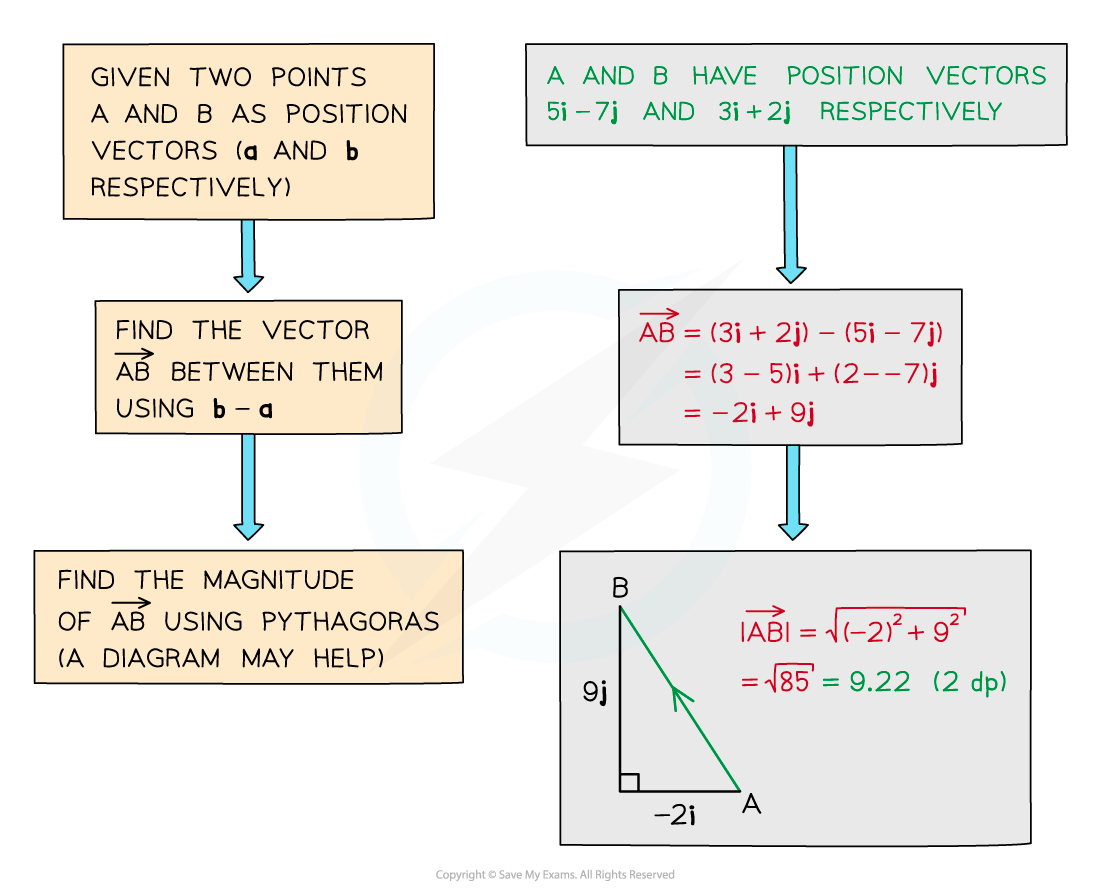
  • The distance between two points is the magnitude of the vector between them
 

Position Vectors Diagram 2a, AS & A Level Maths revision notes

How do I find the magnitude of a displacement vector?

  • You can use coordinate geometry to find magnitudes of displacement vectors from A  to B

    • From the position vectors of A  and B  you know their coordinates

      • If  a=OA→=x1i+y1j=x1y1{"language":"en","fontFamily":"Times New Roman","fontSize":"18","autoformat":true},  then point A has coordinates x1, y1{"language":"en","fontFamily":"Times New Roman","fontSize":"18","autoformat":true}

      • If  b=OB→=x2i+y2j=x2y2{"language":"en","fontFamily":"Times New Roman","fontSize":"18","autoformat":true},  then point B has coordinates x2, y2{"language":"en","fontFamily":"Times New Roman","fontSize":"18","autoformat":true}

    • The distance between two points is given by d = x1- x22 + y1- y22 {"language":"en","fontFamily":"Times New Roman","fontSize":"18","autoformat":true}

      • So  AB→ = x1- x22 + y1- y22 {"language":"en","fontFamily":"Times New Roman","fontSize":"18","autoformat":true}

    • For example, if points A and B have position vectors 5i+3j{"language":"en","fontFamily":"Times New Roman","fontSize":"18","autoformat":true} and 3i-6j{"language":"en","fontFamily":"Times New Roman","fontSize":"18","autoformat":true} respectively

      • then  AB→=5-32+3--62=85=9.22 3 s.f.{"language":"en","fontFamily":"Times New Roman","fontSize":"18","autoformat":true}

  • Alternatively, you could find AB→{"language":"en","fontFamily":"Times New Roman","fontSize":"18","autoformat":true} by

    • first using  AB→=-OA→+OB→{"language":"en","fontFamily":"Times New Roman","fontSize":"18","autoformat":true} to find AB→{"language":"en","fontFamily":"Times New Roman","fontSize":"18","autoformat":true} in vector form

      • and then calculating its magnitude directly

    • See the Worked Example below