StudyDeck

Problem Solving using Vectors

Exam code: 4037
Written by: Ashika|Reviewed by: Caroline Carroll|Updated 2 July 2026

Problem Solving using Vectorsvideo

Problem Solving using Vectors

Problem-solving using vectors

What problems may I be asked to solve involving vectors?

  • Showing that two lines or vectors are parallel

    • Two vectors are parallel if they are scalar multiples of each other

    • i.e.  a=kb{"language":"en","fontFamily":"Times New Roman","fontSize":"18","autoformat":true} where k{"language":"en","fontFamily":"Times New Roman","fontSize":"18","autoformat":true} is a constant

      • See Vector Addition

  • Finding the midpoint of two (position) vectors

  • Showing that three points are collinear

    • Collinear describes points that lie on the same straight line

      • e.g.  The points -2, -2, 3, 3{"language":"en","fontFamily":"Times New Roman","fontSize":"18","autoformat":true} and 8, 8{"language":"en","fontFamily":"Times New Roman","fontSize":"18","autoformat":true} all lie on the line with equation y=x{"language":"en","fontFamily":"Times New Roman","fontSize":"18","autoformat":true}

      • Vectors can be used to show this, and similar, results

  • Results concerned with geometric shapes

    • Shapes with parallel lines are often involved

      • e.g.  parallelogram, rhombus

    • These often include lines or vectors being split into ratios

      • e.g.  The point Q{"language":"en","fontFamily":"Times New Roman","fontSize":"18","autoformat":true} lies on the line PR{"language":"en","fontFamily":"Times New Roman","fontSize":"18","autoformat":true} such that PQ→:QR→=3:1{"language":"en","fontFamily":"Times New Roman","fontSize":"18","autoformat":true}

How do I find the midpoint of two vectors?

  • If the point A{"language":"en","fontFamily":"Times New Roman","fontSize":"18","autoformat":true} has position vector a{"language":"en","fontFamily":"Times New Roman","fontSize":"18","autoformat":true} and the point B{"language":"en","fontFamily":"Times New Roman","fontSize":"18","autoformat":true} has position vector b{"language":"en","fontFamily":"Times New Roman","fontSize":"18","autoformat":true}

    • the position vector of the midpoint of AB{"language":"en","fontFamily":"Times New Roman","fontSize":"18","autoformat":true} is 12a+b{"language":"en","fontFamily":"Times New Roman","fontSize":"18","autoformat":true}

  • This can be derived by considering

    • AB→=b-a{"language":"en","fontFamily":"Times New Roman","fontSize":"18","autoformat":true}

      • using the result from Vector Addition 

    • If M{"language":"en","fontFamily":"Times New Roman","fontSize":"18","autoformat":true} is the midpoint of AB{"language":"en","fontFamily":"Times New Roman","fontSize":"18","autoformat":true} then

      • AM→=12AB→{"language":"en","fontFamily":"Times New Roman","fontSize":"18","autoformat":true}

    • Therefore, the position vector of the midpoint, OM→{"language":"en","fontFamily":"Times New Roman","fontSize":"18","autoformat":true} is  

      • OM→=OA→+AM→=a+12b-a{"language":"en","fontFamily":"Times New Roman","fontSize":"18","autoformat":true} OM→=12a+b{"language":"en","fontFamily":"Times New Roman","fontSize":"18","autoformat":true} 

How do I show three points are collinear?

  • Three points are collinear if they all lie on the same straight line

  • There are two ways to show this for three points, A, B{"language":"en","fontFamily":"Times New Roman","fontSize":"18","autoformat":true} and C{"language":"en","fontFamily":"Times New Roman","fontSize":"18","autoformat":true} say

    • Method 1 Show that AB→=kAC→{"language":"en","fontFamily":"Times New Roman","fontSize":"18","autoformat":true} where k{"language":"en","fontFamily":"Times New Roman","fontSize":"18","autoformat":true} is a constant i.e.  show that AB→{"language":"en","fontFamily":"Times New Roman","fontSize":"18","autoformat":true} and AC→{"language":"en","fontFamily":"Times New Roman","fontSize":"18","autoformat":true} are scalar multiples of each other

      • As the vectors are scalar multiples they will have the same direction (and so be parallel)

      • So as both vectors start at point A{"language":"en","fontFamily":"Times New Roman","fontSize":"18","autoformat":true}, they must be collinear

    • Method 2 Show that AB→=kBC→{"language":"en","fontFamily":"Times New Roman","fontSize":"18","autoformat":true}  AND  that point B{"language":"en","fontFamily":"Times New Roman","fontSize":"18","autoformat":true} lies on both the vectors AB→{"language":"en","fontFamily":"Times New Roman","fontSize":"18","autoformat":true} and BC→{"language":"en","fontFamily":"Times New Roman","fontSize":"18","autoformat":true}

  • Which method you should use will depend on the information given and how you happen to see the question

How do I solve problems involving geometric shapes?

  • Problems involving geometric shapes involve finding paths around the shape using known vectors

    • there will be many other vectors in the shape that are equal and/or parallel to the known vectors

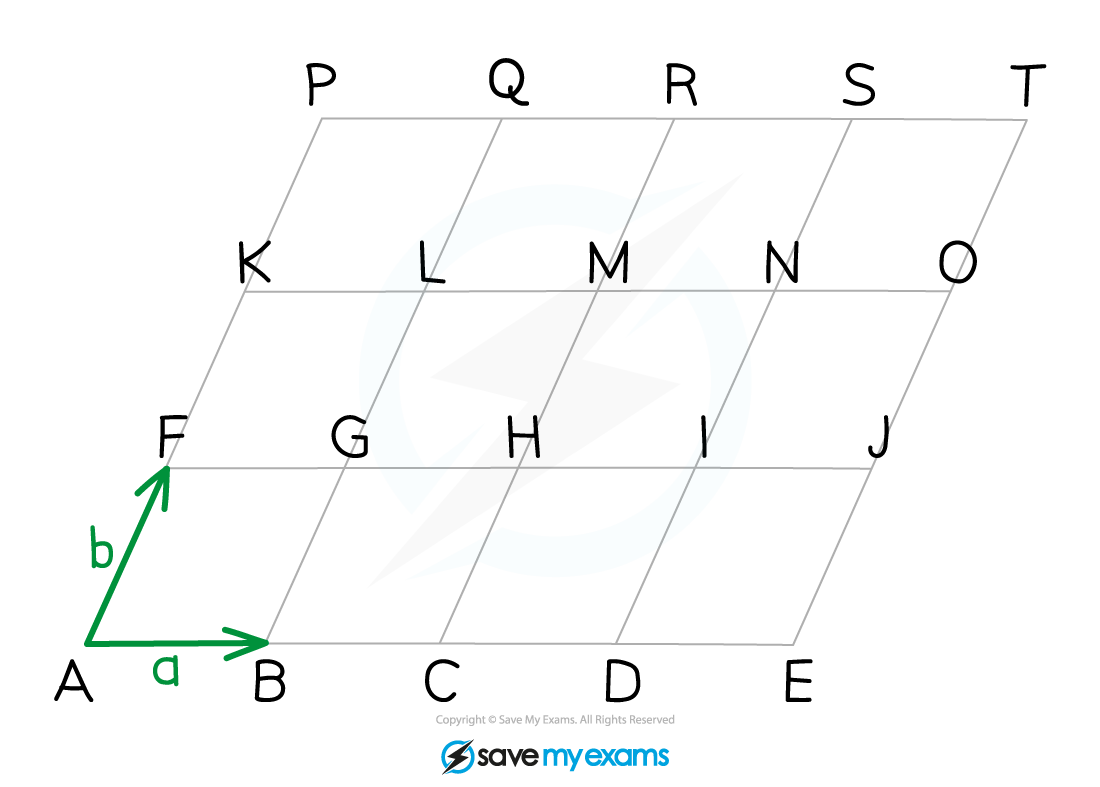
  • The following grid is made up entirely of parallelograms, with the vectors a{"language":"en","fontFamily":"Times New Roman","fontSize":"18","autoformat":true} and b{"language":"en","fontFamily":"Times New Roman","fontSize":"18","autoformat":true} defined as marked in the diagram:

Vector parallelogram grid, Maths revision notes
  • Note the difference between "specific" and "general" vectors

    • The vector AB→{"language":"en","fontFamily":"Times New Roman","fontSize":"18","autoformat":true} in the diagram is specific and refers only to the vector starting at A{"language":"en","fontFamily":"Times New Roman","fontSize":"18","autoformat":true} and ending at B{"language":"en","fontFamily":"Times New Roman","fontSize":"18","autoformat":true}

      • However, the vector a{"language":"en","fontFamily":"Times New Roman","fontSize":"18","autoformat":true} is a general vector

        • any vector the same length as AB→{"language":"en","fontFamily":"Times New Roman","fontSize":"18","autoformat":true} and parallel to it is equal to a{"language":"en","fontFamily":"Times New Roman","fontSize":"18","autoformat":true}

        • e.g.  RS→=a{"language":"en","fontFamily":"Times New Roman","fontSize":"18","autoformat":true}

      • Vector b{"language":"en","fontFamily":"Times New Roman","fontSize":"18","autoformat":true} is also a general vector

        • e.g.  GL→=b{"language":"en","fontFamily":"Times New Roman","fontSize":"18","autoformat":true} 

    • There will also be vectors in the diagram that are the same magnitude but have the opposite direction to a{"language":"en","fontFamily":"Times New Roman","fontSize":"18","autoformat":true} or b{"language":"en","fontFamily":"Times New Roman","fontSize":"18","autoformat":true}

      • e.g.  ON→=-a,  JE→=-b{"language":"en","fontFamily":"Times New Roman","fontSize":"18","autoformat":true}

  • There are also many instances of the vector addition result FB→=b-a{"language":"en","fontFamily":"Times New Roman","fontSize":"18","autoformat":true}

    • e.g.  PL→=b-a{"language":"en","fontFamily":"Times New Roman","fontSize":"18","autoformat":true}

  • There are many scalar multiples of the vectors a{"language":"en","fontFamily":"Times New Roman","fontSize":"18","autoformat":true} or b{"language":"en","fontFamily":"Times New Roman","fontSize":"18","autoformat":true}

    • e.g.  FI→=3a,  IS→=2b,  QE→=3(b-a){"language":"en","fontFamily":"Times New Roman","fontSize":"18","autoformat":true}

  • Using a combination of these it is possible to describe a vector between any two points in terms of a{"language":"en","fontFamily":"Times New Roman","fontSize":"18","autoformat":true} and b{"language":"en","fontFamily":"Times New Roman","fontSize":"18","autoformat":true}