1.7.2 Impacts of Urban Growth
Impacts of Urban Growth
Impacts of Urban Growth
Urban areas offer a variety of opportunities to people and businesses
However, rapid and unplanned urbanisation creates a range of problems, including
Poor housing
Deprivation/inequality
Unemployment
Along with congestion, transport, crime, and poor environmental quality issues
The speed of development is greatest in LEDCs, e.g. Sao Paulo in Brazil, which grew from 7 million people to over 20 million in 40 years and is now the second-largest urban area in the Americas
Transport
The provision of roads and public transport tends to be poor in quality, size, and reliability
Rapid development leads to transport systems becoming easily overloaded and overcrowded
Urban congestion varies over the week, time of day, the weather, and the season
High numbers of vehicles create high levels of atmospheric pollution such as smog
As poor rural migrants arrive, there is a lack of affordable housing and demand is high
Transportation issues mean people will have to live closer to their employment
Temporary or informal settlements arise, adding to overcrowding and poor living conditions, so adding to already cramped/congested conditions around the city
Housing
Availability and affordability of housing cannot keep up with the rate at which the urban population is increasing in LEDCs
This leads to people building their own homes on any vacant land using scrap materials like cardboard, corrugated iron and plastic
They are unplanned and unregulated housing (informal settlements) with little sanitary facilities, freshwater or reliable energy supply
Usually on land not owned by them and found:
In areas of no economic value
On the urban edges or fringes
Along main roads or railways
Clinging onto the side of steep slopes
Depending on the country, these informal settlements are also called:
Favelas in Brazil
Shanty towns in the West Indies and Canada
Bustees on the Indian subcontinent
Skid row in the USA
Townships in South Africa
In LEDCs, about a quarter of urban inhabitants (1.6 billion) live in these impoverished slums and squatter settlements and by 2030 the UN estimates that 1 in 4 people on the planet will live in some form of informal settlement
Some cities have 'mega-slums', these are very large, overcrowded areas usually within megacities
The largest are found:
Nairobi, Kenya with a population of 1.5 million crowded into 3 sprawling slums of mud huts and tin shacks - Kibera being the largest of the 3
Neza, Mexico City, Mexico with a population of 1.1 million people
Dharavi, Mumbai, India with 1 million people in a warren of narrow lanes, interconnected shacks and single room living spaces that double as factories
Orangi Town, Karachi, Pakistan with an estimated population of 2.4 million people across 8000 acres of concrete block homes with 8-10 people sharing two or three rooms
Khayelitsha in Cape Town, South Africa with a population of 400,000 in iron and wooden shacks
These unregulated housing present serious risks such as fire, flooding and landslides
These informal settlements typically suffer from:
Poor, overcrowded, small housing, built very close together using inadequate material and with uncertain electricity supplies
They have restricted access to water supplies
Little to no sanitation facilities and no solid waste disposal, which leads to a polluted and degraded local environment
There are inadequate health facilities which, along with poor living conditions, increase sickness and death rates
The population in the squatter settlements have insecure living conditions as they may be forcibly removed by landowners or other authorities
Issues of the informal economy
Megacities have rapidly growing populations and job creation cannot match the pace of growth
As a result, unemployment and underemployment are not unusual
People will often work on street corners doing informal work like shining shoes, giving haircuts, taxing, selling water or food
These jobs are often unskilled and labour-intensive and require little money to set up
The informal economy leaves cities without revenue to provide adequate services as workers pay no taxes
It also makes wages and working conditions difficult to regulate
Deprivation and inequality
Deprivation is connected with poverty and occurs when a person’s well-being falls below an acceptable minimum standard
The minimum standard varies from country to country and applies to several different aspects of daily life
It is more than just not having enough money
Cycle of poverty
All cities have levels of inequality, but LEDCs are amongst the worst affected
Many low-income families are 'pulled' to informal settlements around towns and cities looking for a sense of 'belonging' with others in the same situation
For others without a strong social network or cities with recently arrived large populations, high levels of crime, begging and petty theft are more common
Overall, this creates urban poverty that degrades both the physical and social environment around that area
This makes it difficult for people to escape from poverty and they fall victim to the vicious 'cycle of poverty’ and urban poverty becomes ingrained within the city
Combined with a lack of suitable work, housing, water supply, sewerage, solid waste disposal and pollution, the quality of life for people in cities is low
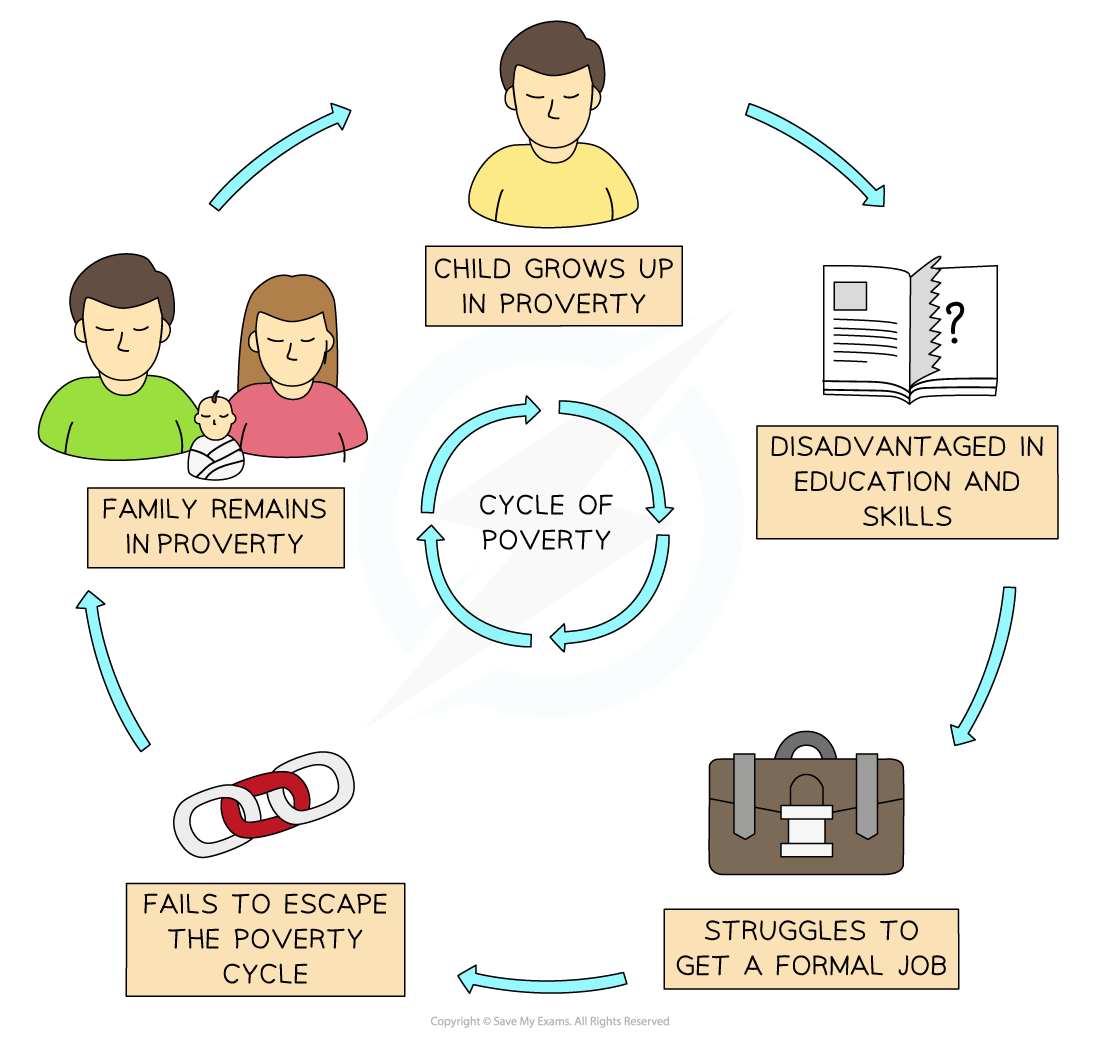
Cycle of Poverty
Poverty and deprivation are passed on from one generation to the next
Children will tend to get less parental support and usually have to attend inadequate schools
They also tend to leave school early with few qualifications
Lack of qualifications means they cannot find well-paid employment and rely on social handouts
Children they have will be born into this cycle and so families remain ‘trapped’ and unable to improve their circumstances
This feeds into a lower quality of life
Impacts of urban growth on rural areas
Rise of the suburbanised village
Originally these were quiet, independent places with basic services and located near large urban areas
Also known as 'dormitory or commuter towns' and had a residential population that commuted to work
As people have moved out of the city - retirement, family or work reasons - these areas have changed
New, large, expensive housing estates with detached or semi-detached homes, some are gated communities
Urban style services increased - hence the change in name to 'suburbanised' village
The commuter belt means new roads and public transport links
New businesses such as pubs, restaurants, supermarkets and hotels have opened
Dilution of traditional country life