Hydrological Characteristics
Specification link
This page covers part of section 1.1.1 and sections 1.1.3 and 1.1.4 of the CIE O Level Specification.
1.1.1 - Characteristics of drainage basins: the watershed, tributary, confluence, source and mouth.
1.1.3 - How the drainage basin operates within the water cycle.
1.1.4 - Processes which operate in a drainage basin: precipitation, interception, infiltration, percolation, overland flow, channel flow, throughflow, groundwater flow, transpiration, evaporation, evapotranspiration.
Features of drainage basins
Features of drainage basins
A drainage basin is the area of land drained by a river and its tributaries
This is also known as the catchment area of the river
Drainage basins are open systems
This means that as well as stores and transfers, drainage basins have inputs and outputs
The input is any water entering the system (precipitation)
Outputs are where water is lost from the drainage basin (evaporation, transpiration and into the sea/lake)
When precipitation falls into the drainage basin, it will take different paths
The possible paths include:
Direct channel precipitation, which occurs when the water falls directly into a river
Overland flow (surface runoff) when the water cannot infiltrate the soil due to the ground being impermeable
Throughflow when the water flows through the soil
Groundwater flow when the water flows through the rocks
Every drainage basin is unique
They have different
shapes
sizes
rock types
relief
land use
Drainage basin features
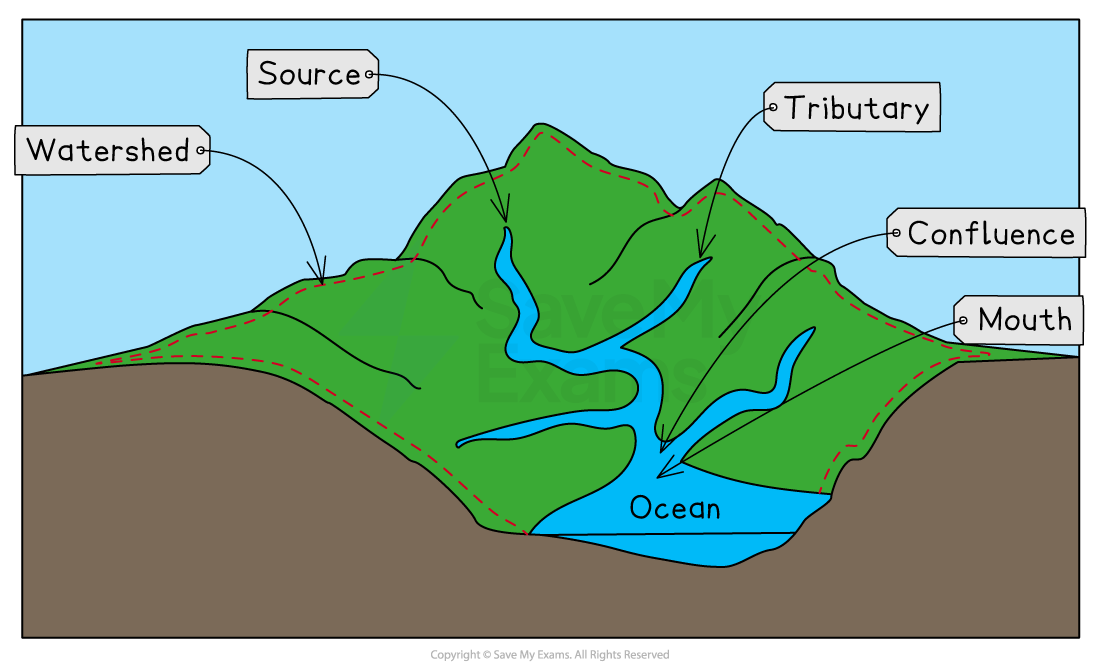
All drainage basins have some features in common:
The watershed is the boundary between drainage basins
A source is the point of the river which is furthest from the mouth; this is the point at which the river begins and is usually an upland lake, spring or glacier
Gravity then causes water to flow downhill, taking the fastest and easiest path
A confluence is the place where two or more streams/rivers meet
Tributaries are streams or rivers flowing into larger streams or rivers
The mouth of a river is where it enters the sea/ocean or sometimes a lake
The water cycle and drainage basins
The water cycle & drainage basins
All drainage basins are part of Earth's hydrological cycle
The hydrological cycle is a closed system
Water is constantly recycled through the system
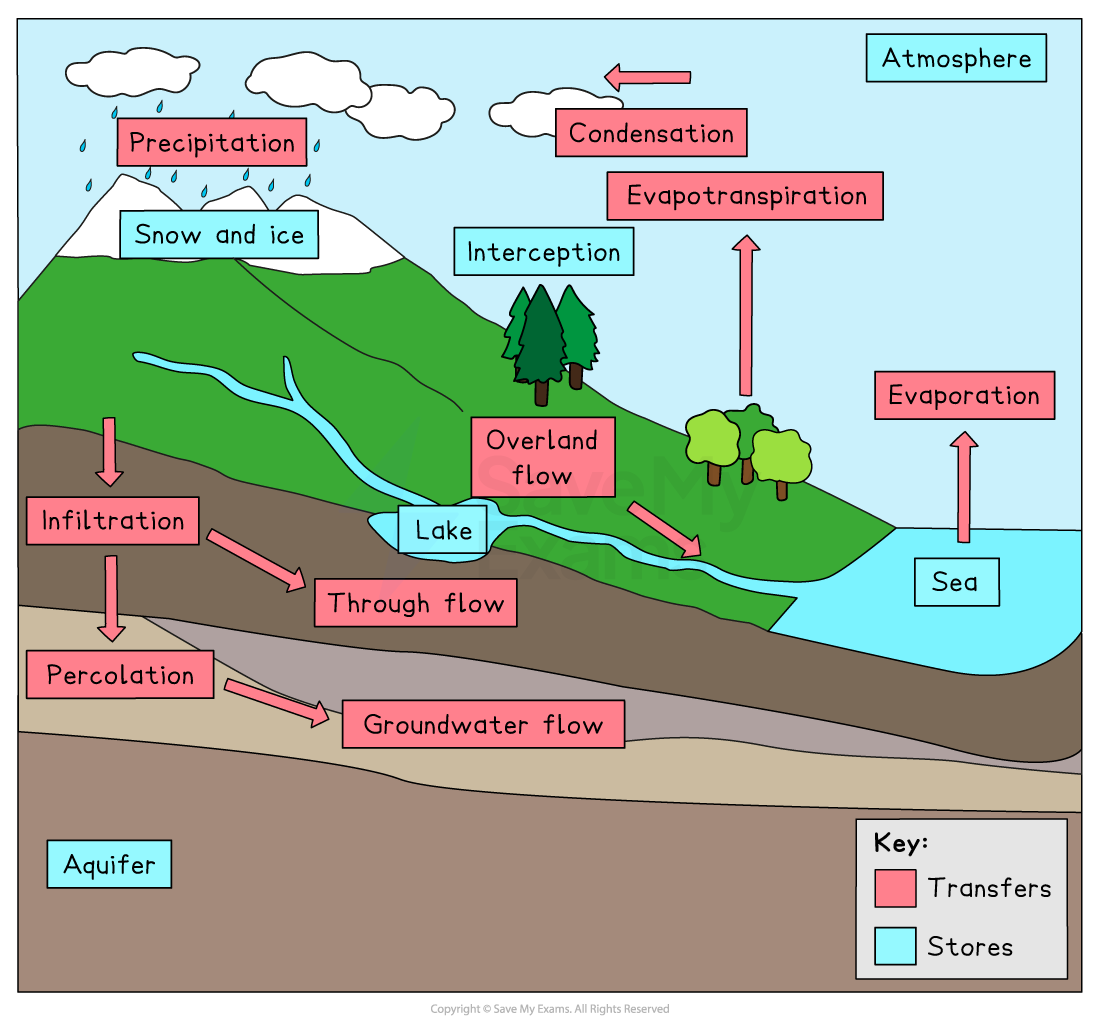
The hydrological cycle includes stores and transfers
The stores and transfer processes of the hydrological cycle all take place within individual drainage basins
Drainage basin processes
Drainage basin processes
Stores
Stores are those places where water is held for a period of time
Stores of the hydrological cycle include:
The atmosphere where water is stored in the form of water vapour or as water droplets in clouds
Surface stores such as puddles, lakes, rivers and reservoirs
Aquifers, which are permeable rocks such as limestone and sandstone which can hold water
Ice and snow
Seas and oceans
Interception is how precipitation is prevented from reaching the ground, usually by being caught on leaves or branches
Some of the water will be stored on the leaves and evaporate into the atmosphere
The remaining water will flow down the leaves, branches and trunk until it reaches the ground (stemflow)
Transfers
Transfers are how water is moved around the hydrological cycle and each drainage basin
Transfers include:
Evaporation is the change of water from a liquid to a gas (water vapour) due to heat from the sun
This process transfers water from the surface up into the atmosphere
Higher temperatures and strong winds lead to increased evaporation
Condensation, which occurs when water cools and changes from water vapour into a liquid (water droplets)
Condensation leads to the formation of clouds
Transpiration, which occurs when plants release water vapour from their leaves
This process transfers water from the plants into the atmosphere
Evapotranspiration is the combined transfer of water vapour from the Earth's surface and plants
Precipitation is the transfer of water from the atmosphere to the Earth's surface in the form of hail, sleet, rain or snow
Overland flow is any water flowing across the Earth's surface
When water is transferred from the surface into the soil, this is known as infiltration
Percolation is the transfer of water from the soil into the rocks and aquifers
Throughflow occurs when water is transferred through the soil between the surface and the water table
Groundwater flow is the transfer of water through rocks
Channel flow is water flowing in a river or stream