Farms as a system
Specification link
This page covers section 10.1.2 of the CIE O Level specification.
10.1.2 - Farming systems: inputs, processes and outputs.
Farm systems
Farm systems
All farms are systems; they have inputs, processes and outputs
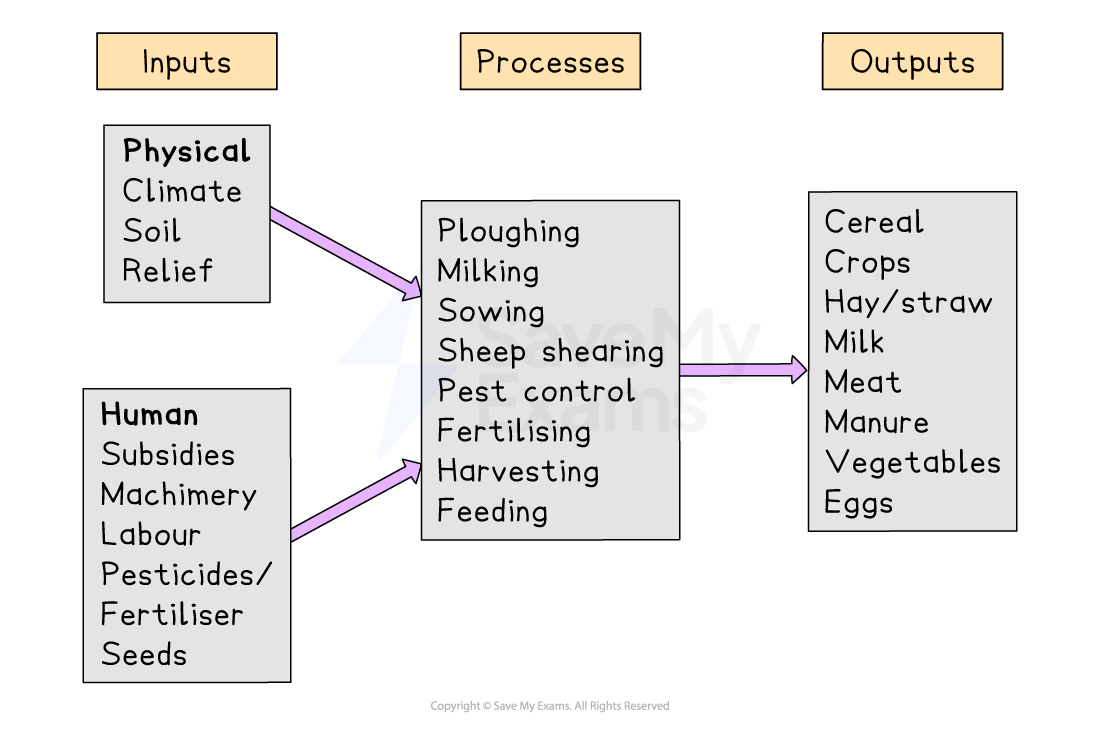
A farming system Impacts of farming systems
All farming systems impact the ecosystem in which they are located
Some have more impact than others:
Monocultures reduce diversity by limiting animals' food access
Nutrient cycling often depends on natural (manure) or artificial fertilisers
Ecosystems are modified with inputs of seed, fertiliser, pesticides, herbicides and the use of machines
Where food webs are reduced, so too is the amount of biomass
Inputs
Inputs into the farm system can be either natural (physical) or human
Natural inputs
The natural inputs influence the type of farming and include:
Temperature
All crops have a minimum temperature below which they will not grow or will not produce a good yield; wheat grows best between 21 and 24 ºC
Growing season
The length of the growing season affects the type of crop grown—barley needs about 90 days from sowing to harvest, whereas rice takes about 120 days
Precipitation
Both the average annual rainfall and the distribution of rain over the year affect the types of crops grown
In dry/arid areas very few crops can be grown unless irrigation is used
Relief and slope aspect
The altitude of the land affects temperature and the steepness affects the suitability for crops
In local areas, different crops may be grown on south-facing slopes, which get more sunshine and are warmer
Soil type and fertility
In areas with thin, infertile soils, grazing is likely to dominate as crops need deeper, more fertile soil
Drainage
For most crops to grow, the land needs to be well drained so that roots do not get waterlogged
Human inputs
Tradition
Many farms simply grow the crops or raise the livestock that have been on the farm for generations
Subsidies
Farmers may change crops or livestock depending on the money available from the government
Transport
The cost of transporting the product may affect what is produced
Livestock transport is more expensive than grain transport
Farm size
Due to economies of scale, larger farms can afford more in terms of feed, fertiliser and machinery; this may affect what is produced
Market demand
The changing demand for produce
There has been an increase in demand for meat such as buffalo and ostrich, which may affect the choice of what is produced
Capital
The amount of money a farmer has to invest will affect the machines and artificial inputs (irrigation, pesticides, fertilisers) they can afford
Processes
The processes which take place on a farm will depend on the type of farm
They are the things which change the inputs into outputs
Outputs
Commercial farming
The aim of commercial farming is to make a profit
In HICs commercial farming may be individual farmers or occasionally agribusinesses
In LICs individuals often do not have the money to farm land commercially
Commercial farming is often done by large agribusinesses such as Nestle and Del Monte
Commercial farming in LICs usually results in monocultures where cash crops such as coffee, tea, cocoa and palm oil are grown.