StudyDeck

Properties of Polygons

Exam code: 4024
Written by: Ashika|Reviewed by: Caroline Carroll|Updated 2 July 2026

Properties of Polygons

Properties of polygons

What are the names of common 2D shapes?

  • You should know the general names of all the 2D polygons

    • A triangle has 3 sides

    • A quadrilateral has 4 sides

    • A pentagon has 5 sides

    • A hexagon has 6 sides

    • A heptagon has 7 sides

    • An octagon has 8 sides

    • A nonagon has 9 sides

    • A decagon has 10 sides

    • A polygon is a flat (plane) shape with n straight sides

      • A regular polygon has all sides the same length and all angles the same size  
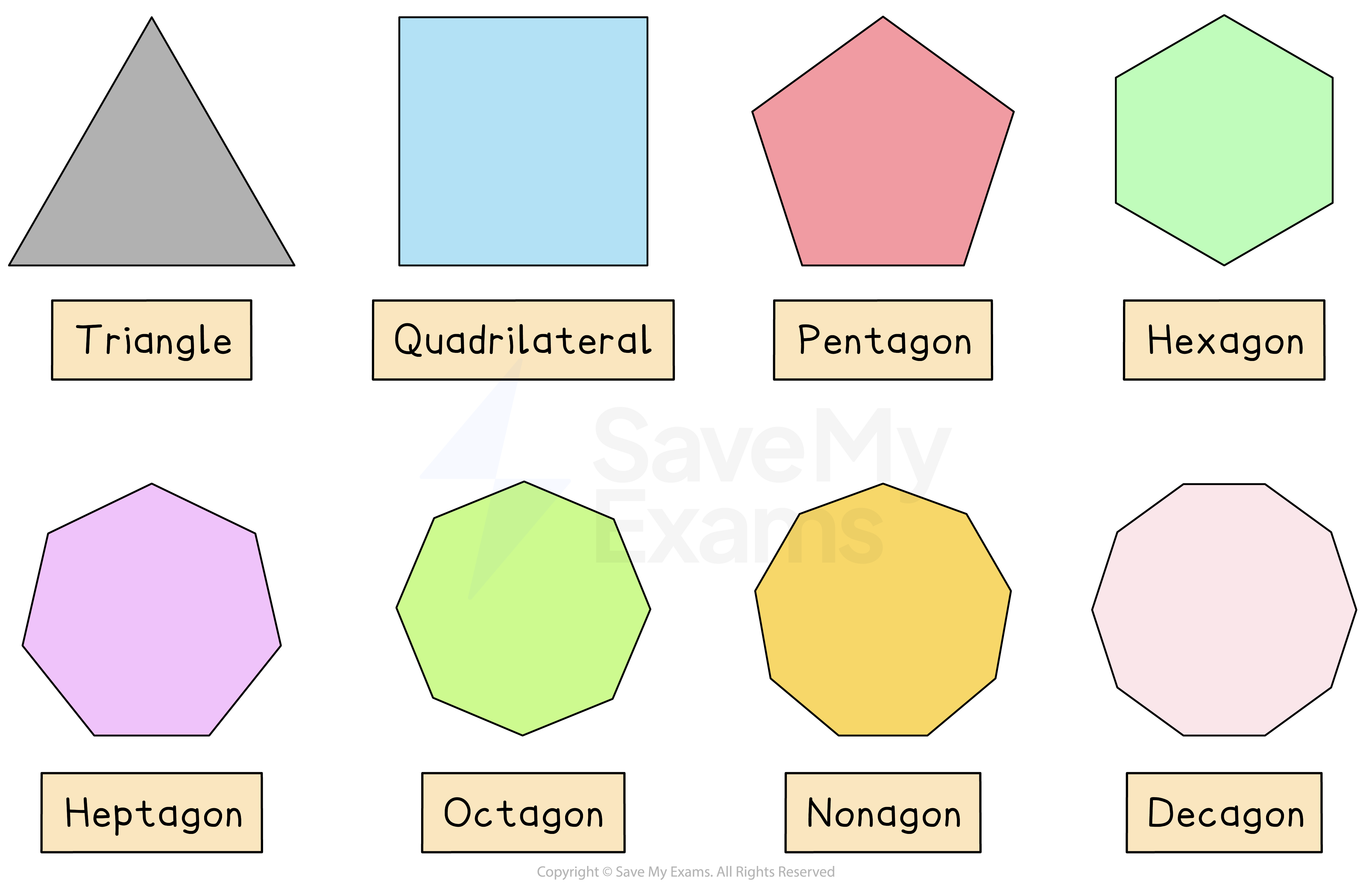
Names of shapes with 3 to 10 sides
Polygons

What are the names of the different types of triangles?

  • You should know the names and properties of the different types of triangles

    • An equilateral triangle has 3 equal sides and 3 equal angles

    • An isosceles triangle has 2 equal sides and 2 equal angles

    • A right-angled triangle has one 90° angle

    • A scalene triangle has 3 sides all of different lengths
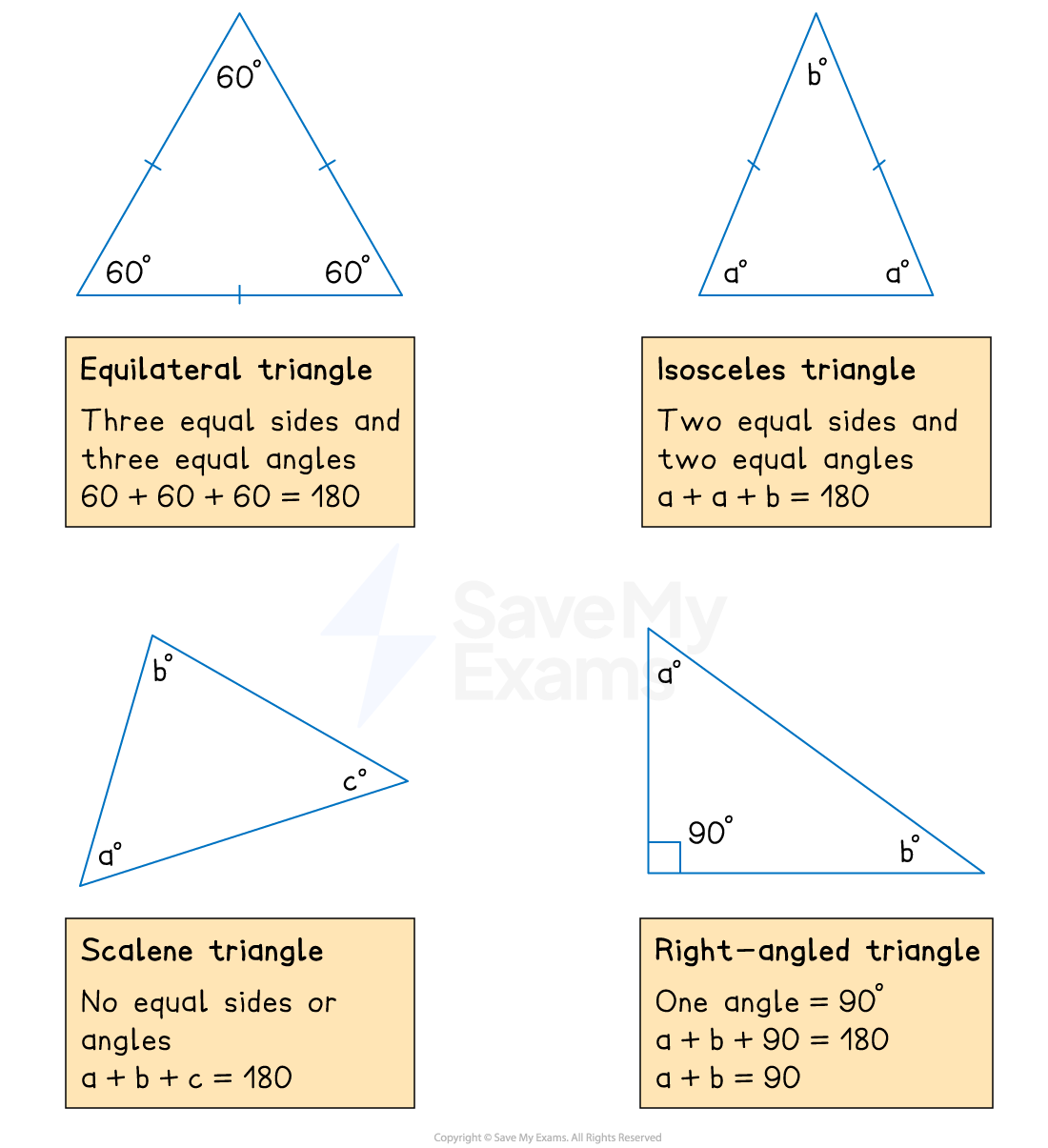
Types of triangles: Equilateral with equal sides and angles; Isosceles with two equal sides and angles; Scalene with no equal sides; Right-angled with 90° angle.

What are the names of the different types of quadrilaterals?

  • You should know the names and properties of the different types of quadrilaterals

    • These are squares, rectangles, parallelograms, rhombuses, trapeziums and kites
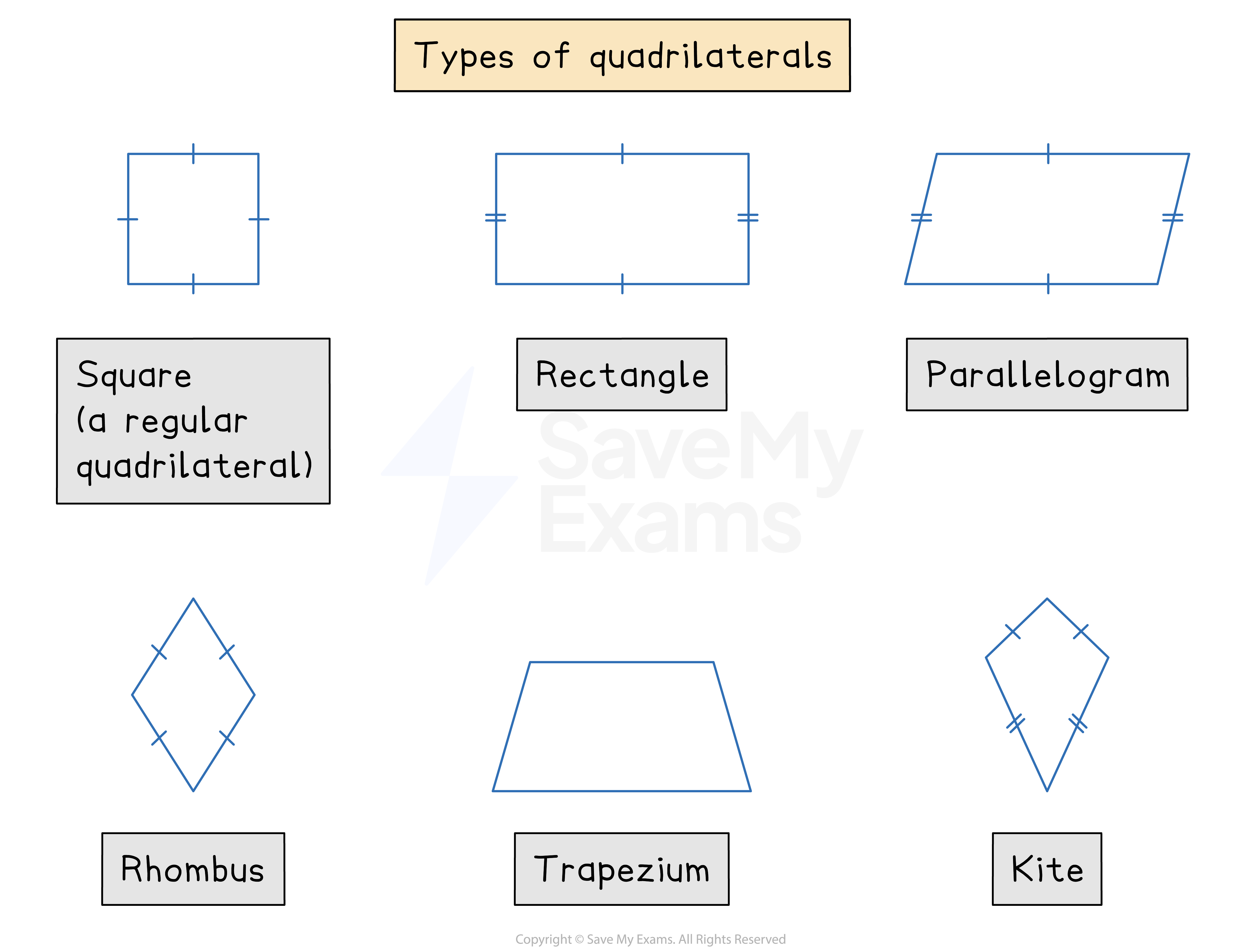
types of quadrilaterals

What are the properties of rectangles and squares?

  • A square is a rectangle where all the sides have the same length

  • The table below shows the properties of a rectangle and square
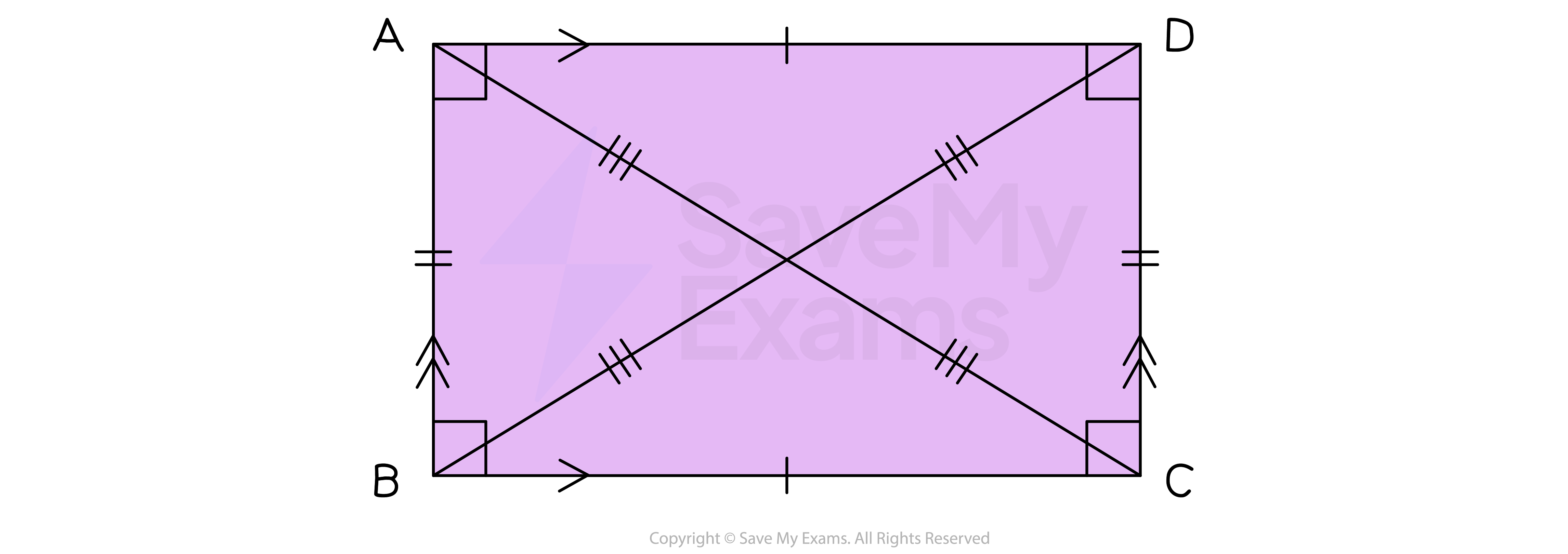
Properties of a rectangle
Rectangle

Rectangle

Square

Sides

  • Two pairs of equal, opposite sides

  • Two pairs of parallel sides

  • All sides have the same length

  • Two pairs of parallel sides

Angles

  • All angles are 90°

  • All angles are 90°

Diagonals

  • Both diagonals bisect each other

  • Diagonals have the same length

  • Both diagonals bisect each other

  • Diagonals have the same length

  • Diagonals are perpendicular

Symmetries

  • Two lines of symmetry

  • Order of rotational symmetry is two

  • Four lines of symmetry

  • Order of rotational symmetry is four

What are the properties of parallelograms and rhombuses?

  • A rhombus is a parallelogram where all the sides have the same length

  • The table below shows the properties of a parallelogram and rhombus
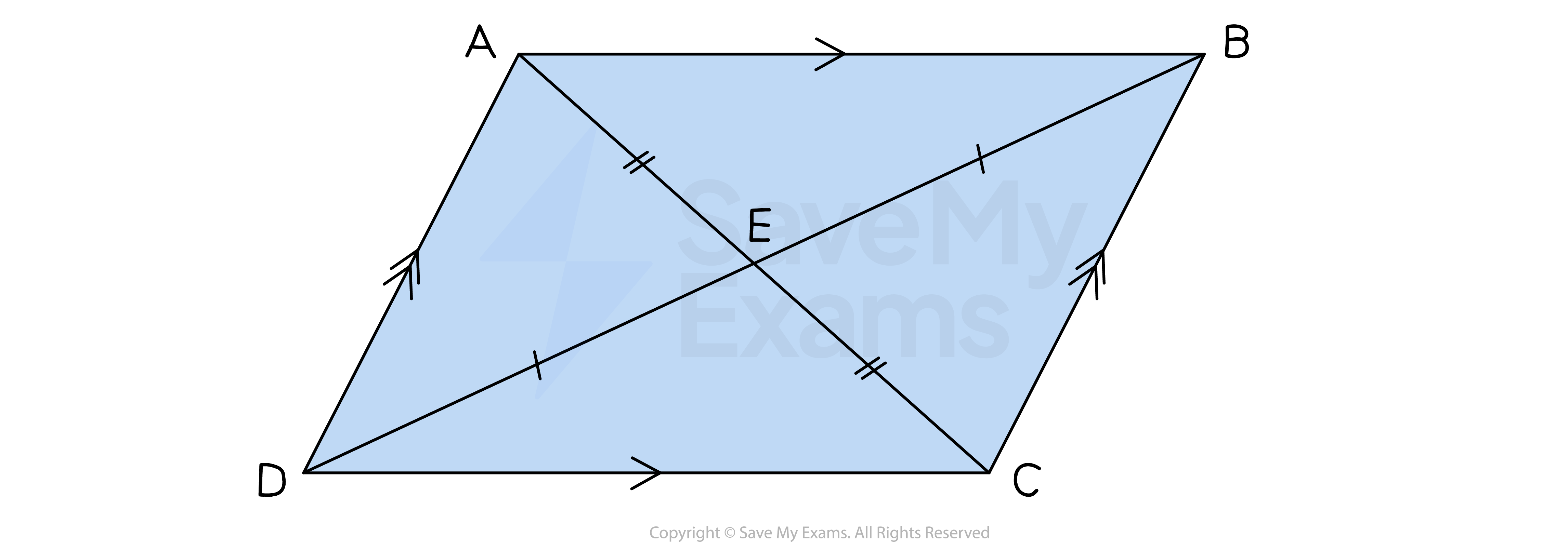
Properties of a parallelogram.
Parallelogram

Parallelogram

Rhombus

Sides

  • Two pairs of equal, opposite sides

  • Two pairs of parallel sides

  • All sides have the same length

  • Two pairs of parallel sides

Angles

  • Two pairs of equal, opposite angles

  • Each pair of adjacent angles add up 180°

  • Two pairs of equal, opposite angles

  • Each pair of adjacent angles add up 180°

Diagonals

  • Both diagonals bisect each other

  • Both diagonals bisect each other

  • Diagonals are perpendicular

Symmetries

  • No lines of symmetry

  • Order of rotational symmetry is two

  • Two lines of symmetry

  • Order of rotational symmetry is two

What are the properties of trapeziums?

  • The table below shows the properties of a trapezium and an isosceles trapezium
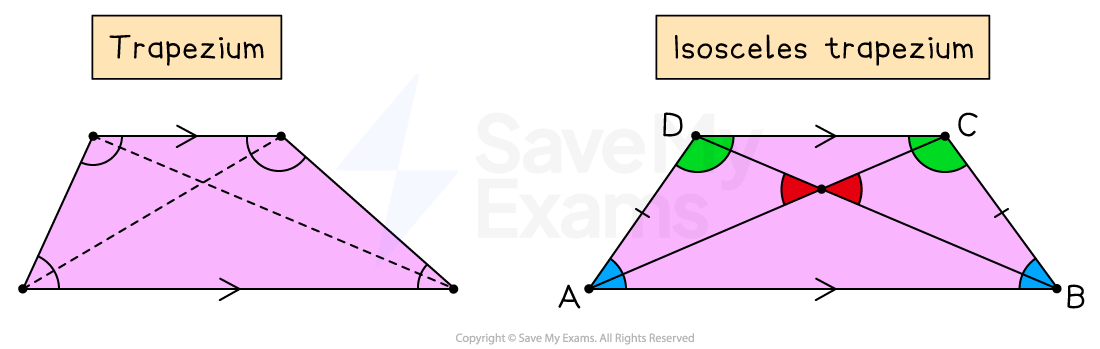
Diagram comparing a trapezium and isosceles trapezium, highlighting equal angles with colours and marked parallel sides, both with dashed diagonals.

Trapezium

Isosceles trapezium

Sides

  • One pair of parallel sides

  • The parallel sides have different lengths

  • One pair of parallel sides

  • The parallel sides have different lengths

  • The non-parallel sides have the same length

Angles

  • Two pairs of adjacent angles that add up to 180°

  • Two pairs of adjacent angles that add up to 180°

  • Two pairs of adjacent angles that are equal

Diagonals

  • Do not bisect each other

  • Do not bisect each other

  • Diagonals have the same length

Symmetries

  • No lines of symmetry

  • Order of rotational symmetry is one

  • One line of symmetry

  • Order of rotational symmetry is one

What are the properties of kites?

  • The table below shows the properties of a kite

Geometric diagram of a kite shape with vertices labelled A, B, C, D and intersecting diagonals at point O. All sides are marked equal in pairs.
Kite

Kite

Sides

  • Two pairs of equal, adjacent sides

  • No parallel sides

Angles

  • One pair of equal, opposite angles

Diagonals

  • One diagonal bisects the other

  • Diagonals are perpendicular

Symmetries

  • One line of symmetry

  • Order of rotational symmetry is one