Consider two points and .
(a) Write down the column vector .
Answer:
Find the horizontal and vertical distances between the two points
Subtract the x and y components of A from B
(b) Find the modulus of vector .
Answer:
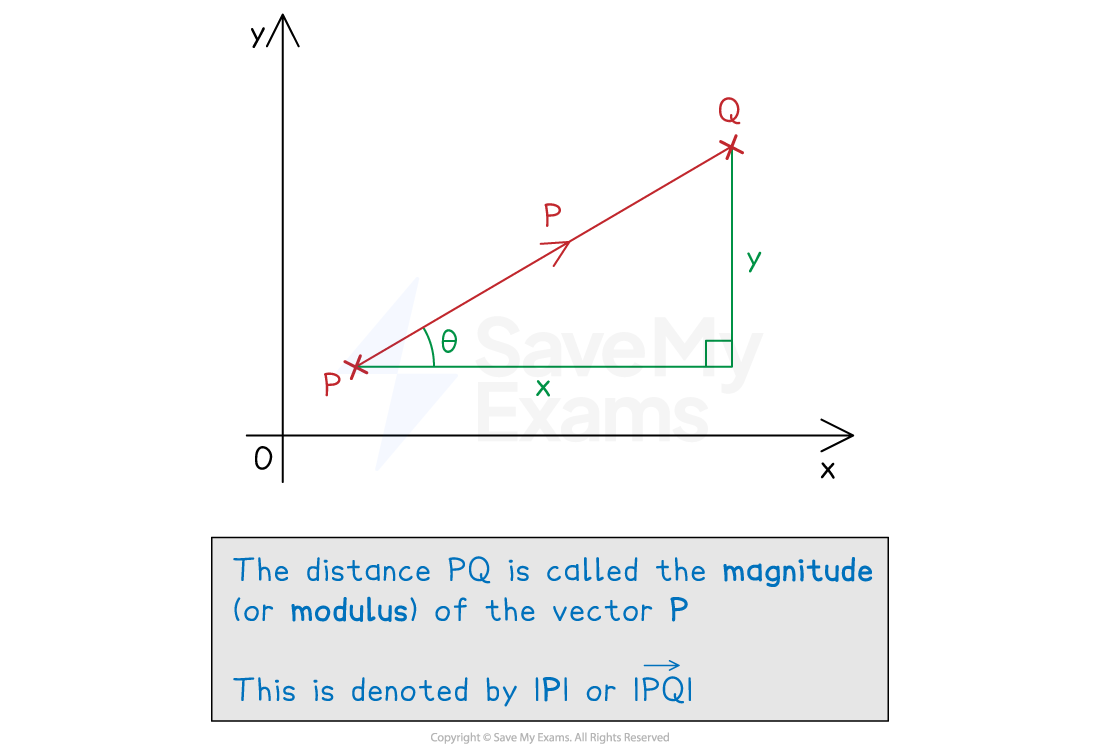
Sketching a diagram of the vector can help

Apply Pythagoras' theorem to the x and y components of
(c) Briefly explain why .
Answer:
The magnitude of a vector is it's 'size'
Direction of the vector is ignored
since both vectors have the same distance
Another vector, , has three times the magnitude of vector .
(d) Write down a possible column vector for .
Answer:
Being three times means the vector is three times longer
One way to find a vector is to multiply each component of the vector by 3 or -3
or