StudyDeck

Representing Vectors as Diagrams

Exam code: 4024
Written by: Ashika|Reviewed by: Caroline Carroll|Updated 2 July 2026

Vector Diagrams

Vector diagrams

How can I represent a vector visually?

  • A vector has both a size (magnitude) and a direction

    • You need to draw a line to show the size of the vector

    • You also need to draw an arrow to show the direction of the vector
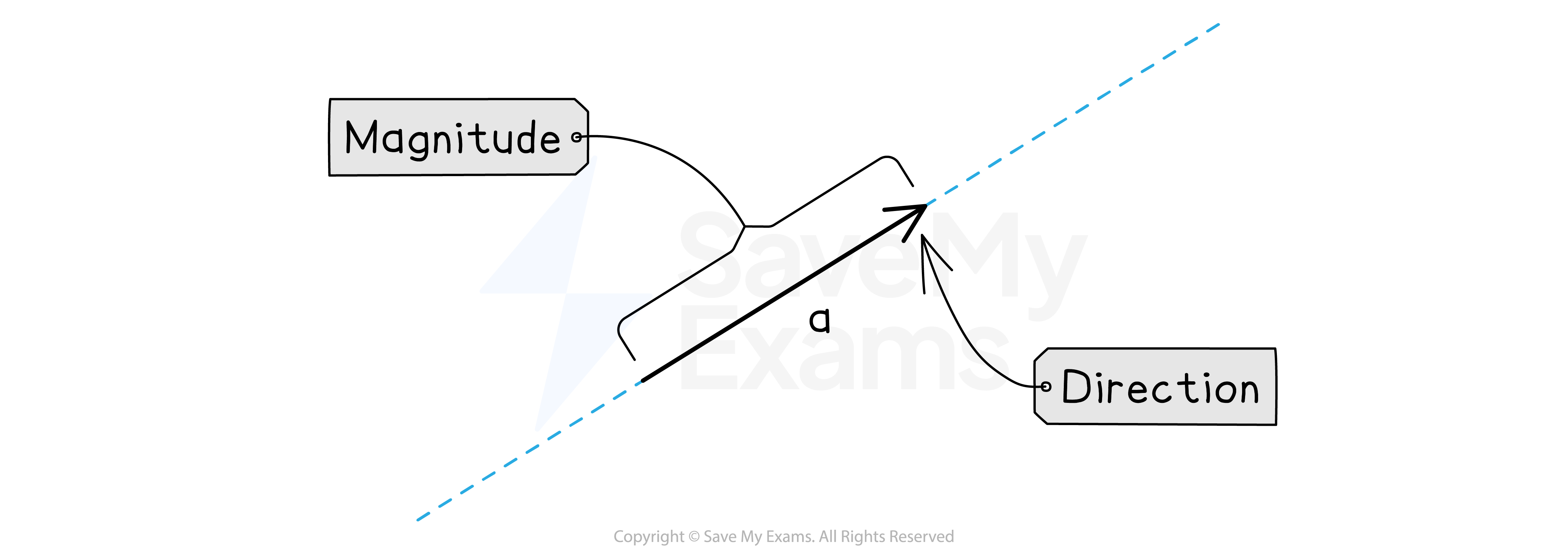
Magnitude and direction of a vector


  • Vectors are written in bold when typed to show that they are a vector and not a scalar

    • When writing a vector in an exam you should underline the letter to show it is a vector

    • a{"language":"en","fontFamily":"Times New Roman","fontSize":"18","autoformat":true} when typed and a{"language":"en","fontFamily":"Times New Roman","fontSize":"18","autoformat":true} when handwritten

      • You will not lose marks if you forget to underline vectors

  • If a vector starts at A and ends at B we can write it as AB→{"language":"en","fontFamily":"Times New Roman","fontSize":"18","autoformat":true}

    • Here the arrow will point toward B

    • Vector BA→{"language":"en","fontFamily":"Times New Roman","fontSize":"18","autoformat":true} will have the same length but point toward A

Vector between two points

How do I draw a vector on a grid?

  • You can draw a vector anywhere on a grid

    • Just make sure it has the correct length and the correct direction

  • To draw the vector a=34{"language":"en","fontFamily":"Times New Roman","fontSize":"18","autoformat":true}

    • Pick a point on the grid and draw a dot there

    • Count 3 units to the right and 4 units up and draw another dot

    • Draw a line between the two dots

    • Put an arrow on the line pointing toward the second dot

  • Look out for negatives and zeroes

    • b=2-4{"language":"en","fontFamily":"Times New Roman","fontSize":"18","autoformat":true}  goes 2 to the right and 4 down

    • c=20{"language":"en","fontFamily":"Times New Roman","fontSize":"18","autoformat":true} goes 2 to the right but does not go up or down
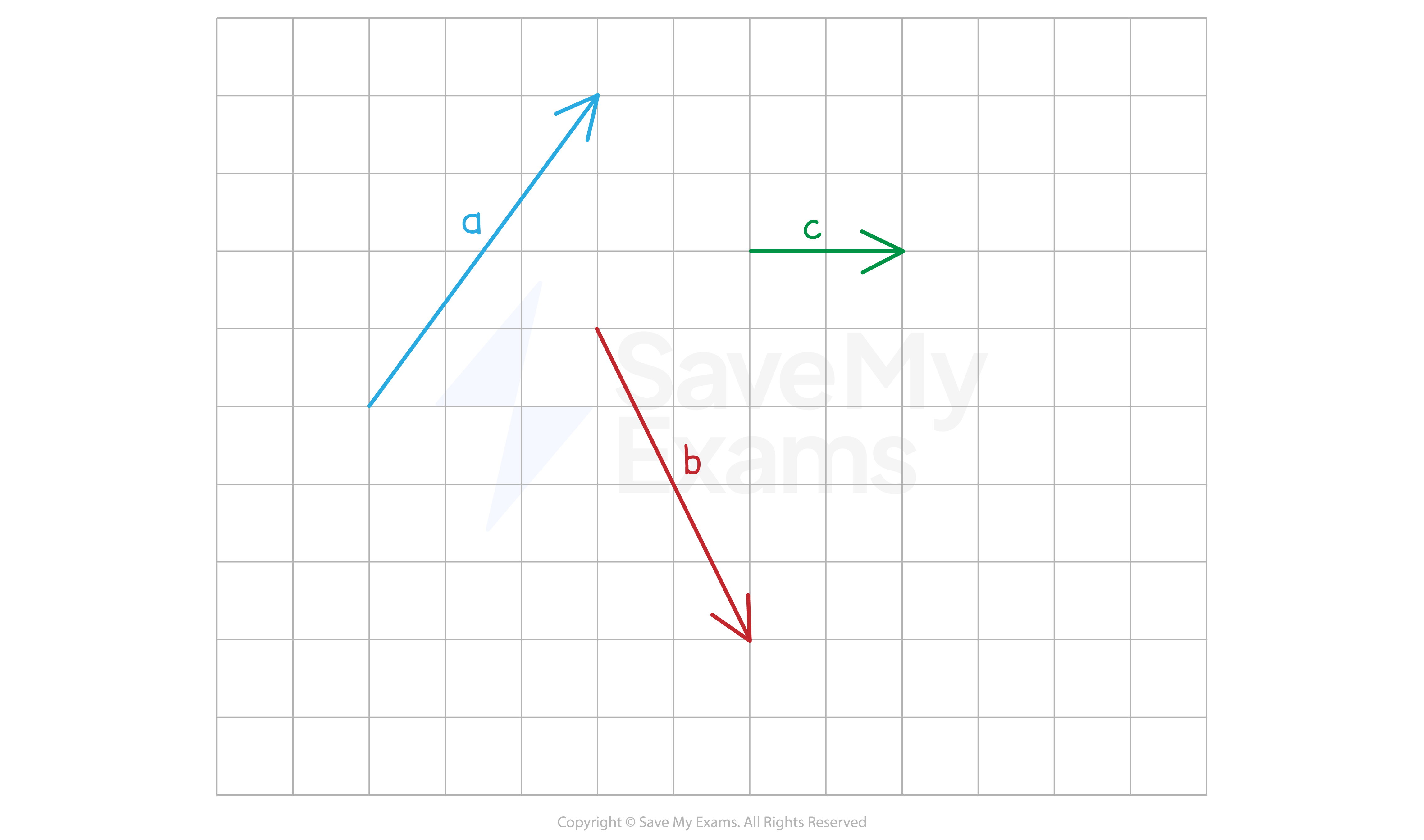
Vectors on a grid

What happens when I multiply a vector by a scalar?

  • When you multiply a vector by a positive scalar:

    • The direction stays the same

    • The length of the vector is multiplied by the scalar

  • For example, a=4-2{"language":"en","fontFamily":"Times New Roman","fontSize":"18","autoformat":true}

    • 2a=8-4{"language":"en","fontFamily":"Times New Roman","fontSize":"18","autoformat":true} will have the same direction but double the length

    • 12a=2-1{"language":"en","fontFamily":"Times New Roman","fontSize":"18","autoformat":true} will have the same direction but half the length
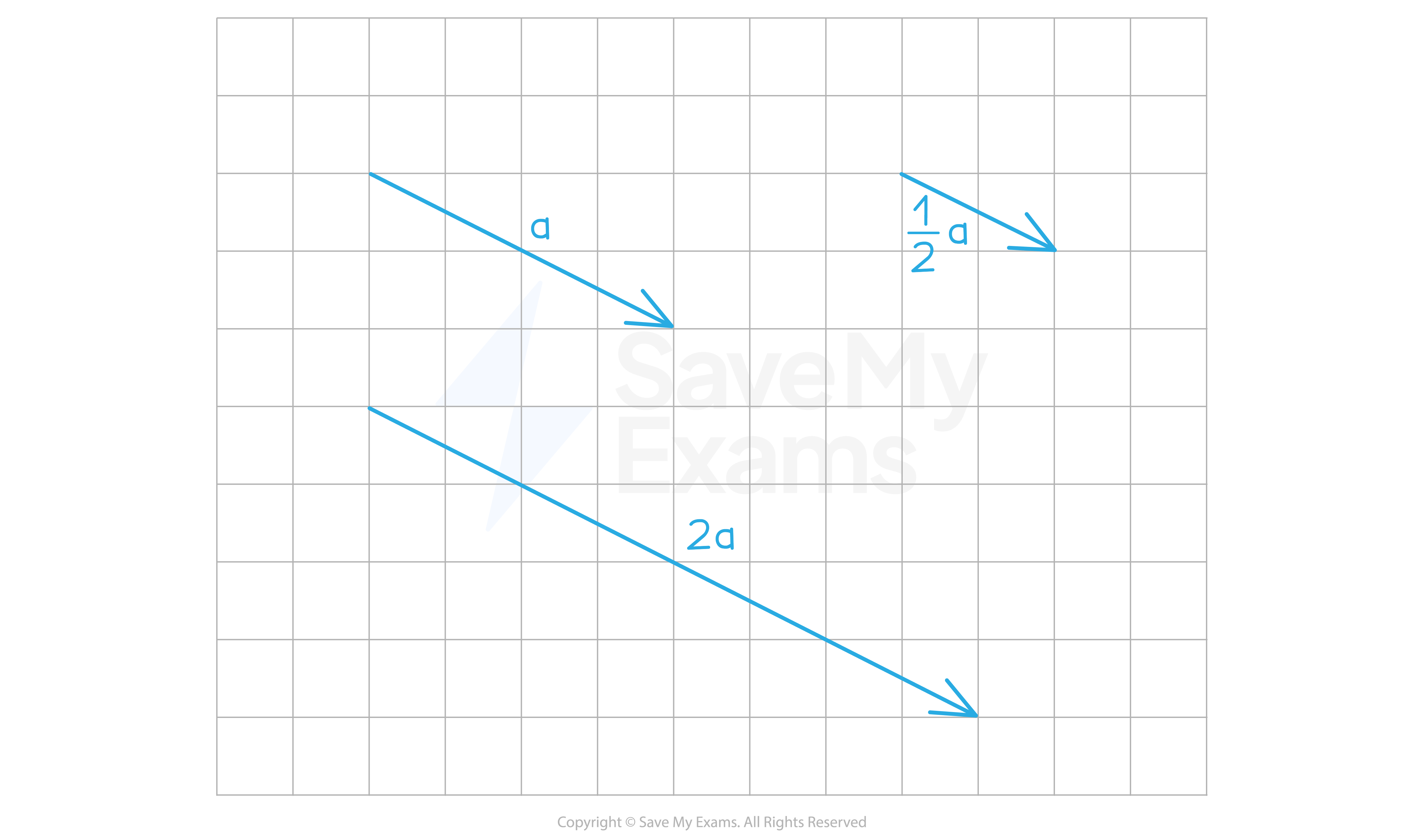
Multiplying vectors by a scalar
  • When you multiply a vector by a negative scalar:

    • The direction is reversed

    • The length of the vector is multiplied by the number after the negative sign

  • For example, a=4-2{"language":"en","fontFamily":"Times New Roman","fontSize":"18","autoformat":true}

    • -a=-42{"language":"en","fontFamily":"Times New Roman","fontSize":"18","autoformat":true} will be in the opposite direction and its length will be the same

    • -2a=-84{"language":"en","fontFamily":"Times New Roman","fontSize":"18","autoformat":true} will be in the opposite direction and its length will be doubled
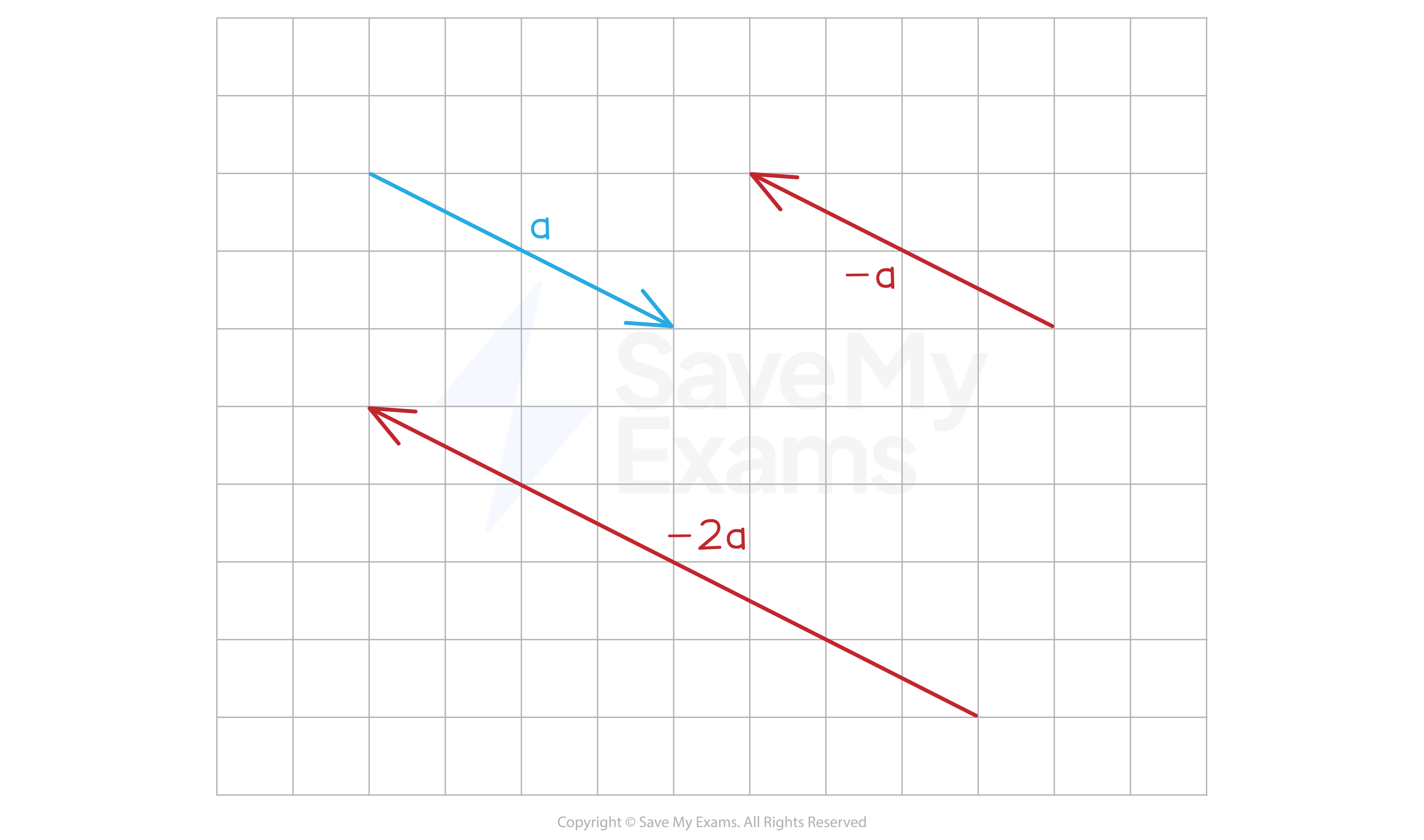
Multiplying a vector by a negative scalar

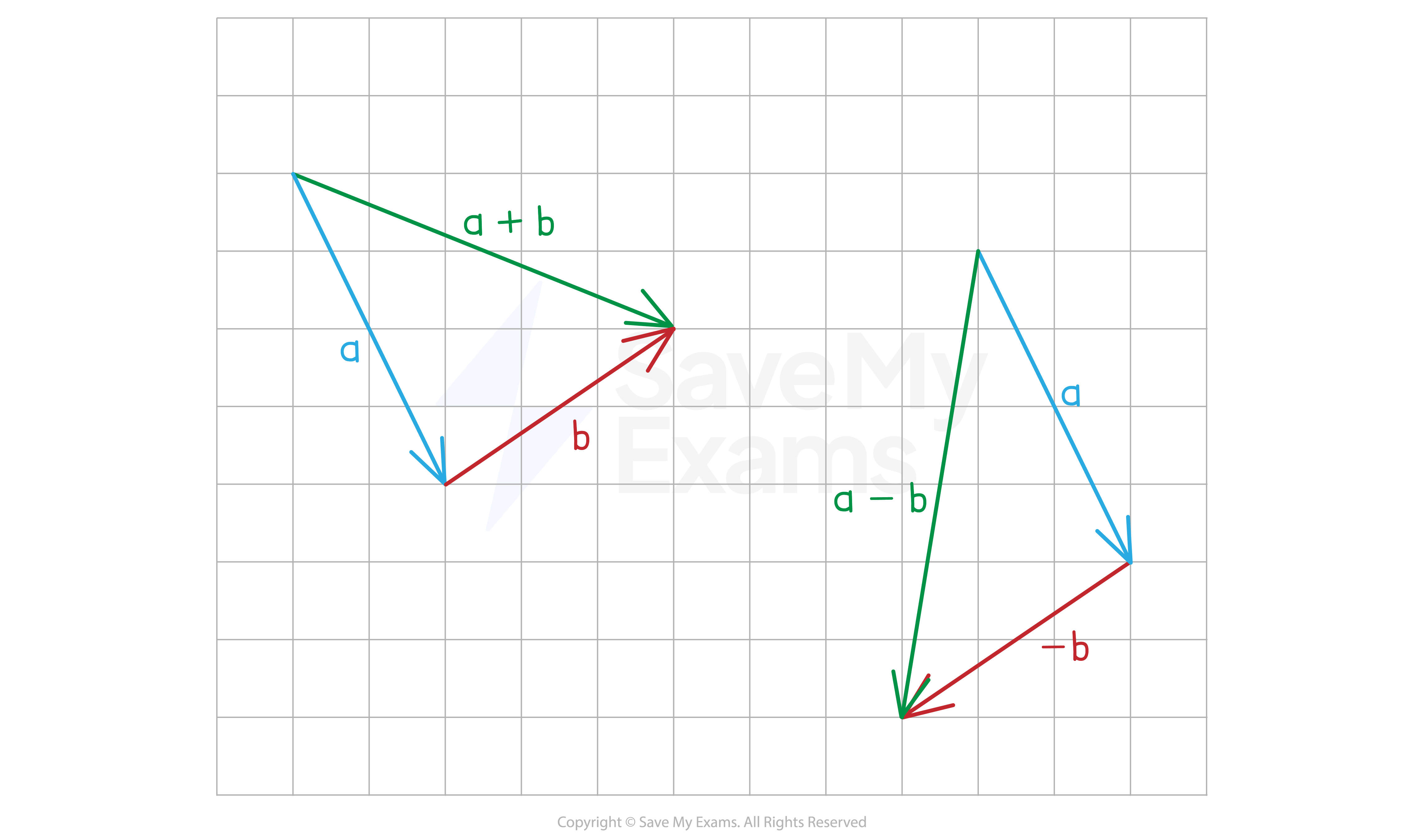
What happens when I add or subtract vectors?

  • To draw the vector a+b{"language":"en","fontFamily":"Times New Roman","fontSize":"18","autoformat":true}

    • Draw the vector a{"language":"en","fontFamily":"Times New Roman","fontSize":"18","autoformat":true}

    • Draw the vector b{"language":"en","fontFamily":"Times New Roman","fontSize":"18","autoformat":true} starting at the endpoint of a{"language":"en","fontFamily":"Times New Roman","fontSize":"18","autoformat":true}

    • Draw a line that starts at the start of a{"language":"en","fontFamily":"Times New Roman","fontSize":"18","autoformat":true} and ends at the end of b{"language":"en","fontFamily":"Times New Roman","fontSize":"18","autoformat":true}

  • To draw the vector a-b{"language":"en","fontFamily":"Times New Roman","fontSize":"18","autoformat":true} 

    • Draw the vector a{"language":"en","fontFamily":"Times New Roman","fontSize":"18","autoformat":true}

    • Draw the vector -b{"language":"en","fontFamily":"Times New Roman","fontSize":"18","autoformat":true}  starting at the endpoint of a{"language":"en","fontFamily":"Times New Roman","fontSize":"18","autoformat":true}

    • Draw a line that starts at the start of a{"language":"en","fontFamily":"Times New Roman","fontSize":"18","autoformat":true}  and ends at the end of -b{"language":"en","fontFamily":"Times New Roman","fontSize":"18","autoformat":true}

Adding and subtracting vectors