Melting, Boiling & Evaporation
Fixed Points of Water
Fixed Points of Water
The melting and boiling points of pure water are known as fixed points
Ice melts at 0 °C
Pure water boils at 100 °C
These are the accepted values for pure water at atmospheric pressure
Ice Melting and Water Boiling
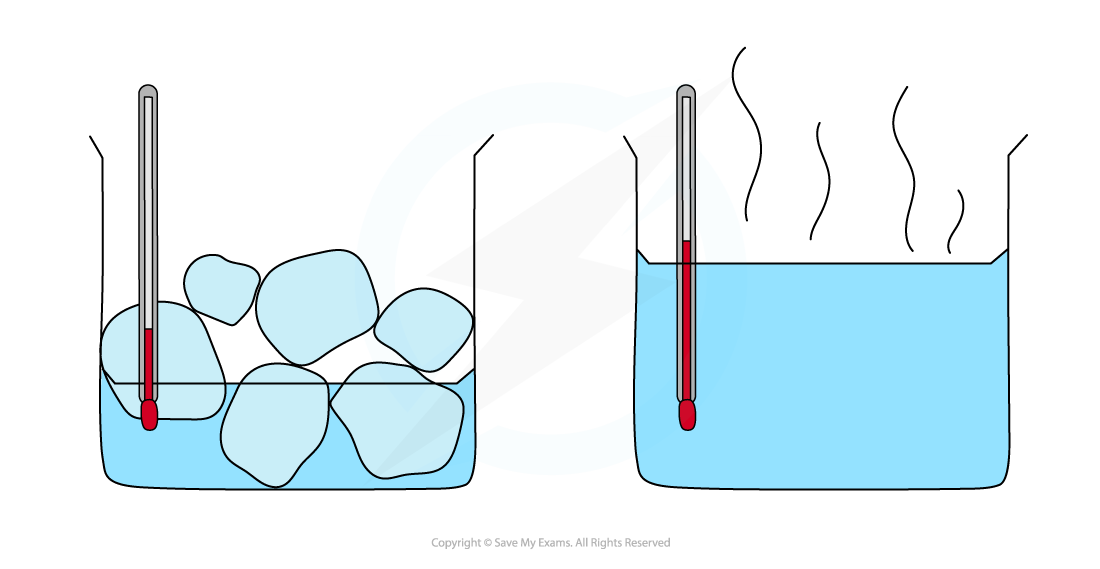
Ice melts at 0 °C and water boils at 100 °C
Melting & Boilingvideo
Melting & Boiling
While a substance is changing state, either
Melting or freezing
Boiling or condensing
The substance does not change temperature, even though energy is being transferred to or away from the thermal energy store of the substance
Changing Temperature through State Changes
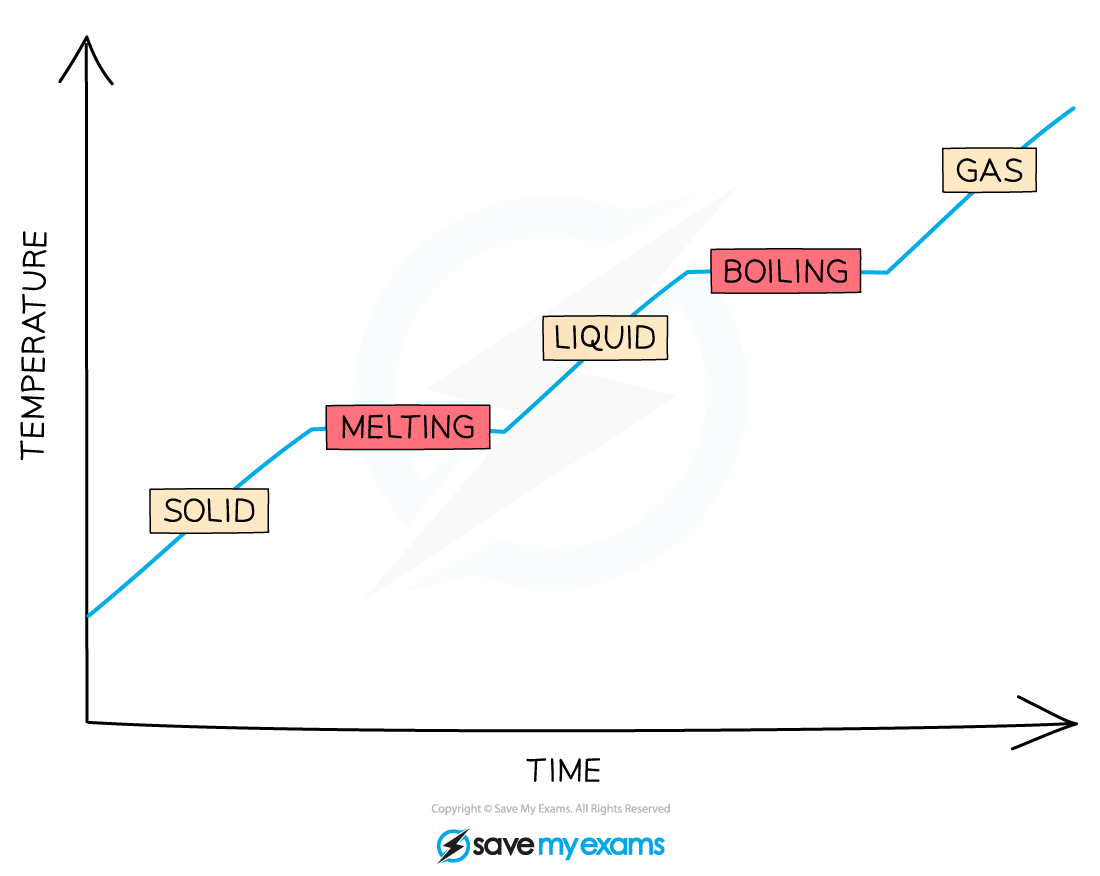
Energy is transferred to the material over time. This causes an increase in temperature when the material is a solid, liquid or gas, but does not cause an increase in temperature when there is a change of state.
Boiling
When liquid water is heated by adding thermal energy (e.g., from a gas flame or kettle element), the temperature of the water rises until the water boils
At the boiling point, even if more thermal energy is added, the temperature of the liquid water does not increase
The additional thermal energy is transferred to the potential store of the molecules, not the kinetic store
This energy goes into overcoming the intermolecular forces between the molecules of water, so the internal energy continues to rise even though the temperature stays constant
As the forces are overcome, the liquid water becomes water vapour (steam); the water is now a gas
Melting
When solid water (ice) is heated by adding thermal energy, the temperature of the ice increases until the melting point is reached
At the melting point, even if more thermal energy is added, the temperature of the ice does not increase
The additional thermal energy is transferred to the potential store of the molecules, not the kinetic store
This energy goes into overcoming the intermolecular forces between the molecules of the ice, so the internal energy continues to rise even though the temperature stays constant
As the forces are overcome, the solid water becomes liquid; this is melting
Condensation & Solidification
Condensation & Solidification
Heating and cooling graphs are used to summarise:
How the temperature of a substance changes when energy is transferred to or away from it
Where changes of state occur
Heating and cooling graphs tend to be the same
Heating is when energy is transferred to the system, increasing the internal energy of the molecules (red arrows to the right)
Cooling is when energy is transferred away from the system (or dissipated to the surroundings), decreasing the internal energy of the molecules (blue arrows to the left)
Condensation
When a gas cools, energy is transferred away from the system, and kinetic energy decreases until the temperature reaches the boiling point
At the boiling point, energy transferred away from the system reduces its potential energy
The particles no longer have enough energy to overcome the intermolecular forces of attraction
They only have enough energy to flow over one another
The gas has condensed; it is now a liquid
As the energy has been transferred away from the potential store of the particles, the energy in the kinetic store is unchanged, so temperature remains constant through this process
Solidification
When a liquid cools, energy is transferred away from the system, and kinetic energy decreases until the temperature reaches the melting point
At the melting point, energy transferred away from the system reduces its potential energy
The particles no longer have enough energy to overcome the intermolecular forces of attraction
They are now low enough in energy to be bound to each other and can only vibrate around a fixed point
The liquid has solidified; it is now a solid
As the energy has been transferred away from the potential store of the particles, the energy in the kinetic store is unchanged, so temperature remains constant through this process
Heating / Cooling Graph
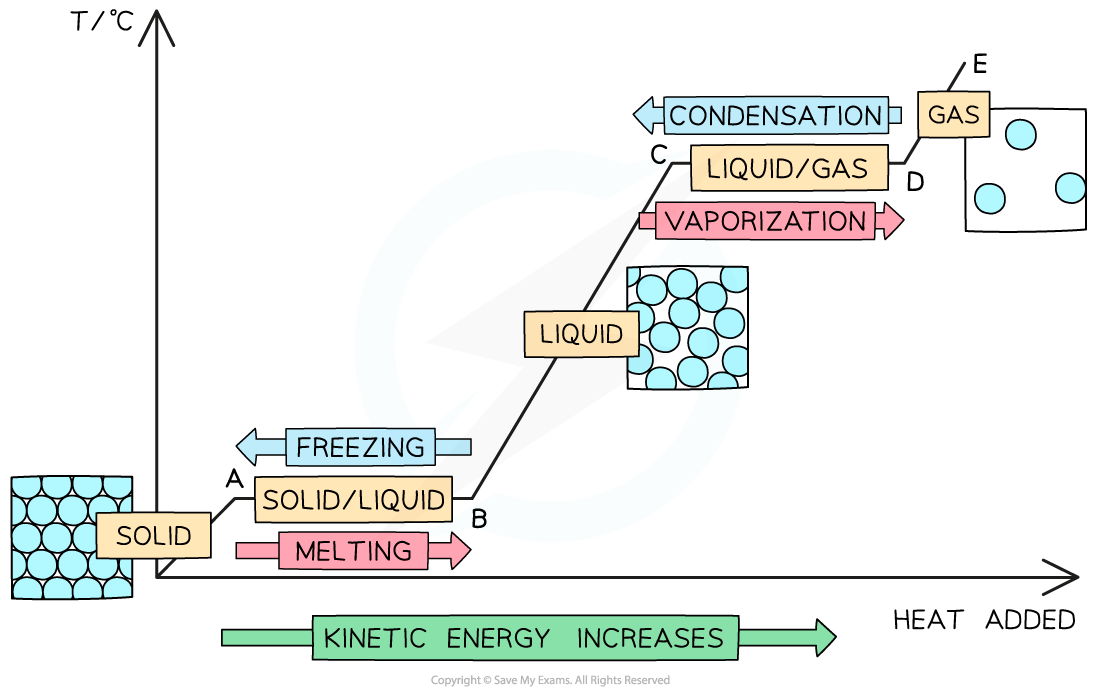
Heating/cooling curve of a substance showing the energy changes as temperature is increased/decreased