Specific Heat Capacity
Internal Energy
Internal Energy
A rise in the temperature of an object increases its internal energy
This can be thought of as due to an increase in the average speed of the particles
Increasing speed increases kinetic energy
Internal energy is defined as:
The total energy stored inside a system by the particles that make up the system due to their motion and positions
Motion of the particles affects their kinetic energy
Positions of the particles relative to each other affect their potential energy
Together, these two make up the internal energy of the system
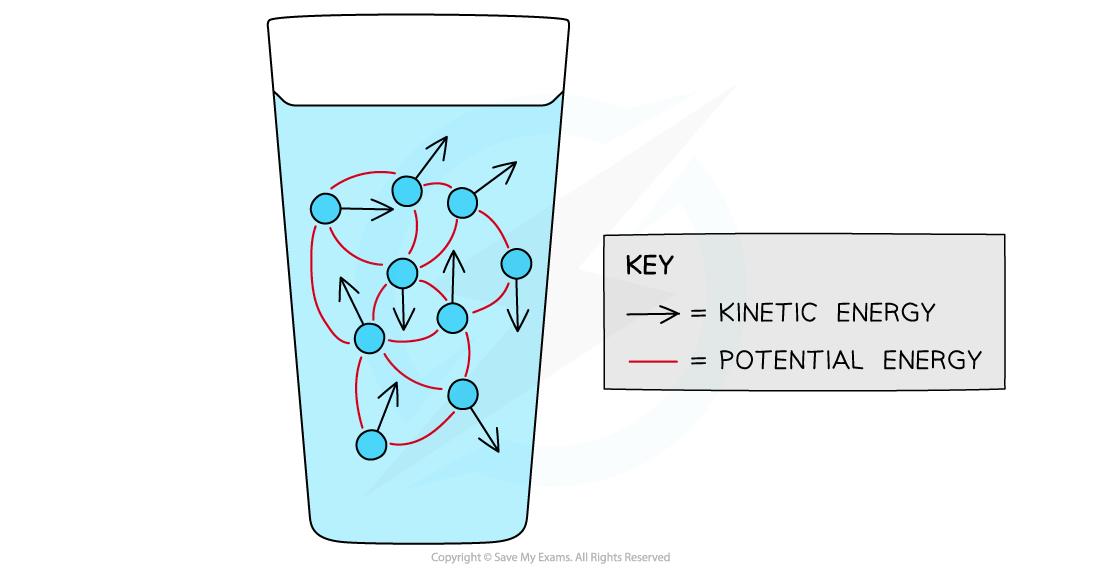
Substances have internal energy due to the motion of the particles and their positions relative to each other
Average Kinetic Energy
Average Kinetic Energy
The temperature of a substance is related to the average kinetic energy of its molecules
The higher the temperature, the higher the average kinetic energy of the molecules, and vice versa
This means they move faster at higher temperatures
This applies to all states of matter, although the motion of particles in a solid is different from that of particles in a gas
For a gas, the internal energy can be taken as the sum of the kinetic energies of all the molecules
In a gas, the intermolecular forces are negligible, so the contribution from potential energy can be taken as zero
This is different from a solid or liquid, where the internal energy includes contributions from both kinetic and potential energy
If the temperature of a gas is increased, the particles move faster and gain kinetic energy
They collide more often with each other and the container walls, leading to an increase in pressure
The temperature (in Kelvin) is proportional to the average kinetic energy of the molecules:
Specific Heat Capacity
Specific Heat Capacity
How much the temperature of a system increases depends on:
The mass of the substance heated
The type of material
The amount of thermal energy transferred into the system
The specific heat capacity, c, of a substance is defined as:
The amount of energy required to raise the temperature of 1 kg of the substance by 1 °C
Different substances have different specific heat capacities
If a substance has a low specific heat capacity, it heats up and cools down quickly (ie. it takes less energy to change its temperature)
If a substance has a high specific heat capacity, it heats up and cools down slowly (ie. it takes more energy to change its temperature)
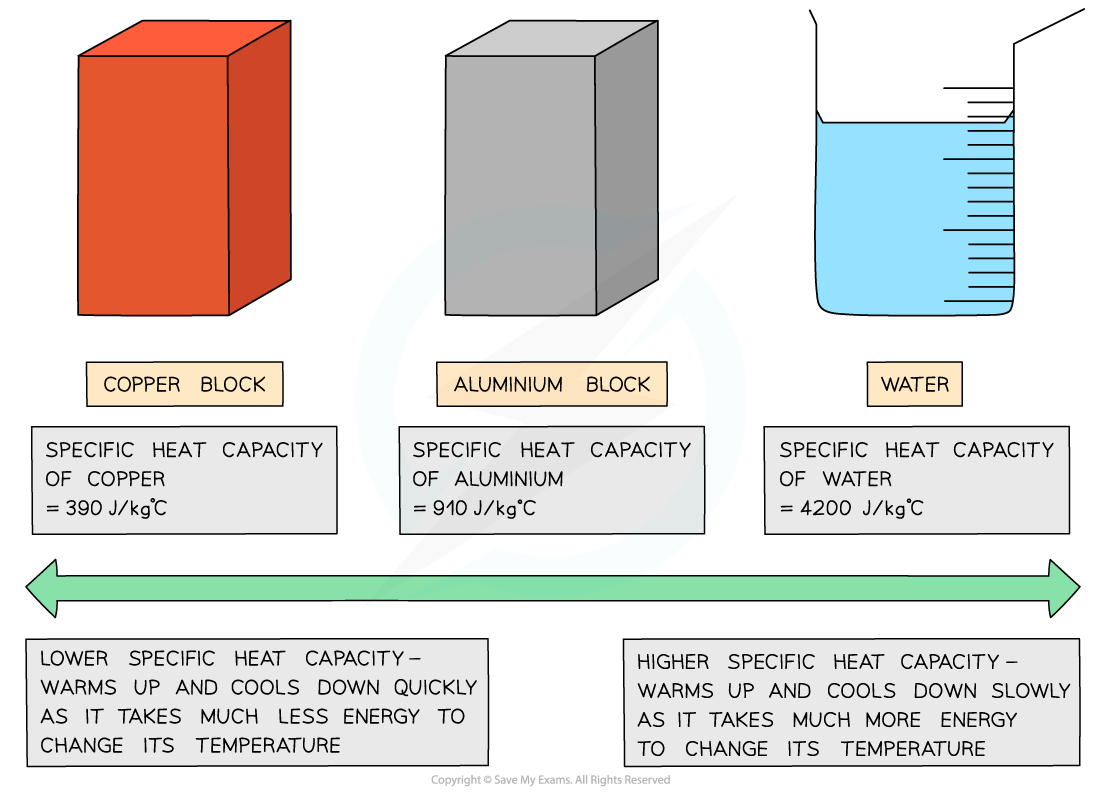
Low vs high specific heat capacity
Calculating Specific Heat Capacity
The specific heat capacity in terms of the amount of energy needed to raise the temperature of a given mass by a given amount can be calculated using the equation:
Where:
ΔE = change in thermal energy, in joules (J)
m = mass, in kilograms (kg)
c = specific heat capacity, in joules per kilogram per degree Celsius (J/kg °C)
Δθ = change in temperature, in degrees Celsius (°C)