Convection
Convectionvideo
Convection
Convection is the main way that heat travels through liquids and gases
Convection only occurs in fluids
Convection cannot happen in solids
Density & Convection
Descriptions of convection currents always need to refer to changes in temperature causing changes in density
The temperature may fall or rise, both can create a convection current
When a liquid (or gas) is heated (for example by a radiator near the floor):
The molecules push each other apart, making the liquid/gas expand
This makes the hot liquid/gas less dense than the surroundings
The hot liquid/gas rises, and the cooler (surrounding) liquid/gas moves in to take its place
Eventually the hot liquid/gas cools, contracts and sinks back down again
The resulting motion is called a convection current
Convection Currents
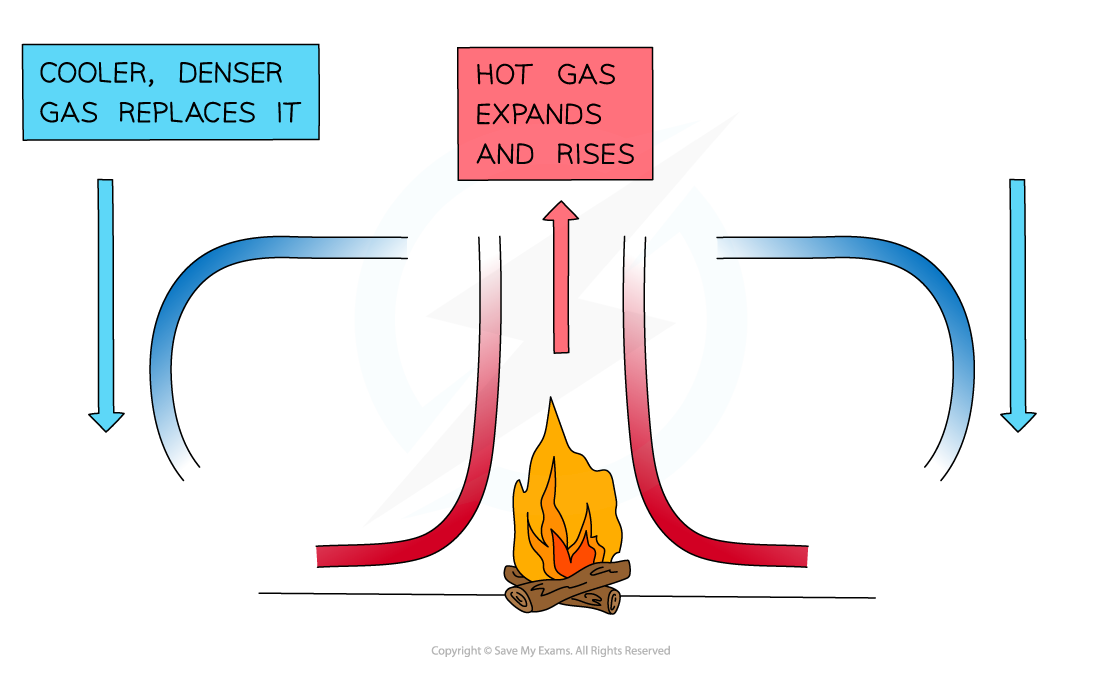
When a liquid or gas is heated, it becomes less dense and rises
When a liquid (or gas) is cooled (for example by an A.C. unit high up on a wall):
The molecules move together, making the liquid/gas contract
This makes the hot liquid/gas more dense than the surroundings
The cold liquid/gas falls, so that warmer liquid or gas can move into the space created
The warmer liquid or gas gets cooled and also contracts and falls down
The resulting motion is called a convection current
Demonstrating Convection Currents
A simple demonstration of convection in liquids involves taking a beaker of water and placing a few crystals of potassium permanganate in it, to one side, as shown in the diagram above
When the water is heated at that side, the potassium permanganate will dissolve in the heated water and rise along with the warmed water, revealing the convection current
Demonstrating Convection
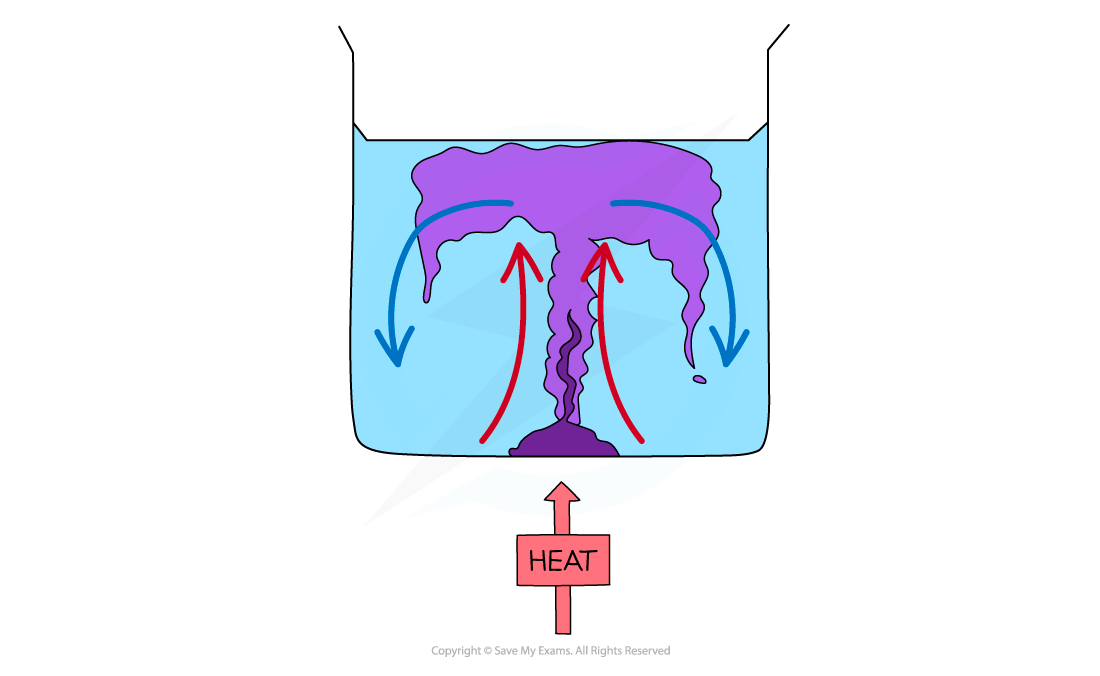
Diagram showing an experiment with potassium permanganate to demonstrate convection