StudyDeck

Financial Methods of Motivation

Exam code: 7115
Written by: Ashika|Reviewed by: Caroline Carroll|Updated 2 July 2026

Financial Methods of Motivation

Financial methods of motivation

  • Financial incentives are rewards or payments given to employees in return for their labour - or improved performance

  • The different theories of human motivation offer varying perspectives on the role of money in motivating staff

    • Herzberg's Two Factor Theory says that money is not generally a motivator, but the lack of it leads to dissatisfaction

    • Maslow's Hierarchy of Needs argues that people move through levels of needs that motivate them - their lower-order needs are closely linked to financial rewards, whilst higher-order needs are rarely linked to pay

      • Physiological and safety needs can be partially met by providing adequate pay 

      • Love and Belonging needs are often met by encouraging aspects such as team working

Financial methods of motivation
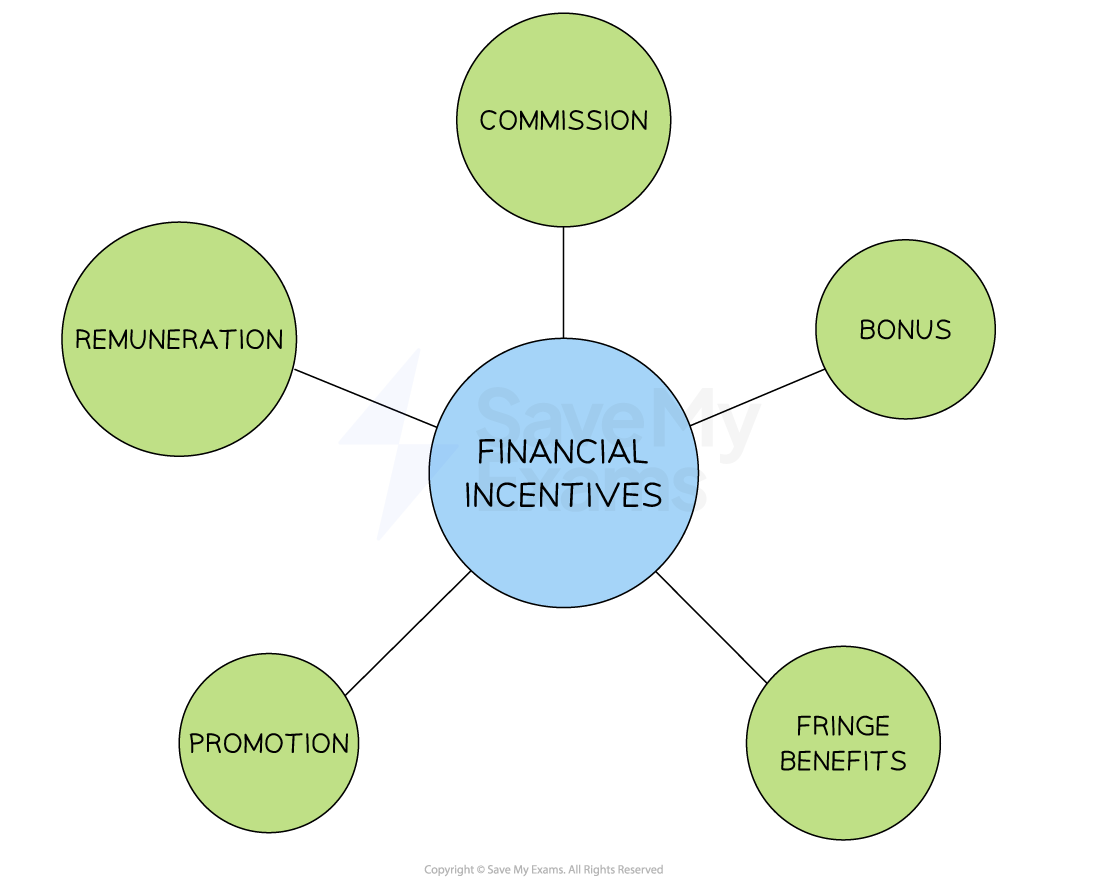
Diagram showing financial incentives: central blue circle labelled "Financial Incentives" connects to green circles for commission, bonus, fringe benefits, promotion, remuneration.
Financial incentives motivate some employees, depending upon the importance that they place on monetary items/money as a reward

Explaining the financial incentives

Incentive Type

Explanation

Remuneration

  • This refers to the basic wage or salary that a worker receives for their labour

  • Employees who work on an hourly rate are paid wages and accrue benefits such as annual leave according to the hours they work

  • Some workers may be paid a piece rate according to how many items they produce or sell

  • Salaries are paid to full time staff and usually accompanied by benefits such as a fixed number of days of annual leave

Commission

  • A percentage of sales revenue is paid to workers who sell products or services

  • Commonly used in sales roles and motivates staff to sell more and upsell

Bonus

  • An additional payment given to staff awarded for achieving specific goals, completing projects on time or exceeding performance expectations

  • The opportunity to earn more money may motivate staff to work harder and achieve better results

Promotion

  • Promotion usually demands a higher level of responsibility from an employee in the job role

    • Higher pay is usually offered to reflect the increased responsibility

  • A clear promotion pathway can act as a motivator to improve productivity and staff performance

Fringe benefits

  • These are additional benefits usually offered to salaried employees

    • Fringe benefits could include the use of a company car, private healthcare or gym membership

    • Employees can be motivated to work hard in order to keep their job and the associated fringe benefits