Ionic Bonds & Lattice Structure
The Lattice Structure of Ionic Compoundsvideo
The Lattice Structure of Ionic Compounds
Lattice structure
Ionic compounds have a giant lattice structure
Lattice structure refers to the arrangement of the atoms of a substance in 3D space
In lattice structures, the atoms are arranged in an ordered and repeating fashion
The lattices formed by ionic compounds consist of a regular arrangement of alternating positive and negative ions
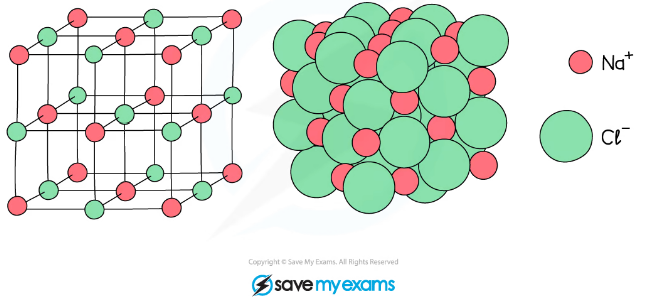
The lattice structure of NaCl
Ionic Bonds between Metallic & Non-Metallic Elementsvideo
Ionic Bonds between Metallic & Non-Metallic Elements
Ionic compounds
Ionic compounds are formed when metal atoms and non-metal atoms react
The ionic compound has no overall charge
Example: Magnesium Oxide, MgO
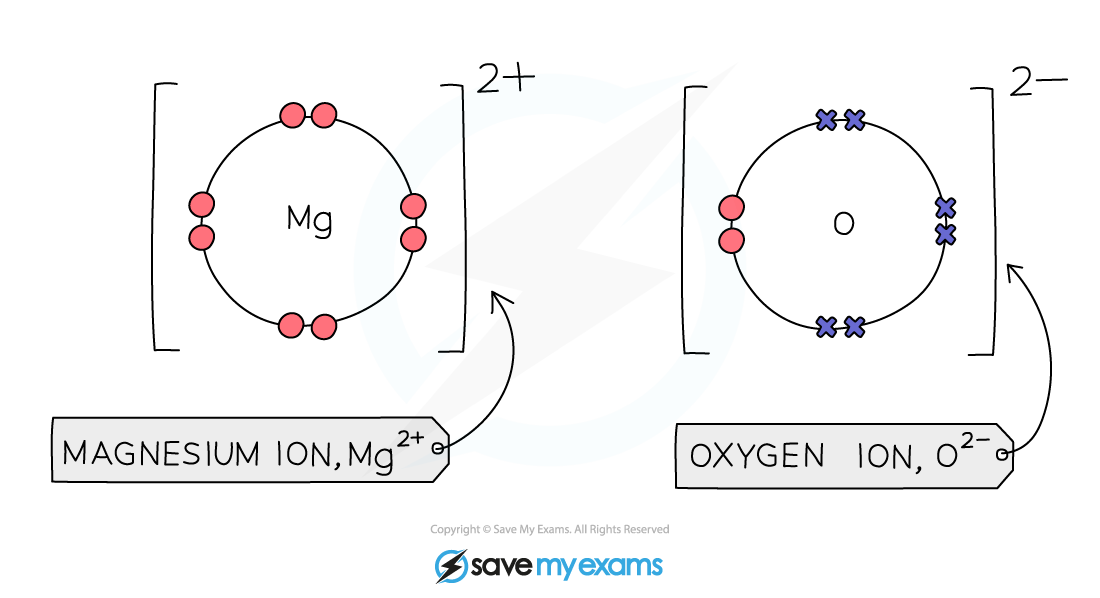
Diagram showing the dot-and-cross diagram of magnesium oxide
Explanation
Magnesium is a Group II metal so will lose two outer electrons to another atom to have a full outer shell of electrons
A positive ion with the charge 2+ is formed
Oxygen is a Group VI non-metal so will need to gain two electrons to have a full outer shell of electrons
Two electrons will be transferred from the outer shell of the magnesium atom to the outer shell of the oxygen atom
Oxygen atom will gain two electrons to form a negative ion with charge 2-
Magnesium oxide has no overall charge
Formula of ionic compound: MgO