Properties of Ionic Compounds
Properties of Ionic Compoundsvideo
Properties of Ionic Compounds
What are the properties of ionic compounds?
Ionic compounds are usually solid at room temperature
They have high melting and boiling points
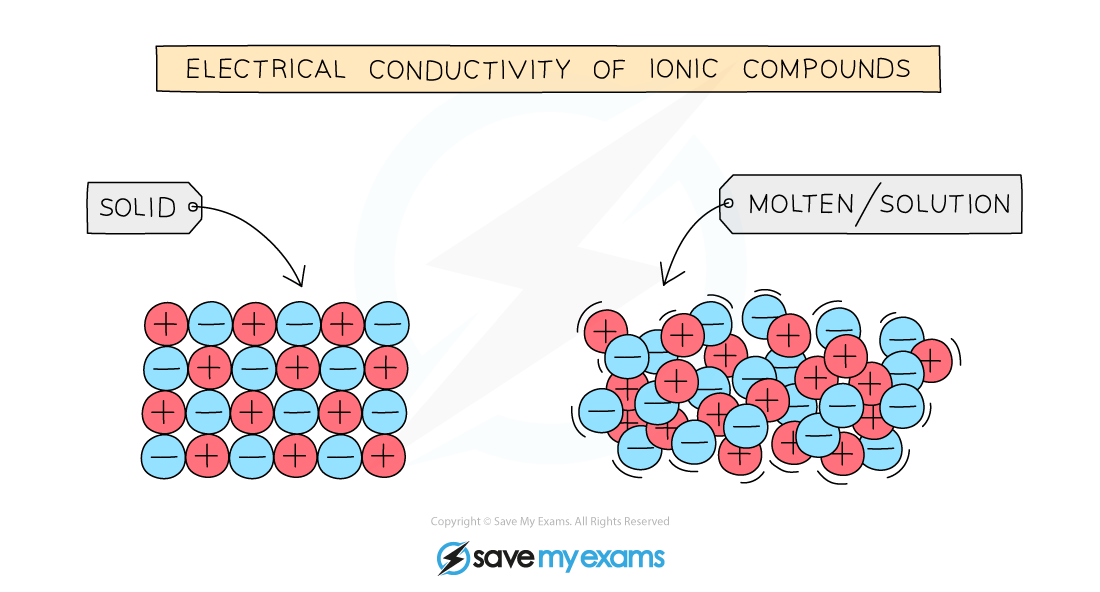
Ionic compounds are good conductors of electricity in the molten state or in solution
They are poor conductors in the solid state
Explaining the properties of ionic compounds
Ionic substances have high melting and boiling points due to the presence of strong electrostatic forces acting between the oppositely charged ions
These forces act in all directions and a lot of energy is required to overcome them
The greater the charge on the ions, the stronger the electrostatic forces and the higher the melting point will be
For example, magnesium oxide consists of Mg2+ and O2- so will have a higher melting point than sodium chloride which contains the ions, Na+ and Cl-
For electrical current to flow there must be freely moving charged particles such as electrons or ions present
Ionic compounds are good conductors of electricity in the molten state or in solution as they have ions that can move and carry a charge
They are poor conductors in the solid state as the ions are in fixed positions within the lattice and are unable to move