Ions & Ionic Bonds
The Formation of Ionsvideo
The Formation of Ions
An ion is an electrically charged atom or group of atoms formed by the loss or gain of electrons
An atom will lose or gain electrons to become more stable
The loss or gain of electrons takes place to gain a full outer shell of electrons which is a more stable arrangement of electrons
The electronic configuration of an ion will be the same as that of a noble gas – such as helium, neon and argon
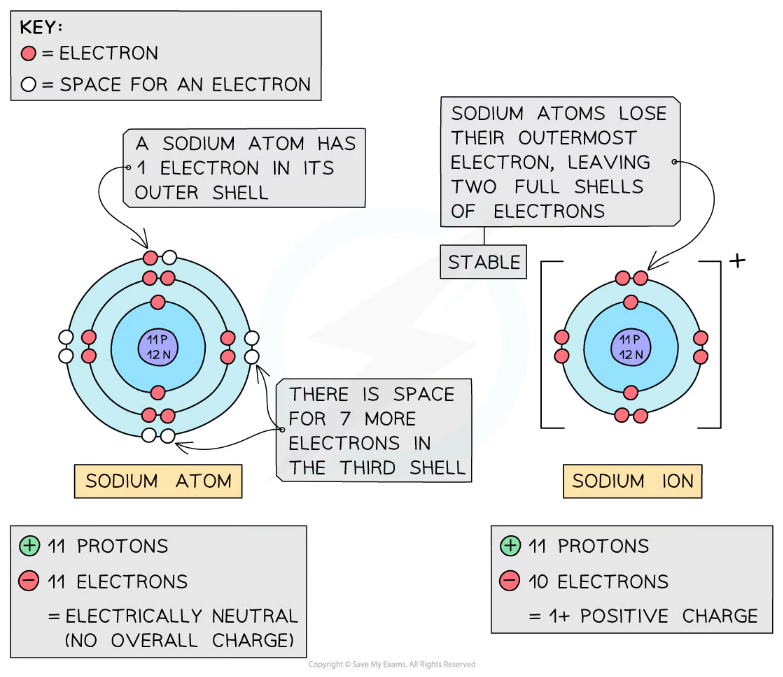
Formation of positively charged sodium ion
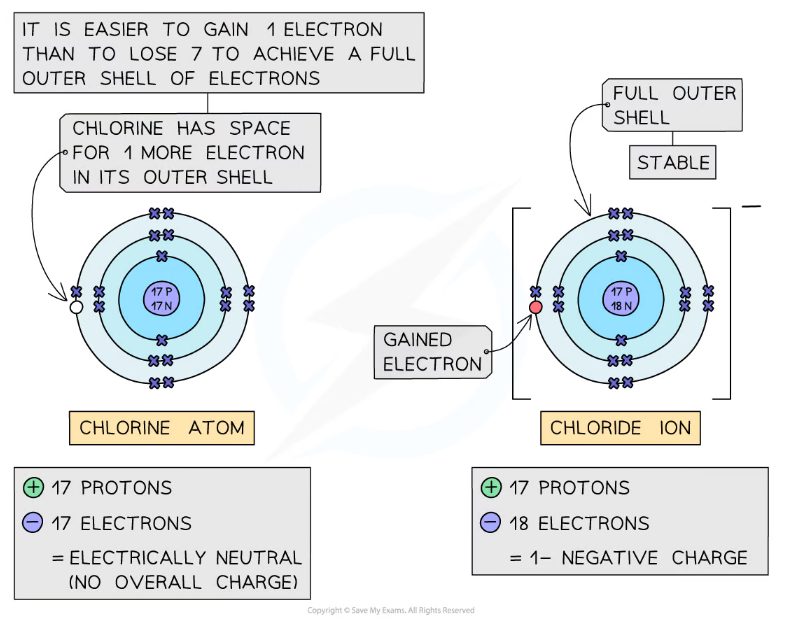
Formation of negatively charged chloride ion
Ionisation of metals and non-metals
Metals: all metals can lose electrons to other atoms to become positively charged ions, known as cations
Non-metals: all non-metals can gain electrons from other atoms to become negatively charged ions, known as anions
The Formation of Ionic Bonds
The Formation of Ionic Bonds
Ionic compounds are formed when metal atoms react with non-metal atoms
Metal atoms lose their outer electrons which the non-metal atoms gain to form positive and negative ions
The positive and negative ions are held together by strong electrostatic forces of attraction between opposite charges
This force of attraction is known as an ionic bond and they hold ionic compounds together
Dot-and-cross diagrams
Dot and cross diagrams are diagrams that show the arrangement of the outer-shell electrons in an ionic or covalent compound or element
The electrons are shown as dots and crosses
In a dot and cross diagram:
Only the outer electrons are shown
The charge of the ion is spread evenly which is shown by using brackets
The charge on each ion is written at the top right-hand corner
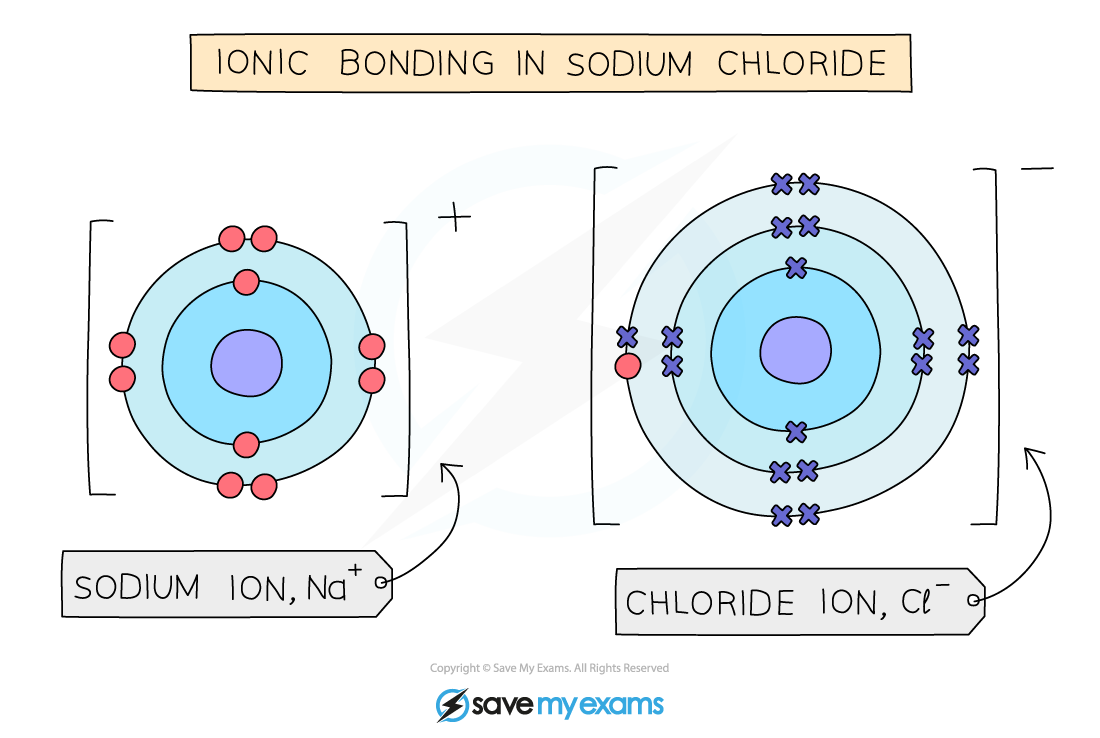
Electrostatic forces between the positive Na ion and negative Cl ion