Metallic Bonding
Metallic Bondingvideo
Metallic Bonding
Metal atoms are held together strongly by metallic bonding in a giant metallic lattice
Within the metallic lattice, the atoms lose the electrons from their outer shell and become positively charged ions
The outer electrons no longer belong to a particular metal atom and are said to be delocalised
They move freely between the positive metal ions like a 'sea of electrons'
Metallic bonds are strong and are a result of the electrostatic attraction between the positive metal ions and the negatively charged delocalised electrons
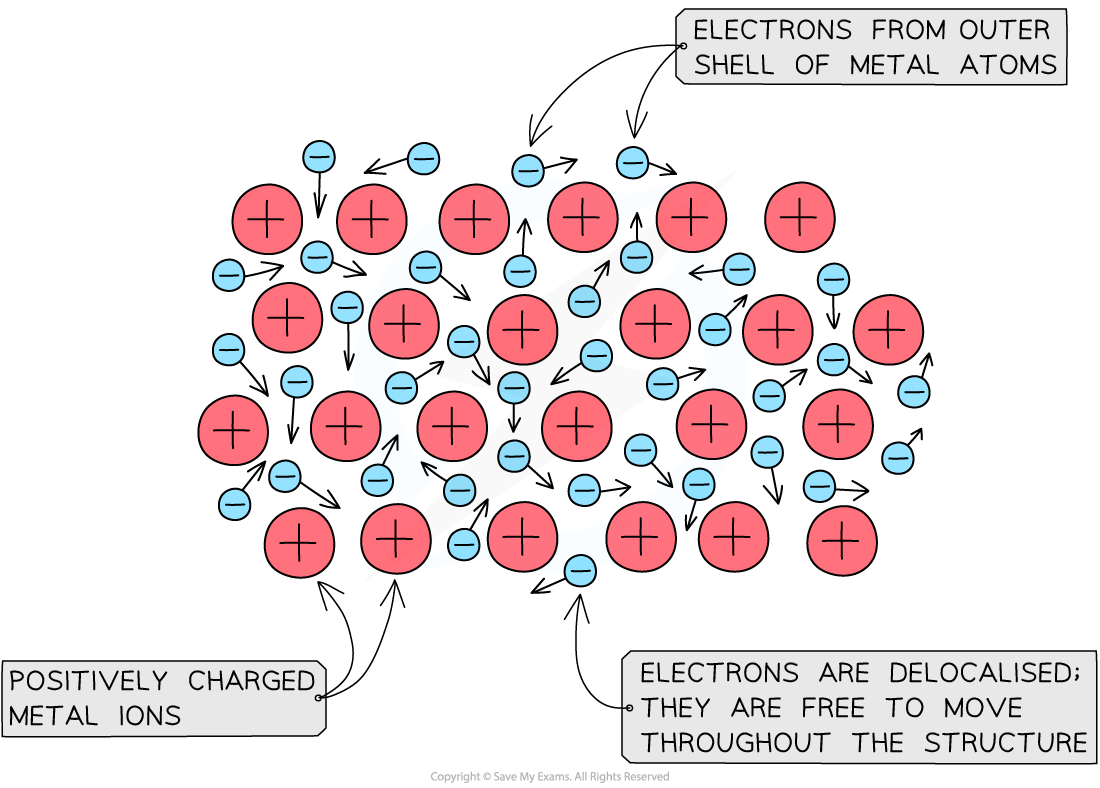
Diagram showing metallic lattice structure with delocalised electrons
Properties of Metals
Properties of Metals
Metals conduct electricity
There are delocalised electrons that are free to move through the structure and carry charge
Electrons entering one end of the metal cause a delocalised electron to displace itself from the other end
Hence electrons can flow so electricity is conducted
Metals are malleable and ductile
Layers of positive ions can slide over one another and take up different positions
Metallic bonding is not disrupted as the outer electrons do not belong to any particular metal atom so the delocalised electrons will move with them
Metallic bonds are thus not broken and as a result metals are strong but flexible
They can be hammered and bent into different shapes or drawn into wires without breaking