Forming Equations from Shapes
Forming Equations from Shapes
Forming equations from shapes
How do I form equations from shapes?
You need to use all the information given on the diagram and any specific properties of that shape
Common 2D shapes that you should know properties for are
Triangles: equilateral, isosceles, scalene, right-angled
Quadrilaterals: square, rectangle, kite, rhombus, parallelogram, trapezium
You may be asked about perimeter, area or angles
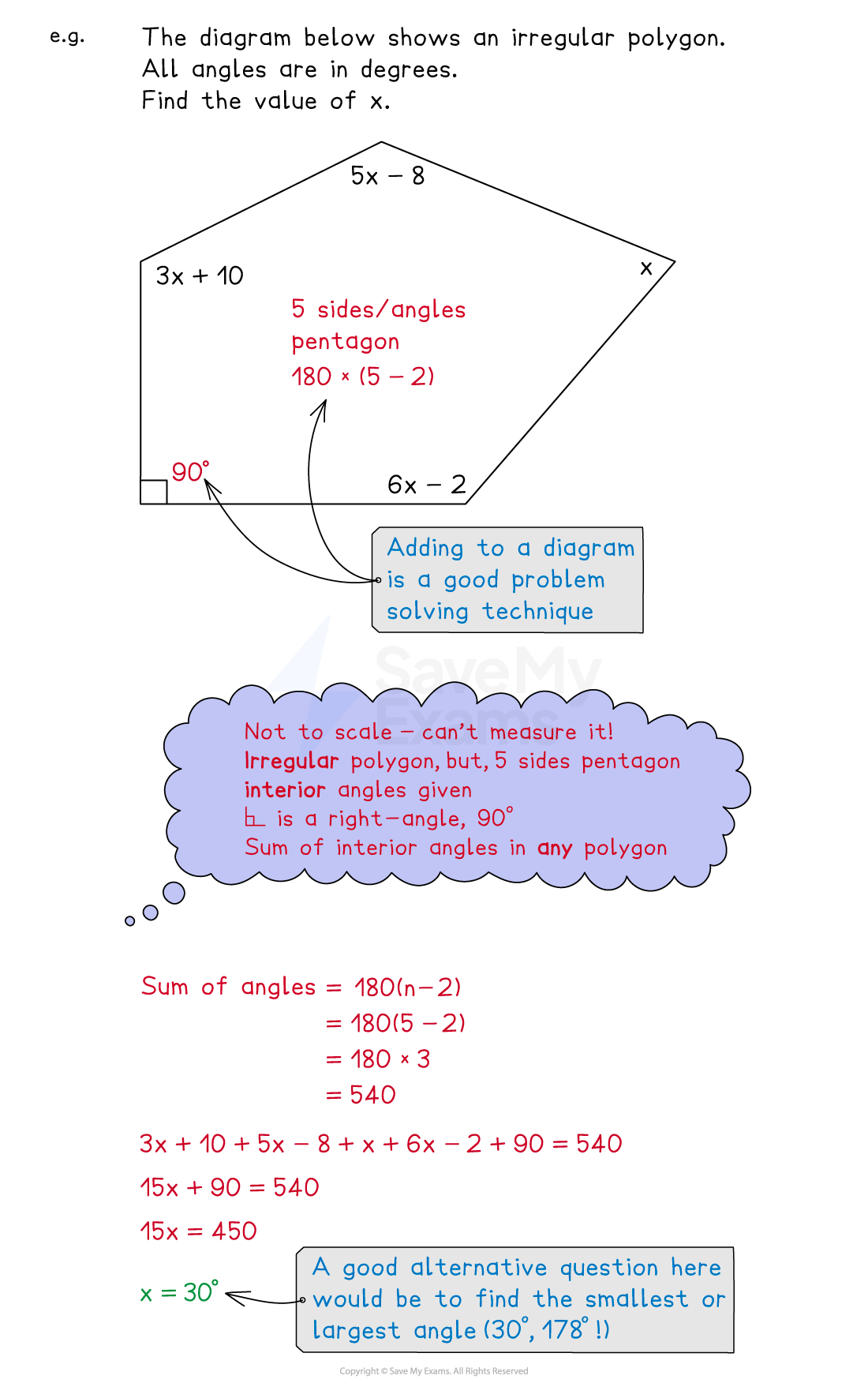
You may be asked about polygons
Regular vs irregular polygons
Interior vs exterior angles
The sum of interior angles is 180(n-2) for an n-sided polygon
You may be asked about angles in parallel lines
Alternative, corresponding and co-interior
You may be asked about 3D shapes involving surface area and volume
Prisms have constant cross sections
Volume is cross-section area multiplied by length
Is there anything else that can help?
Sketch a diagram if none is given
Split up uncommon shapes into the sum or difference of common shapes
Look out for important extra information
For example, a trapezium "with a line of symmetry"
With irregular shapes, assume all angles and lengths are different (unless told otherwise)
Put brackets around algebraic expressions when substituting them into geometric properties