Solving Linear Inequalities
Solving Linear Inequalitiesvideo
Solving linear inequalities
What is an inequality?
An inequality tells you that something is greater than (>) or less than (<) something else
x > 5 means x is greater than 5
x could be 6, 7, 8, 9, ...
Inequalities may also include being equal (=)
⩾ means greater than or equal to
⩽ means less than or equal to
x ⩽ 10 means x is less than or equal to 10
x could be 10, 9, 8, 7, 6,....
When they cannot be equal, they are called strict inequalities
> and < are strict inequalities
x > 5 does not include 5 (strict)
x ⩾ 5 does include 5 (not strict)
How do I find integers that satisfy inequalities?
You may be given two end points and have to list the integer values of x that satisfy the inequality
Look at whether each end point is included or not
3 ⩽ x ⩽ 6
x = 3, 4, 5, 6
3 ⩽ x < 6
x = 3, 4, 5
3 < x ⩽ 6
x = 4, 5, 6
3 < x < 6
x = 4, 5
If only one end point is given, there are an infinite number of integers
x > 2
x = 3, 4, 5, 6, ...
x ⩽ 2
x = 2, 1, 0, -1, -2, ...
Remember zero and negative whole numbers are integers
If the question had said positive integers only then just list x = 2, 1
You may be asked to find integers that satisfy two inequalities
0 < x < 5 and x ⩾ 3
List separately: x = 1, 2, 3, 4 and x = 3, 4, 5, 6, ...
Find the values that appear in both lists: x = 3, 4
If the question does not say x is an integer, do not assume x is an integer!
x > 3 actually means any value greater than 3
3.1 is possible
= 3.14159... is possible
You may be asked to find the smallest or largest integer
The smallest integer that satisfies x > 6.5 is 7
How do I represent an inequality on a number line?
The inequality -3 < x ≤ 4 is shown on a number line below
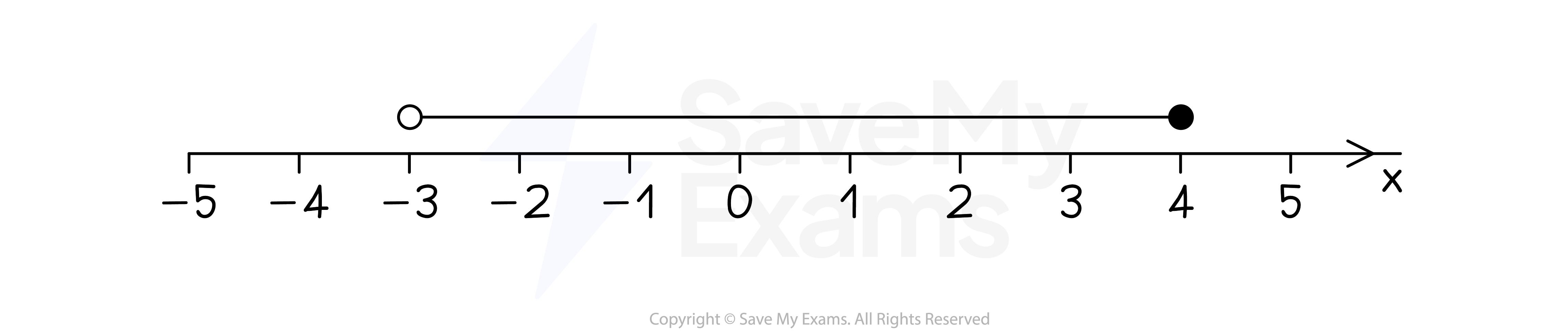
Draw circles above the end points and connect them with a horizontal line
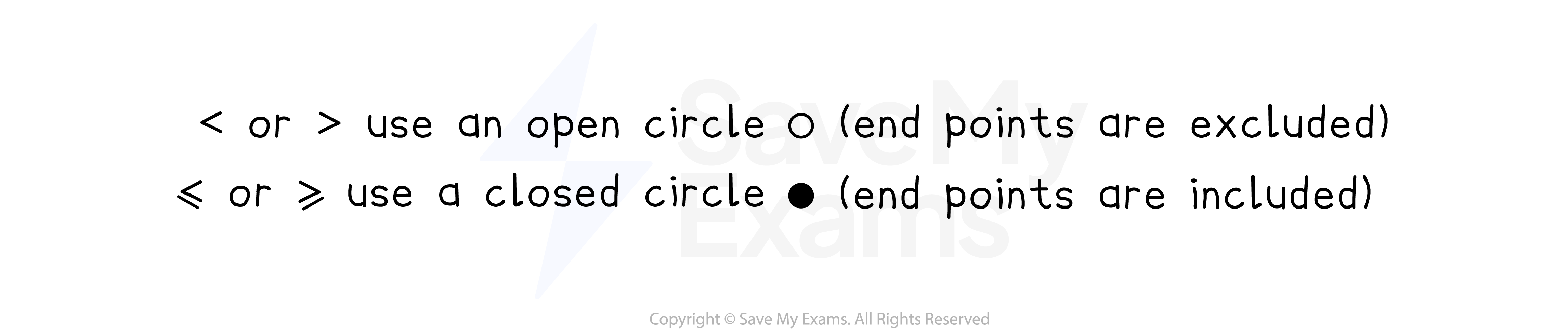
Leave an open circle for end points with strict inequalities, < or >
These end points are not included
Fill in a solid circle for end points with ≤ or ≥ inequalities
These end points are included
Use a horizontal arrow for inequalities with one end point
x > 5 is an open circle at 5 with a horizontal arrow pointing to the right
How do I solve linear inequalities?
Solving linear inequalities is just like Solving Linear Equations
Follow the same rules, but keep the inequality sign throughout
If you change the inequality sign to an equals sign you are changing the meaning of the problem
When you multiply or divide both sides by a negative number, you must flip the sign of the inequality
E.g.
Never multiply or divide by a variable (x) as this could be positive or negative
The safest way to rearrange is simply to add and subtract to move all the terms onto one side
How do I solve double inequalities?
Inequalities such as can be solved by applying the same operation to all three sides of the inequality
E.g.
Alternatively, you can separate the inequality into two inequalities
and