StudyDeck

Introduction to Functions

Exam code: 4024
Written by: Ashika|Reviewed by: Caroline Carroll|Updated 2 July 2026

Introduction to Functionsvideo

Introduction to Functions

Introduction to functions

What is a function?

  • A function is a combination of one or more mathematical operations that takes a set of numbers and changes them into another set of numbers

  • The numbers being put into the function are often called the inputs

  • The numbers coming out of the function are often called the outputs

  • A function may be thought of as a mathematical “machine”

    • For example, for the function “double the number and add 1”, the two mathematical operations are "multiply by 2 (×2)" and "add 1 (+1)"  

      • Putting 3 in to the function would give 2 × 3 + 1 = 7

      • Putting -4 in would give 2 × (-4) + 1 = -7 

      • Putting x{"language":"en","fontFamily":"Times New Roman","fontSize":"18","autoformat":true} in would give 2x+1{"fontFamily":"Times New Roman","fontSize":"18","autoformat":true,"toolbar":""}

What is function notation?

  • A function, f, with input x{"fontFamily":"Times New Roman","fontSize":"18","autoformat":true,"toolbar":""} can be written as fx=...{"fontFamily":"Times New Roman","fontSize":"18","autoformat":true,"toolbar":""}

    • Letters other than f can be used

      • The letters g, h and j are common but any letter can be used

      • Typically, a new letter will be used to define a new function in a question

  • For example, the function with the rule “triple the number and subtract 4” would be written

    • f(x)=3x–4{"fontFamily":"Times New Roman","fontSize":"18","autoformat":true,"toolbar":""} 

  • In such cases, "x{"language":"en","fontFamily":"Times New Roman","fontSize":"18","autoformat":true}" is the input and "fx{"language":"en","fontFamily":"Times New Roman","fontSize":"18","autoformat":true}" is the output

  • Sometimes functions don’t have names like f and are just written as y = …

    • E.g. y=3x–4{"fontFamily":"Times New Roman","fontSize":"18","autoformat":true,"toolbar":""}

How does a function work?

  • A function has an input x{"fontFamily":"Times New Roman","fontSize":"18","autoformat":true,"toolbar":""} and an output fx{"fontFamily":"Times New Roman","fontSize":"18","autoformat":true,"toolbar":""}

    • If the input is 2, then the output is f2{"fontFamily":"Times New Roman","fontSize":"18","autoformat":true,"toolbar":""}

    • If the input is m{"fontFamily":"Times New Roman","fontSize":"18","autoformat":true,"toolbar":""}, then the output is fm{"fontFamily":"Times New Roman","fontSize":"18","autoformat":true,"toolbar":""}

    • If the input is t+5{"fontFamily":"Times New Roman","fontSize":"18","autoformat":true,"toolbar":""}, then the output is ft+5{"fontFamily":"Times New Roman","fontSize":"18","autoformat":true,"toolbar":""}

      • You cannot simplify this output any further

  • If the function is known, the output can be calculated

    • For example, given the function f(x)=2x+1{"fontFamily":"Times New Roman","fontSize":"18","autoformat":true,"toolbar":""}

      • f(3)=2×3+1=7{"fontFamily":"Times New Roman","fontSize":"18","autoformat":true,"toolbar":""}

      • f(-4)=2×(-4)+1=-7{"fontFamily":"Times New Roman","fontSize":"18","autoformat":true,"toolbar":""}

      • f(a)=2a+1{"fontFamily":"Times New Roman","fontSize":"18","autoformat":true,"toolbar":""}

  • If the output is known, an equation can be formed and solved to find the input

    • For example, given the function f(x)=2x+1{"fontFamily":"Times New Roman","fontSize":"18","autoformat":true,"toolbar":""}

      • If f(x)=15{"fontFamily":"Times New Roman","fontSize":"18","autoformat":true,"toolbar":""}, then form an equation by replacing fx{"fontFamily":"Times New Roman","fontSize":"18","autoformat":true,"toolbar":""} with 2x+1{"fontFamily":"Times New Roman","fontSize":"18","autoformat":true,"toolbar":""}

      • 2x+1=15{"fontFamily":"Times New Roman","fontSize":"18","autoformat":true,"toolbar":""}

      • Solving this equation gives an input of 7

  • Note that fx=15{"fontFamily":"Times New Roman","fontSize":"18","autoformat":true,"toolbar":""} and f15{"fontFamily":"Times New Roman","fontSize":"18","autoformat":true,"toolbar":""} are very different things:

    • fx=15{"fontFamily":"Times New Roman","fontSize":"18","autoformat":true,"toolbar":""} means an input of x{"fontFamily":"Times New Roman","fontSize":"18","autoformat":true,"toolbar":""} gives an output of 15

    • f15{"fontFamily":"Times New Roman","fontSize":"18","autoformat":true,"toolbar":""} means substitute the input 15 into the function

What is a mapping diagram?

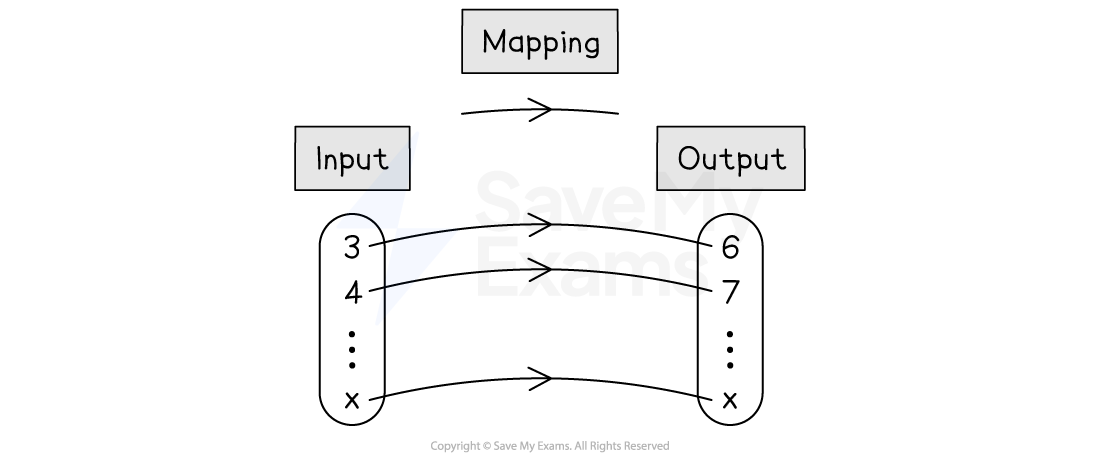
  • A mapping diagram shows a set of different inputs going into the function to become a set of different outputs

    • Transforming inputs into outputs is called mapping

  • For example, a mapping diagram for the function fx=x+3{"fontFamily":"Times New Roman","fontSize":"18","autoformat":true,"toolbar":""} where x≥3{"fontFamily":"Times New Roman","fontSize":"18","autoformat":true,"toolbar":""} could be shown as:

Diagram showing a set of input numbers being mapped over to a set of output values.