StudyDeck

Direct Proportion

Exam code: 4024
Written by: Ashika|Reviewed by: Caroline Carroll|Updated 2 July 2026

Direct Proportionvideo

Direct Proportion

Direct proportion

What is direct proportion?

  • Proportion is a way of talking about how two variables are related to each other

  • Direct proportion means that as one variable goes up the other goes up by the same factor

    • The ratio between the two amounts will always stay the same

  • The symbol ∝{"fontFamily":"Times New Roman","fontSize":"18","autoformat":true,"toolbar":""} means "proportional to"

    • E.g. y is directly proportional to x, y∝{"fontFamily":"Times New Roman","fontSize":"18","autoformat":true,"toolbar":""}x

  • If x and y are directly proportional, then

    • x : y will always be the same

    • there will be some value, k, such that y = kx

    • the graph relating x and y is a linear graph, with gradient k

  • k is called the constant of proportionality
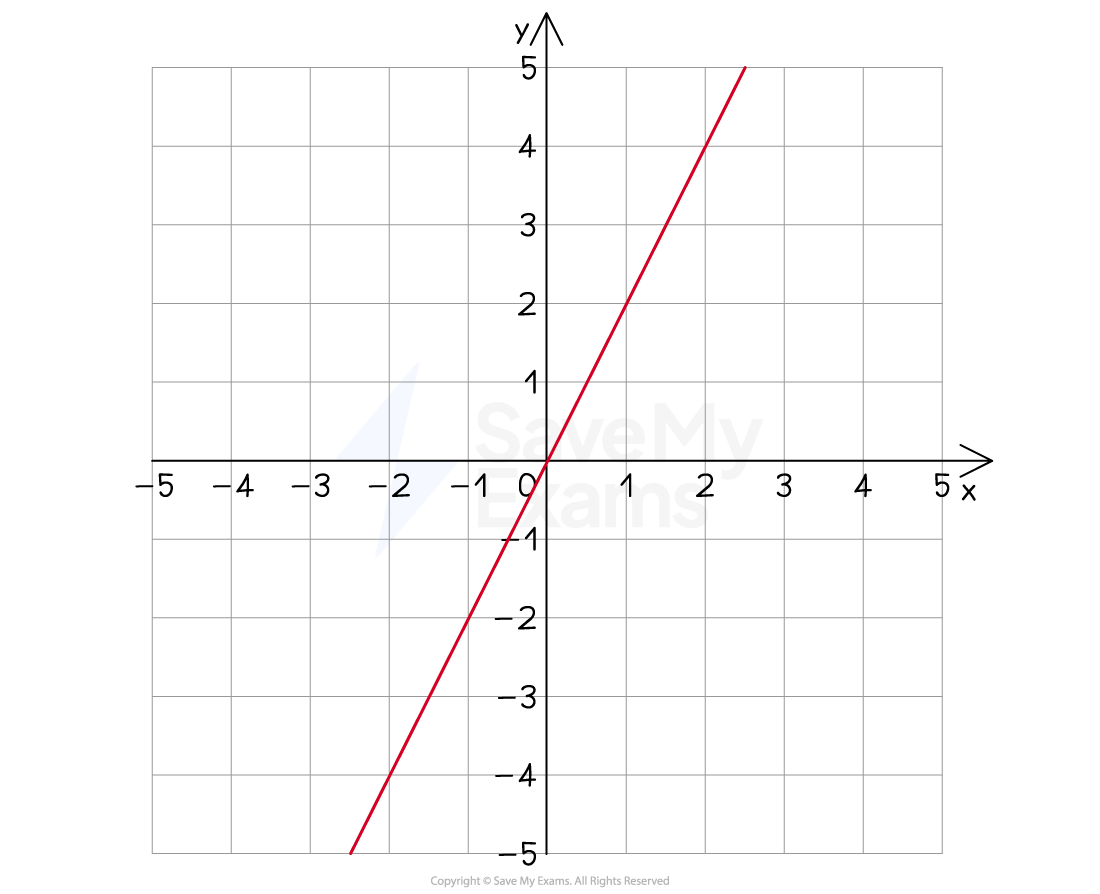
Graph showing a directly proportional relationship between x and y.
Example of a graph showing direct proportion

How do I use direct proportion with powers and roots?

  • Problems may involve a variable being directly proportional to a power or root of another variable

  • For example

    • y is directly proportional to the square of x

      • y∝x2{"fontFamily":"Times New Roman","fontSize":"18","autoformat":true,"toolbar":""}

      • means that y=kx2{"fontFamily":"Times New Roman","fontSize":"18","autoformat":true,"toolbar":""}

    • y is directly proportional to the square root of x

      • y∝x{"fontFamily":"Times New Roman","fontSize":"18","autoformat":true,"toolbar":""}

      • means that y=kx{"fontFamily":"Times New Roman","fontSize":"18","autoformat":true,"toolbar":""}

    • y is directly proportional to the cube of x

      • y∝x3{"fontFamily":"Times New Roman","fontSize":"18","autoformat":true,"toolbar":""}

      • means that equationy=kx3{"fontFamily":"Times New Roman","fontSize":"18","autoformat":true,"toolbar":""}

    • y is directly proportional to the cube root of x

      • y∝x3{"fontFamily":"Times New Roman","fontSize":"18","autoformat":true,"toolbar":""}

      • means that equationy=kx3{"fontFamily":"Times New Roman","fontSize":"18","autoformat":true,"toolbar":""}

    • Each of these would have a different type of graph, depending on the power or root

How do I find the equation between two directly proportional variables?

  • Direct proportion questions always have the same process:

    • STEP 1
      Identify the two variables and write down the formula in terms of k

      • E.g. y is directly proportional to x

      • write down the formula y=kx{"fontFamily":"Times New Roman","fontSize":"18","autoformat":true,"toolbar":""}

    • STEP 2
      Find k by substituting any given values from the question into your formula, then solving to get k

      • E.g. if you are told y = 6 when x = 2

      • then 6=k×2{"fontFamily":"Times New Roman","fontSize":"18","autoformat":true,"toolbar":""} giving k=3{"fontFamily":"Times New Roman","fontSize":"18","autoformat":true,"toolbar":""}

    • STEP 3
      Rewrite the formula with the known value of k from above (substitute it in)

      • y=3x{"fontFamily":"Times New Roman","fontSize":"18","autoformat":true,"toolbar":""}

      • This is the equation relating the two variables

    • STEP 4
      Use the equation to answer other parts of the question

      • E.g. find y when x = 10

      • y=3x{"fontFamily":"Times New Roman","fontSize":"18","autoformat":true,"toolbar":""} gives y=3×10=30{"fontFamily":"Times New Roman","fontSize":"18","autoformat":true,"toolbar":""}