Gametes & Fertilisation
Gametes & Fertilisationvideo
Gametes & Fertilisation
Fertilisation is the fusion of the nuclei from a male gamete (sperm cell) and a female gamete (egg cell)
It occurs in the oviducts
This results in the formation of a zygote which will undergo cell division and grow to form an embryo
Gametes have adaptations to increase the chances of fertilisation and successful development of an embryo
Adaptations of Gametes
Adaptations of Gametes
Gamete | Adaptive feature | Reason |
|---|---|---|
Sperm | Has a flagellum (tail) | Enables it to swim to the egg |
Contains enzymes in the head region (acrosome) | To digest through the jelly coat and cell membrane of an egg cell when it meets one | |
Contains many mitochondria | Provide energy from respiration so that the flagellum can move back and forth for locomotion | |
Egg | Cytoplasm containing a store of energy | Provides energy for the dividing zygote after fertilisation |
Jelly-like coating that changes after fertilisation | Forms an impenetrable barrier after fertilisation to prevent other sperm nuclei entering the egg cell |
Comparison of Male & Female Gametes Table
| Sperm | Egg |
|---|---|---|
Size | Very small (45µm) | Large (0.2mm) |
Structure | Head region and flagellum, many structural adaptations | Round cell with few structural adaptations, covered in a jelly coating |
Motility | Capable of locomotion | Not capable of locomotion |
Numbers | Produced every day in huge numbers (around 100 million per day) | Thousands of immature eggs in each ovary, but only one released each month |
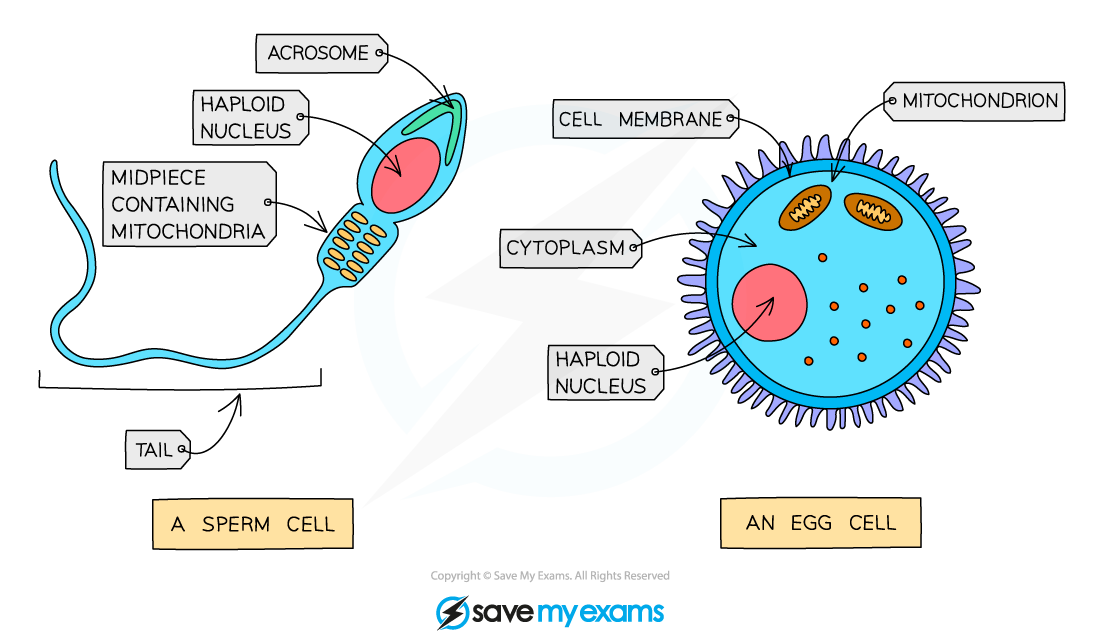
Comparing sperm and egg cells