The Need for Business Finance
Start-up capital
Start-up capital
All businesses need finance to get started, allow them to grow, to fund capital investments and their continuing activity
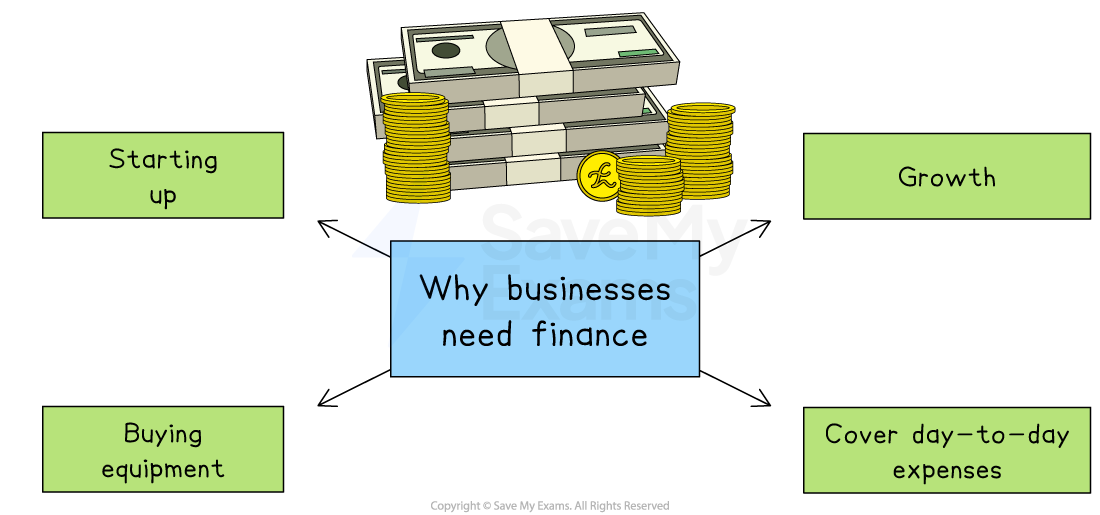
Start-up capital is the finance needed by a new business to pay for fixed assets and current assets before it can begin trading
A business usually estimates the amount of start-up capital they need in the business plan
Many small new businesses will get a start-up loan to cover these initial costs
Capital for growth
Capital for growth
As a business grows more finance may be needed for capital expenditure
It may require more equipment, buildings, IT equipment or vehicles, which will allow the business to increase output
If a business wants to grow by developing a new product, it will need to spend large amounts of capital on research and development (R&D)
For example. Apple's annual research and development expenses for 2023 were $29.915 billion
This represented a 13.96% increase from 2022, with investments in artificial intelligence (AI) and innovation of new products
Finance to replace fixed assets and invest in new technology
Finance to replace fixed assets and invest in new technology
Businesses need finance not just to buy new things, but also to keep their operations up-to-date
Fixed assets like machinery, vehicles, or equipment wear out or become outdated over time
If they are not replaced
Production may slow down
Maintenance costs may increase
Products may become lower quality
Replacing old assets helps the business stay efficient and avoid delays
However, fixed assets are expensive, so businesses often need loans or use leasing to afford them.
Technology changes quickly, so businesses need to invest regularly in
Modern software (e.g. for accounts or sales)
Improved machines (e.g. faster or more accurate equipment)
Digital tools (e.g. online payment systems or apps)
Working capital
Working capital
Working capital is the money used in the day-to-day operations of a business
Finance is required for working capital, which is spending on raw materials, wages or utilities
Having a steady flow of working capital is essential to keep the business operational
Without working capital, the business would be unable to cover its day-to-day expenses
It may suffer cash-flow problems which could lead to business failure
Short-term and long-term finance needs
Short-term and long-term finance needs
Short-term finance needs last less than one year
Examples include
Paying for stock or raw materials
Paying wages and utility bills
Covering temporary cash flow problems
Paying suppliers or rent
Unexpected repairs or inexpensive items of equipment
Long-term finance needs last for more than one year
Examples include
Buying buildings, machinery or vehicles
Starting a new business
Expanding into new markets or countries
Developing new products
Replacing outdated equipment or technology