The Importance of Cash & Cash Flow Forecasts
Why cash is important
Why is cash important?
Cash is the 'blood' of a business, as without it, a business cannot survive
It is a liquid asset in the form of notes, coins and money in the bank
A new business may have to pay cash on purchase for all of its supplies until its suppliers trust them enough to grant trade credit
A supplier may then give the business 30 or 60 days to pay for items they purchase
This means that the business can receive their stock now pay for it later, so the cash outflow is delayed
As the business sells its products, they receive money generated from the business revenue, which represents a cash inflow
At the end of the credit period, they pay the supplier (cash outflow), but the firm may still have half of its stock available for sale
More established businesses need to ensure that they manage cash effectively to ensure that they do not run out of money
Cash-flow issues may put the business in a situation where it is :
Unable to pay key stakeholders, such as workers and suppliers
Production is likely to cease, as workers will not work without pay and suppliers will not supply goods if they are not paid
Unable to pay utility bills and rent
As a result, the business could be forced into liquidation and is, ultimately, likely to fail
Introduction to cash flow forecasts
Introduction to cash flow forecasts
A cash-flow forecast is a prediction of the expected cash inflows and cash outflows, typically for the next three, six or twelve-month period
Typical outflows include payments for raw materials, paying staff wages and salaries, paying bills such as electricity and repaying loans
Typical inflows include receipts from sales, money received from a new bank loan, money from the sale of an asset and money from investors
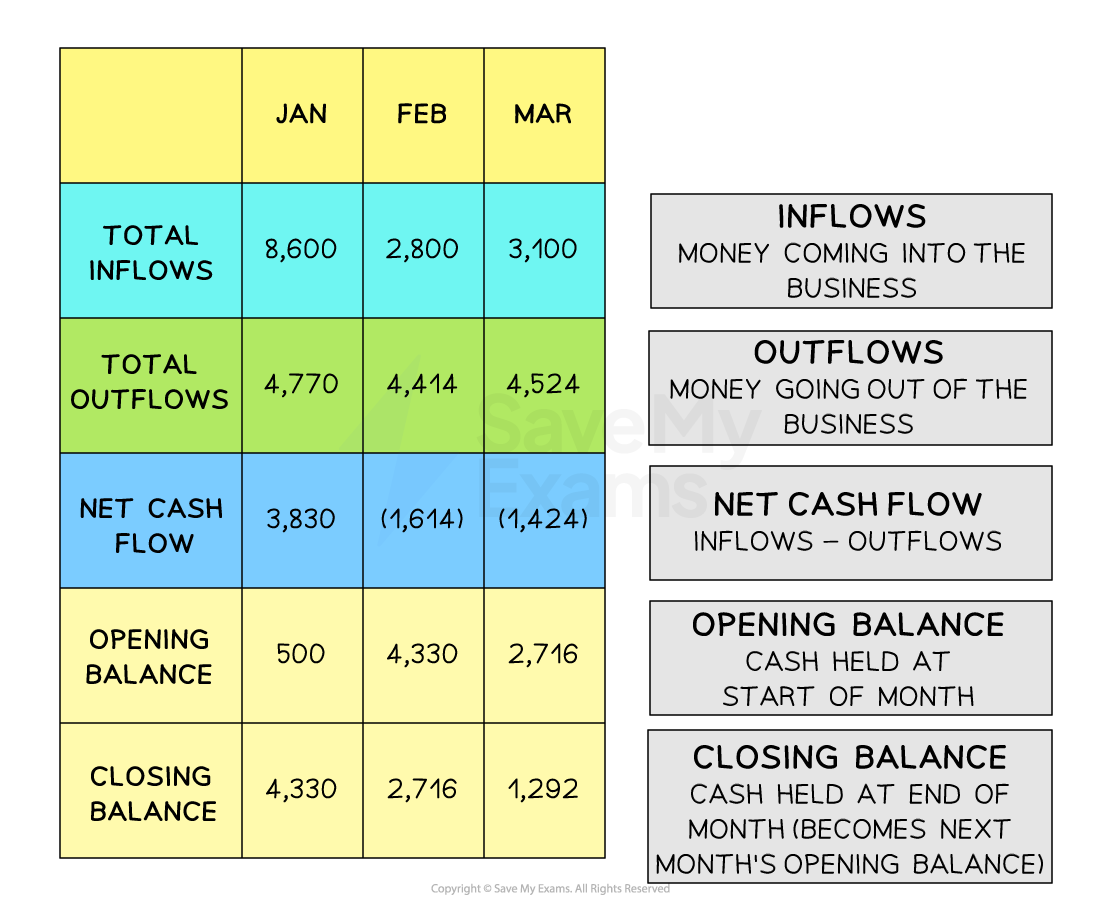
Features of cash flow forecasts
Features of cash flow forecasts
Cash inflows
Cash inflows are sums of money coming into the business
This includes items like sales revenue, loans received or money from investors
Cash outflows
Cash outflows are sums of money leaving the business
This includes payments for rent, wages, stock, bills or loan repayments
Net cash flow
Net cash flow is the difference between cash inflows and cash outflows in a given period
If net cash flow is positive, the business has more cash coming in than going out
If it's negative, the business is spending more than it receives
Net cash flow is calculated using the formula
Opening balance
The opening balance is the amount of cash the business has at the start of a period, e.g., the beginning of the month
It is usually the same as the closing balance from the previous period
Closing balance
The closing balance is the amount of cash the business has at the end of the period
This figure shows whether the business will have enough money at the end of the month to cover its needs
The closing balance is calculated using the formula