Completing & Interpreting Cash Flow Forecasts
Completing cash flow forecasts
Completing cash flow forecasts
A business must first gather information about all cash inflows and cash outflows it expects to encounter over the period
The following steps should then be taken to construct the cash flow forecast
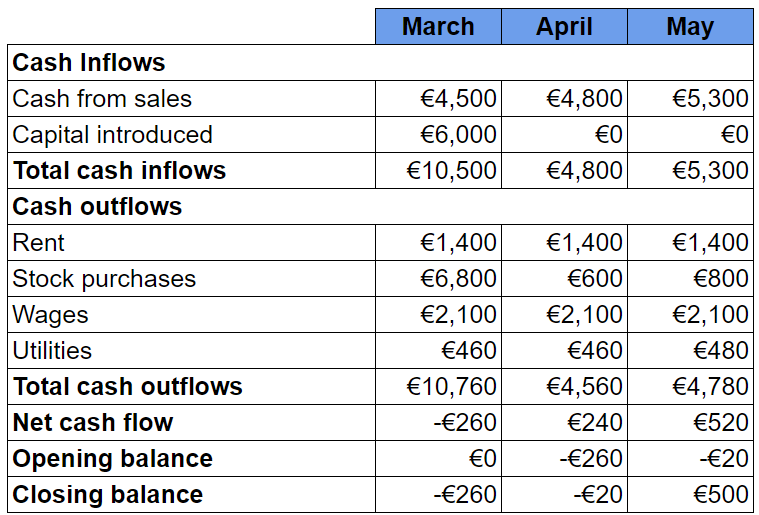
Step 1 – Calculate total cash inflows
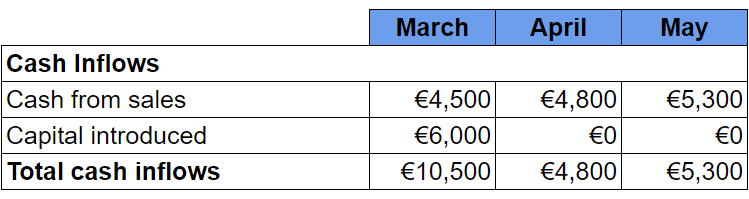
In this instance, the business expects to receive cash inflows from sales in March, April and May
Owners' capital of €6,000 will be introduced in March
The total for each month is calculated by adding cash from sales to capital introduced
Step 2 – Calculate total cash outflows
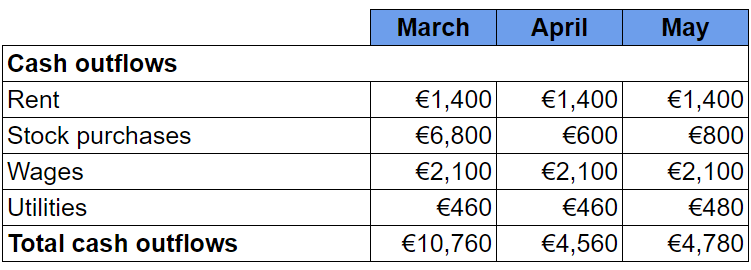
In this instance, the business expects to pay rent of €1,400 in March, April and May
It will purchase a significant amount of stock in March with smaller amounts in April and May
Wages are expected to be €2,100 in each month
Utilities of €460 will be paid in March and April, increasing to €480 in May
Total cash outflows each month is calculated by adding these together
Step 3 – Calculate net cash flows
The net cash flow is calculated by subtracting total cash outflows from total cash inflows
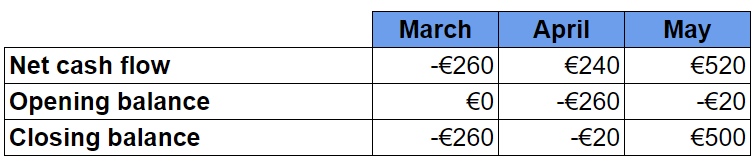
In March the net cash flow is €10,500 - €10,760 = €(260)
Net cash flow is negative as cash outflows are greater than cash inflows
In April the net cash flow is €4,800 - €4,560 = €240
In May the net cash flow is €5,300 - €4,780 = €520
In both months, net cash flow is positive as cash inflows are greater than cash outflows
Step 4 – Calculate opening and closing balances
The opening balance is the previous month’s closing balance carried forward
The closing balance is calculated by adding the net cash flow to the opening balance
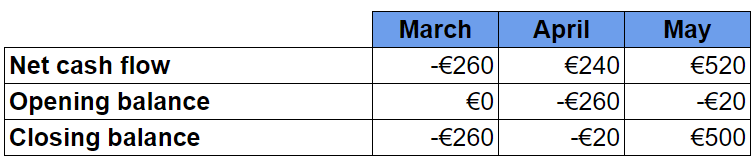
In March the opening balance of €0 is added to the net cash flow of €(260) to leave a closing balance of €(260)
In April the closing balance from March is carried forward to become its opening balance of €(260)
This opening balance is added to April's net cash flow of €240 to leave a closing balance of €(20)
In May the closing balance from April is carried forward to become its opening balance of €(20)
This opening balance is added to May's net cash flow of €520 to leave a closing balance of €500
The complete cash flow forecast
Interpreting cash flow forecasts
Interpreting cash flow forecasts
Once a cash flow forecast has been constructed, managers may be able to use it to make financial decisions
Overall, this cash flow forecast supports an application for the business to borrow £6,000 in March to cover the initial low inflows, significant outflows and negative net cash flow
It may also arrange a short-term overdraft to cover negative closing balances in March and April
Healthy sales mean that from May, inflows are greater than outflows and the business has a positive net cash flow
Overcoming cash flow problems
Overcoming cash flow problems
The cash flow forecast example above identifies a cash flow problem in March and April where the closing balance is negative
It has a range of ways to solve this issue to prevent insolvency
The most suitable method may be to arrange a flexible, short-term overdraft facility with its bank
Ways to solve cash flow problems
Method | Explanation |
|---|---|
Reduce the credit period offered to customers |
|
Ask suppliers for an extended repayment period e.g an extension from 60 to 90 days |
|
Make use of overdraft facilities or short-term loans |
|
Sell off excess stock |
|
Sell assets and lease fixed assets instead |
|
Introduce new capital and reduce drawings from the business |
|
A business can also have too much cash
If it holds large amounts of cash, it may miss out on the benefits of investing it in fixed assets or savings
This may represent a significant opportunity cost, especially when interest rates are high