Business Cycle
Stages of the business cycle
Stages of the business cycle
The business cycle describes the upturns and downturns in the level of a country’s economic activity (gross domestic product or GDP) over time
Economies do not experience consistent levels of growth over time
The business cycle
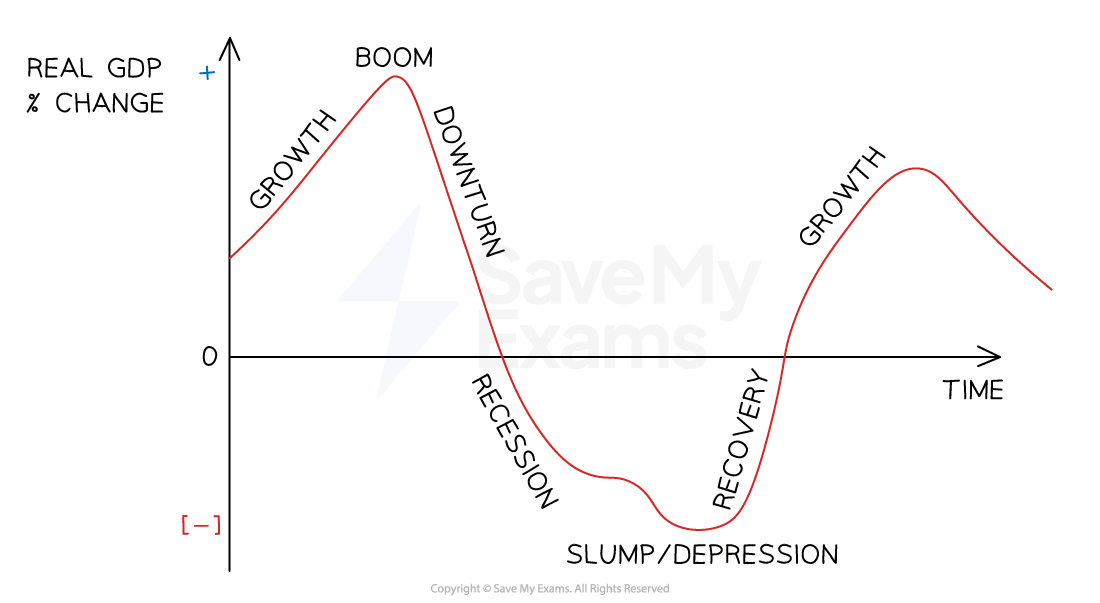
Growth
The growth stage is a period of increasing rates of GDP growth
Disposable income levels rise and lead to increased demand for products
This drives an increase in production levels, which leads to a rise in employment levels
Businesses look to expand and increase profit
Boom
A boom is a period of time when an economy experiences an extended period of increasing rates of GDP growth
Consumer incomes and business profits are high
Inflation is also high due to higher demand for goods and services
Unemployment levels are low and wages are high due to a shortage of skilled workers
Recession
A recession occurs when an economy experiences two consecutive quarters (6 months) or more of negative GDP growth
Incomes and consumer demand fall, leading to reduced output
Consumer and business confidence tend to be low
Business profits fall and unemployment rises
Slump
A slump is an extended period of negative GDP growth
Unemployment is likely to be high as a result of high levels of business failure
Significant declines in household incomes and business profits
Increased government spending on welfare benefits and infrastructure projects to inject demand into the economy may benefit some businesses
The impact of the business cycle on business
The impact of the business cycle on business
Businesses must adapt their strategies at each stage of the cycle
For example, cutting costs in a recession or investing in growth during a boom
Impacts at each stage of the business cycle
Stage of business cycle | Impact on business | Example |
|---|---|---|
Growth |
|
|
Boom |
|
|
Recession |
|
|
Slump |
|
|
Effects of employment, inflation, and economic growth on a business
Effects of employment, inflation, and economic growth on a business
1. Employment Levels
Slump and recession (low employment/high unemployment)
Many people out of work → consumer demand falls, especially for non-essential goods
Easier and cheaper to recruit staff (wages lower, labour supply higher)
Risk of low staff motivation and morale if job insecurity is high
Boom and growth (high employment/low unemployment)
More people in work → consumer demand and sales rise
Harder to recruit staff (skills shortages, competition)
Wages may rise, increasing business costs
2. Inflation
Slump and recession (low inflation or even deflation)
Falling prices may encourage consumers to delay spending, reducing sales
Lower inflation = more stable costs, easier planning for businesses
Risk of squeezed revenue if prices cannot be maintained
Boom and growth (higher inflation likely)
Rising costs of raw materials and wages reduce profit margins
Businesses may need to raise prices, but risk losing customers
Uncertainty in pricing makes planning and forecasting difficult
3. Economic Growth
Slump and recession (low/negative growth)
Consumer incomes fall → lower demand, especially for luxury or non-essential goods
Businesses may cut investment, delay expansion, or make redundancies
Some opportunities for “inferior goods” (low-cost options) as consumers switch to cheaper products
Boom and growth (high/positive growth)
Rising incomes → strong demand for goods and services
More opportunities to expand, innovate, and increase profits
Risk of higher costs (wages, rent, raw materials) as demand outstrips supply