Effects of Government Policy
Introduction to government policy
Introduction to government policy
Most governments pursue similar objectives for their national economies
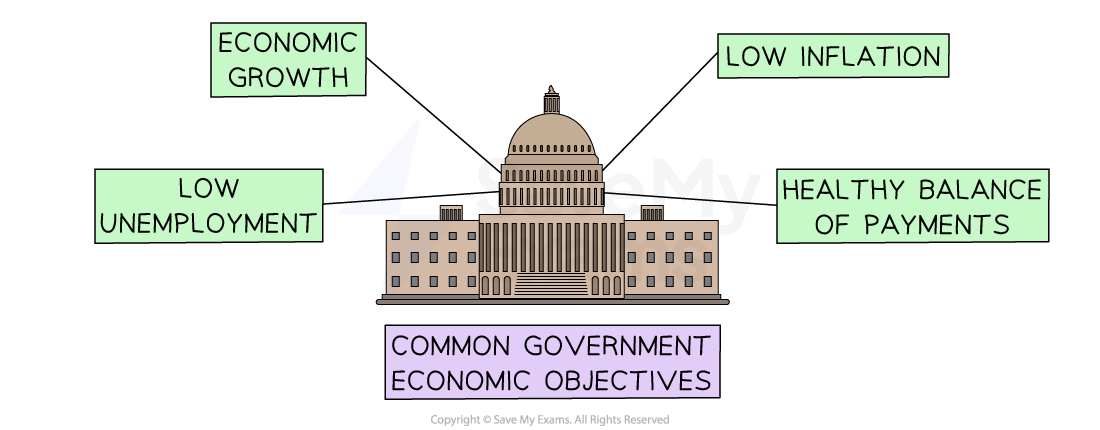
1. Positive economic growth
Positive economic growth is the increase in the value of goods and services produced per head of population over a period of time
The standard of living of the population is likely to increase with GDP growth
As output is rising, more workers are needed, and high levels of employment are achieved
Households can afford to buy more goods and services as most people become richer
Business owners expand their business as people have more money to spend on their products and revenue rises
2. Low levels of inflation
Inflation refers to a general increase in prices and fall in the purchasing value of money over time
Both the UK and US governments set their Central Bank an inflation target of 2%
Central Banks have a range of tools they can use to achieve this target, such as base rates and quantitative easing
3. Low levels of unemployment
Unemployment refers to the number of people without a job who are actively seeking and available for work
Low unemployment increases national output, improves workers’ living standards and reduces government spending on welfare benefits
4. A healthy balance of payments
The balance of payments is the relationship between the value of imports and exports over a period of time
Exports bring foreign currency in to an economy, whilst imports lead to currency flowing out of it
If a balance of payments deficit occurs
The country could run out of foreign currency and it may have to resort to expensive borrowing from abroad
The exchange rate (the price of one country’s currency against another) is likely to fall
Effects of changes in taxes
Effects of changes in taxes
Government decisions on taxation, spending, and interest rates have a major impact on businesses. These policies affect both costs and customer demand, and businesses must adapt their strategies to survive and grow
Effect on business profits
Higher business taxes (e.g. corporation tax):
Reduces the share of profit a business keeps
There is less money available for reinvestment, expansion, or dividends
Why? Because more of the profit is paid to the government
Lower business taxes:
Increases retained profit
Businesses can invest more or reward shareholders
Why? Because the business gives less of its earnings to the government
Effect on people’s income
Higher income tax:
Consumers keep less of their wages
There is less disposable income, and demand for goods and services falls
Why? Because more of people’s pay goes straight to the government
Lower income tax:
Consumers keep more of their wages
There is more disposable income, and spending rises, especially on non-essential goods
Why? Because less is deducted from their earnings, leaving more to spend
Effects of changes in government spending
Effects of changes in government spending
Increased government spending:
Creates new demand for goods and services, for example, contracts for construction firms
It also improves infrastructure like roads, education, and healthcare, which helps businesses operate more efficiently
Why? Because the government is injecting money into the economy, creating jobs and income that flow to businesses
Reduced government spending (austerity):
Leads to fewer contracts for firms and lower consumer spending
Public services may weaken, which can harm the workforce or raise costs for firms
Why? Because less government money is being spent, which slows down the economy
Business responses to changes in government spending
Government policy change | Business response | Why? |
|---|---|---|
Government spending rises |
|
|
Government spending falls |
|
|
Effects of changes in interest rates
Effects of changes in interest rates
The interest rate is the cost of borrowing money and the reward for saving
Higher interest rates
Businesses face higher costs on loans, so they are less likely to borrow for growth
Consumers also pay more on credit cards or mortgages, so they have less disposable income and reduce spending
Why? Because interest is the price of borrowing money, and when it rises, both businesses and households borrow less
Implications of rising interest rates
Implication | Explanation |
|---|---|
Higher repayments |
|
Fall in exports |
|
Credit sales fall |
|
Savings become more attractive than investment |
|
Lower interest rates
Borrowing becomes cheaper, so businesses are more likely to invest and expand
Consumers also borrow and spend more, which increases demand
Why? Because lower interest makes loans and credit more affordable, encouraging spending
Business responses to changes in taxes and interest rates
Business responses to changes in taxes and interest rates
Businesses need to respond appropriately to changes in government policy
Long- and short-term consequences of decisions needs to be balanced
The responses of different stakeholder groups should be carefully considered
Individual business circumstances may mean that even the closest of competitors respond in different ways
Typical business responses
Government policy change | Business response | Why? |
|---|---|---|
Taxes rise |
|
|
Taxes fall |
|
|
Interest rates rise |
|
|
Interest rates fall |
|
|