Causes & Consequences of Recession
Causes of recessions
Causes of recessions
A recession is a period of at least six months (2 quarters) of economic decline which causes a decrease in the real gross domestic product (rGDP)
It can be caused by:
A fall in any of the factors that influence total demand (consumption, investment, government spending, net exports). These are demand-side factors
A decrease in the quantity of resources (supply-side factor)
A decrease in the quality of resources (supply-side factor)
1. Decrease in total demand (demand-side recession)
A fall in total demand is caused by a fall in Consumption (C), Investment (I), Government spending (G), or Net exports (X–M)
Some examples of what may cause this include:
Higher interest rates reduce borrowing and spending
Falling consumer confidence leads to less household consumption
Exports fall due to a global slowdown or stronger exchange rate
A demand-side recession leads to lower output and rising unemployment
2. Decrease in the quantity of resources (supply-side)
This is caused by a reduction in the available factors of production
Some examples of what may cause this include:
Emigration reduces labour supply
Natural disasters destroy productive land or capital
Conflict or political instability disrupts production
A reduction in the quantity of resources reduces the ability of the economy to produce goods and services
3. Decrease in the quality of resources (supply-side)
This occurs when there is a lower productivity or efficiency in the use of existing resources
Some examples of what may cause this include:
Skills shortages due to underinvestment in education and training
An ageing or unhealthy population reduces workforce effectiveness
The poor maintenance of infrastructure slows down production
A reduction on the quality of the factors of production causes long-term declines in productive capacity
The economic decline (recession) caused by supply-side interruptions can be illustrated using a production possibility curve (PPC)
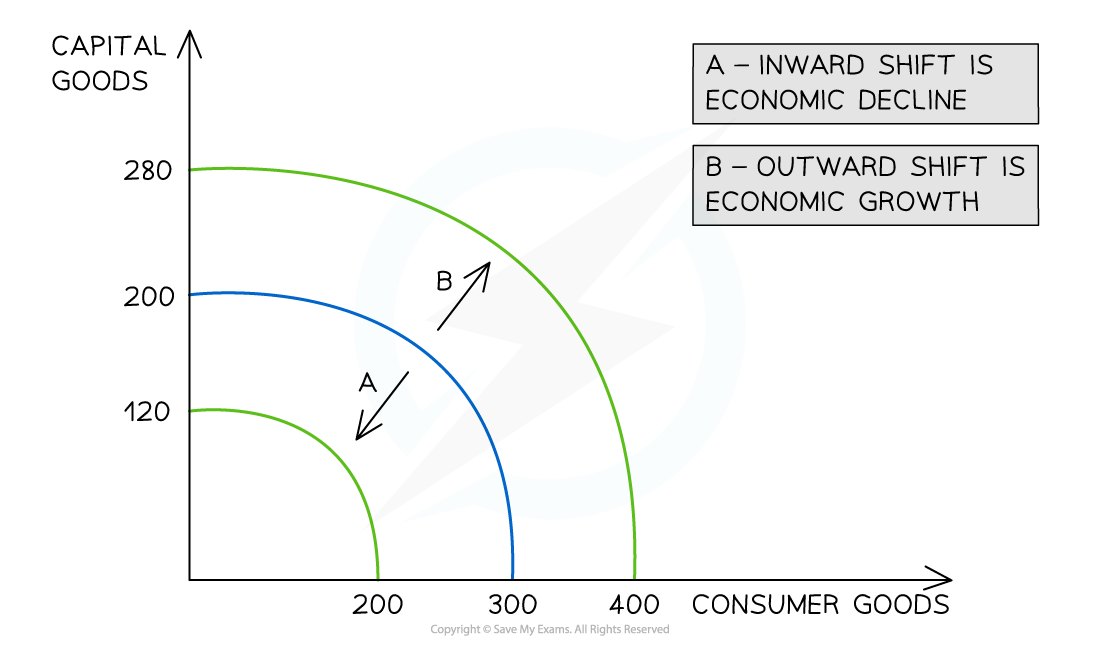
Diagram explanation
Recession (economic decline) occurs when there is any impact on an economy that reduces the quantity or quality of the available factors of production as depicted by the movement A
E.g. The Japanese tsunami of 2011 devastated the production possibilities of Japan for many years. It shifted their PPC inwards, causing economic decline
Consequences of recessions
Consequences of recessions
A recession affects different economic agents in distinct ways, but the main connection is that falling output and incomes reduce spending power, confidence, and investment
Impact on consumers and workers
Consumers | Workers |
|---|---|
|
|
|
|
|
|
|
|
|
|
|
|
|
|
Impact on firms and governments
Firms | Governments |
|---|---|
|
|
|
|
|
|
|
|
|
|
|
|
|
|