Causes & Consequences of Growth
Causes of Economic Growth
Causes of Economic Growth
1. Growth caused by a change in total demand
Actual economic growth occurs when there is an increase in the quantity of goods/services produced in an economy in a given period of time
This is often measured by the percentage change in real gross domestic product (GDP)
If any component of real GDP increases (consumption, investment, government spending, net exports), there will be an increase in total demand

Any movement from Point E towards the PPC boundary represents actual economic growth and is caused by an increase in output (rGDP)
Diagram explanation
Previously unused factors of production are now being employed
This is demonstrated by a shift from inside the production possibilities curve (PPC) such as Point E, towards the boundary of the PPC
At any given point in time, the actual economic growth may be less than the potential growth available to the economy
2. Growth caused by a change in the quantity/quality of factors of production
Potential growth is the increase in the productive potential of an economy
This occurs when there is an increase in the quantity or quality of the factors of production available in an economy
One example of how the quality of a factor of production can be improved is through the impact of training and education on labour. An educated workforce is a more productive workforce and the production possibilities increase
One example of how the quantity of a factor of production can be increased is through a change in migration policies. If an economy allows more foreign workers to work productively in the economy, then the production possibilities increase
Investing in new capital machinery increases the quality of capital
Investing in new technology results in an improvement to productivity
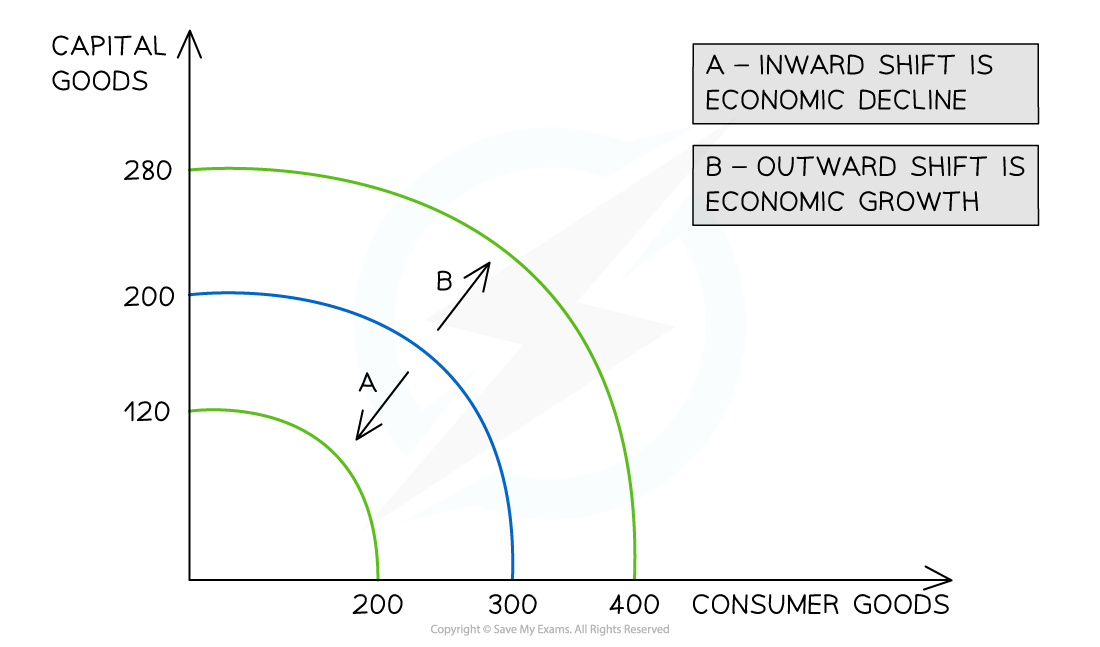
Diagram explanation
Economic growth occurs when there is an increase in the productive potential of an economy
This is demonstrated by an outward shift of the entire curve represented by A
More consumer goods and more capital goods can now be produced using all of the available resources
The Consequences of Economic Growth
The Consequences of Economic Growth
Economic growth is considered to be the main contributor to an improvement in the standards of living
Due to the negative aspects of economic growth, there is much controversy about maintaining it as a central macroeconomic aim
Instead, arguments for a focus on societal well-being are gaining traction
A Table Summarising the Benefits and Costs of Economic Growth
Benefits of Economic Growth | Costs of Economic Growth |
|---|---|
|
|
|
|
|
|
|
|
|
|
|
|
|
|
|
|