Kinematics Toolkit
Displacement, Velocity & Acceleration
Displacement, velocity & acceleration
What is kinematics?
Kinematics is the branch of mathematics that models and analyses the motion of objects
Common words such as distance, speed and acceleration are used in kinematics but are used according to their technical definition
What definitions do I need to be aware of?
Firstly, only motion of an object in a straight line is considered
this could be a horizontal straight line
the positive direction would be to the right
or this could be a vertical straight line
the positive direction would be upwards
Particle
A particle is the general term for an object
some questions may use a specific object such as a car or a ball
Time seconds
Displacement, velocity and acceleration are all functions of time
Initially time is zero
Displacement m
The displacement of a particle is its distance relative to a fixed point
the fixed point is often (but not always) the particle’s initial position
Displacement will be zero if the object is at or has returned to its initial position
Displacement will be negative if its position relative to the fixed point is in the negative direction (left or down)
Distance m
Use of the word distance needs to be considered carefully and could refer to
the distance travelled by a particle
the (straight line) distance the particle is from a particular point
Be careful not to confuse displacement with distance
if a bus route starts and ends at a bus depot, when the bus has returned to the depot, its displacement will be zero but the distance the bus has travelled will be the length of the route
Distance is always positive
Velocity m s-1
The velocity of a particle is the rate of change of its displacement at time
Velocity will be negative if the particle is moving in the negative direction
A velocity of zero means the particle is stationary
Speed m s-1
Speed is the magnitude (a.k.a. absolute value or modulus) of velocity
as the particle is moving in a straight line, speed is the velocity ignoring the direction
if
if
Acceleration m s-2
The acceleration of a particle is the rate of change of its velocity at time
Acceleration can be negative but this alone cannot fully describe the particle’s motion
if velocity and acceleration have the same sign the particle is accelerating (speeding up)
if velocity and acceleration have different signs then the particle is decelerating (slowing down)
if acceleration is zero the particle is moving with constant velocity
in all cases the direction of motion is determined by the sign of velocity
Are there any other words or phrases in kinematics I should know?
Certain words and phrases can imply values or directions in kinematics
a particle described as “at rest” means that its velocity is zero,
a particle described as moving “due east” or “right” or would be moving in the positive horizontal direction
this also means that
a particle “dropped from the top of a cliff” or “down” would be moving in the negative vertical direction
this also means that
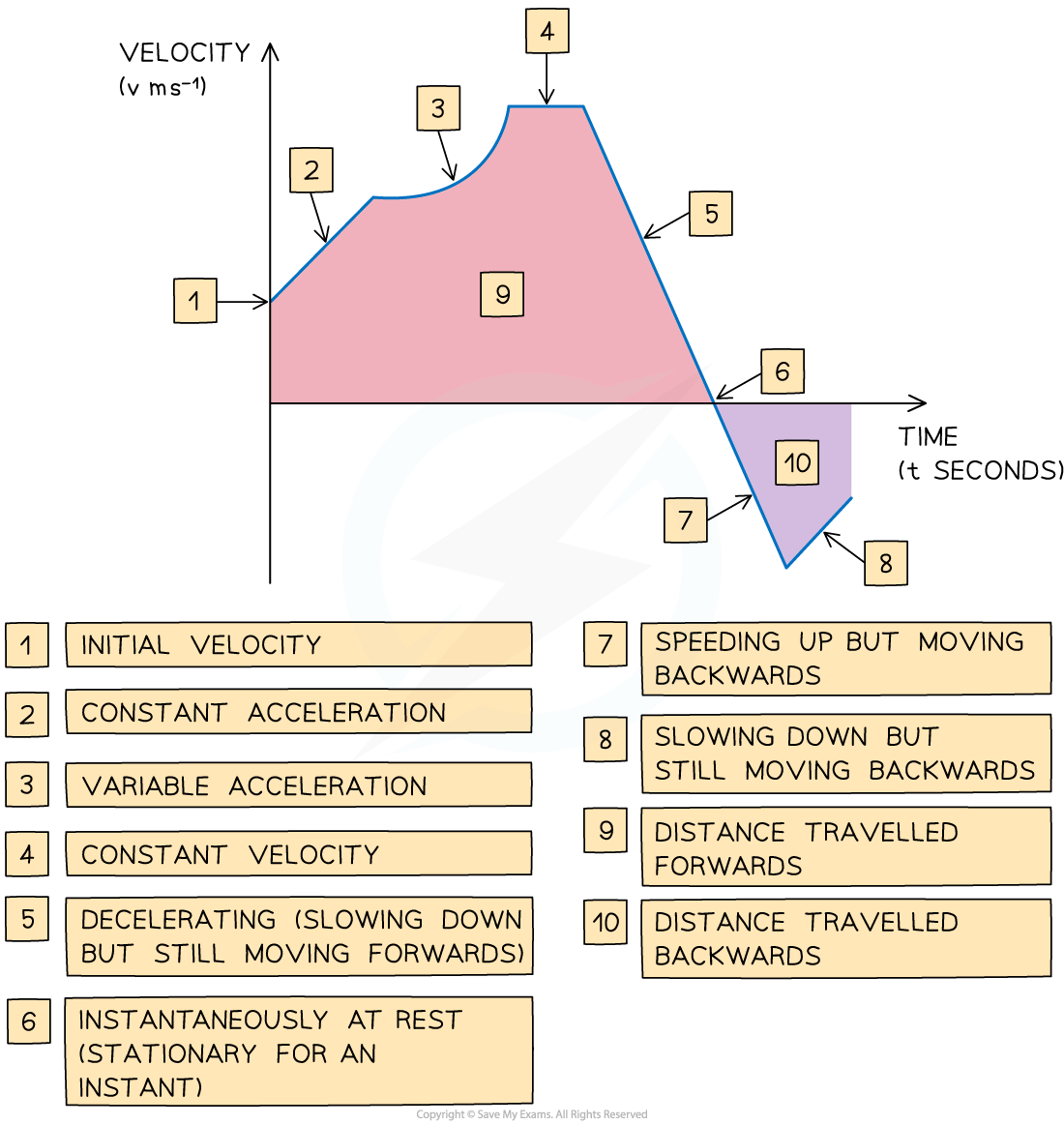
What are the key features of a velocity-time graph?
The gradient of the graph equals the acceleration of an object
A straight line shows that the object is accelerating at a constant rate
A horizontal line shows that the object is moving at a constant velocity
Graph above the x-axis means the object is moving forwards
Graph below the x-axis means the object is moving backwards
The area between graph and the x-axis tells us the change in displacement of the object
The total displacement of the object from its starting point is the sum of the areas above the x-axis minus the sum of the areas below the x-axis
The total distance travelled by the object is the sum of all the areas
If the graph touches the x-axis then the object is stationary at that time
If the graph is above the x-axis then the object has positive velocity and is travelling forwards
If the graph is below the x-axis then the object has negative velocity and is travelling backwards