StudyDeck

Introduction to Differentiation

Exam code: 4037
Written by: Ashika|Reviewed by: Caroline Carroll|Updated 2 July 2026

Definition of Gradientvideo

Definition of Gradient

Definition of gradient

What is the gradient of a curve?

  • At a given point the gradient of a curve is defined as the gradient of the tangent to the curve at that point

  • A tangent to a curve is a line that just touches the curve at one point but doesn't cut the curve at that point
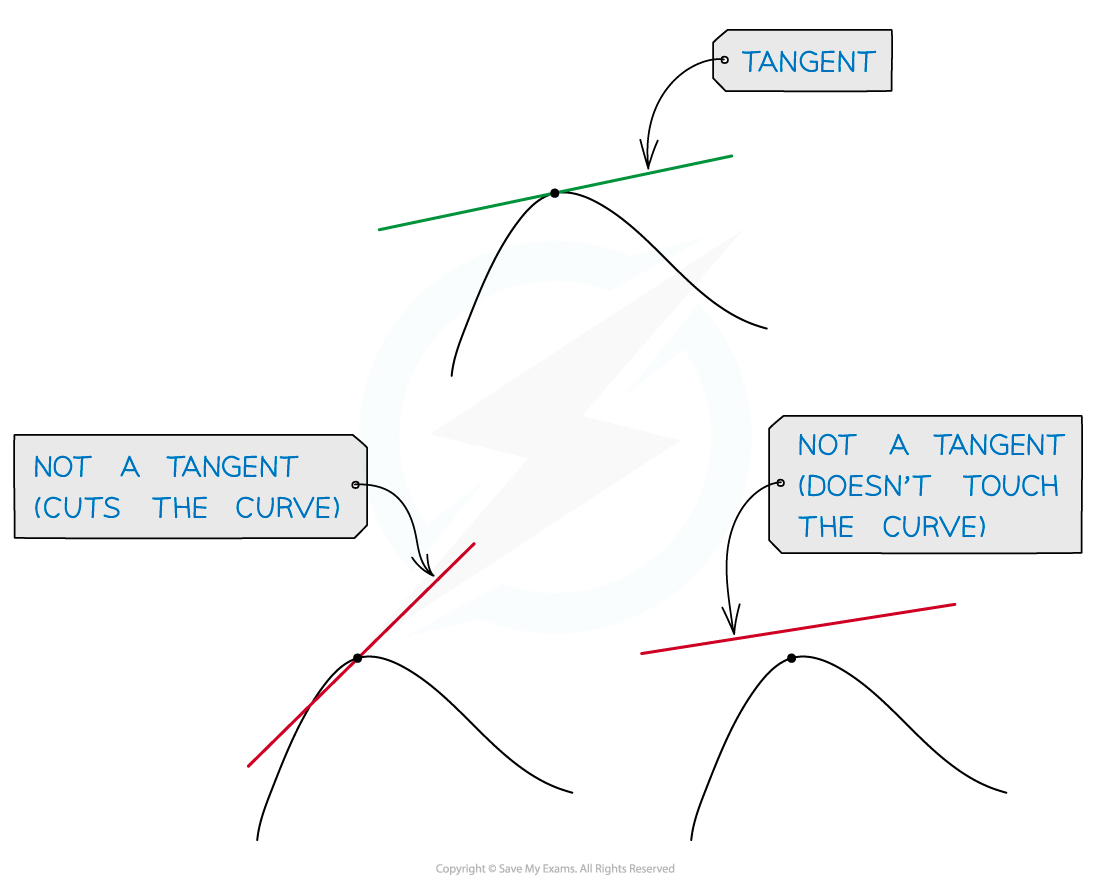
Def Grad Illustr 1, A Level & AS Maths: Pure revision notes
  • A tangent may cut the curve somewhere else on the curve
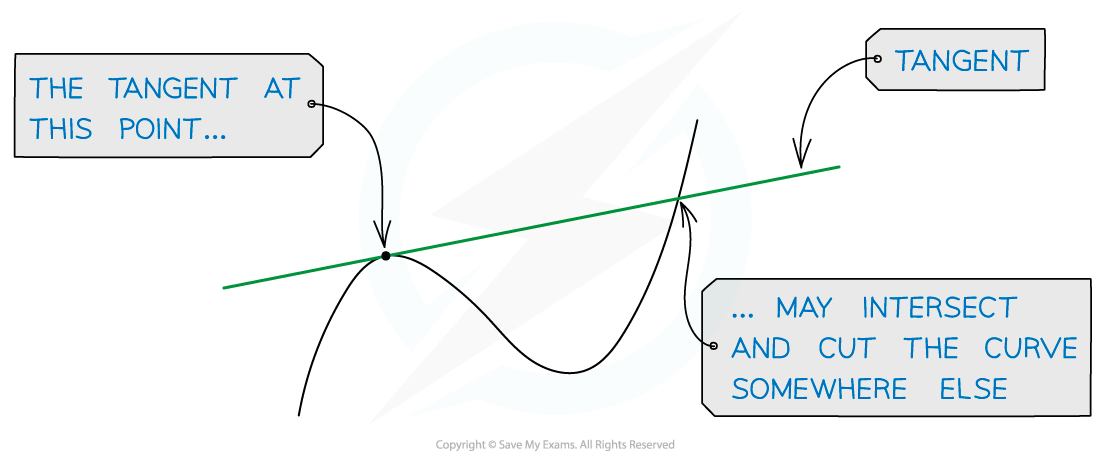
Def Grad Illustr 2, A Level & AS Maths: Pure revision notes
  • It is only possible to draw one tangent to a curve at any given point

  • Note that unlike the gradient of a straight line, the gradient of a curve is constantly changing

Definition of Derivatives

Definition of derivatives

What is a derivative?

  • Calculus is about rates of change

    • the way a car’s position on a road changes is its speed (velocity)

    • the way the car’s speed changes is its acceleration

  • The gradient (rate of change) of a (non-linear) function varies with x{"language":"en","fontFamily":"Times New Roman","fontSize":"18"}

  • The derivative of a function is a function that relates the gradient to the value of x{"language":"en","fontFamily":"Times New Roman","fontSize":"18"}

    • For example, the derivative of  y=x2{"language":"en","fontFamily":"Times New Roman","fontSize":"18","autoformat":true}  is  2x{"language":"en","fontFamily":"Times New Roman","fontSize":"18","autoformat":true}

      • This means that when x=1{"language":"en","fontFamily":"Times New Roman","fontSize":"18","autoformat":true}, the gradient of y=x2{"language":"en","fontFamily":"Times New Roman","fontSize":"18","autoformat":true}  is  21=2{"language":"en","fontFamily":"Times New Roman","fontSize":"18","autoformat":true}

      • And when x=5{"language":"en","fontFamily":"Times New Roman","fontSize":"18","autoformat":true}, the gradient of y=x2{"language":"en","fontFamily":"Times New Roman","fontSize":"18","autoformat":true}  is  25=10{"language":"en","fontFamily":"Times New Roman","fontSize":"18","autoformat":true}

  • The derivative is also called the gradient function

Differentiating Powers of xvideo

Differentiating Powers of x

Differentiating powers of x

What is differentiation?

  • Differentiation is the process of finding an expression for the derivative (gradient function) from the equation of a curve

    • The equation of the curve is written y=...{"language":"en","fontFamily":"Times New Roman","fontSize":"18","autoformat":true} and the gradient function is written dydx=...{"language":"en","fontFamily":"Times New Roman","fontSize":"18","autoformat":true}

How do I differentiate powers of x?

  • Powers of x{"language":"en","fontFamily":"Times New Roman","fontSize":"18","autoformat":true} are differentiated according to the following formula:

    • If y=axn{"language":"en","fontFamily":"Times New Roman","fontSize":"18"} then dydx=anxn-1{"language":"en","fontFamily":"Times New Roman","fontSize":"18"}

      • e.g.  If y=4x3{"language":"en","fontFamily":"Times New Roman","fontSize":"18","autoformat":true} then dydx=4×3×x3-1=12x2{"language":"en","fontFamily":"Times New Roman","fontSize":"18","autoformat":true}

      • you "bring down the power" then "subtract one from the power"

  • Don't forget these two special cases:

    • If y=ax{"language":"en","fontFamily":"Times New Roman","fontSize":"18","autoformat":true} thendydx=a{"language":"en","fontFamily":"Times New Roman","fontSize":"18","autoformat":true}

      • e.g.  If y=6x{"language":"en","fontFamily":"Times New Roman","fontSize":"18"} then dydx=6{"language":"en","fontFamily":"Times New Roman","fontSize":"18"}

    • If y=a{"language":"en","fontFamily":"Times New Roman","fontSize":"18","autoformat":true} thendydx=0{"language":"en","fontFamily":"Times New Roman","fontSize":"18","autoformat":true}

      • e.g.  If y=5{"language":"en","fontFamily":"Times New Roman","fontSize":"18"} then dydx=0{"language":"en","fontFamily":"Times New Roman","fontSize":"18"}

    • These allow you to differentiate linear terms in x{"language":"en","fontFamily":"Times New Roman","fontSize":"18"} and constants

  • Functions involving fractions with denominators in terms of x{"language":"en","fontFamily":"Times New Roman","fontSize":"18"} will need to be rewritten as negative powers of x{"language":"en","fontFamily":"Times New Roman","fontSize":"18"} first

    • e.g.  If y=4x{"language":"en","fontFamily":"Times New Roman","fontSize":"18","autoformat":true} then rewrite as y=4x-1{"language":"en","fontFamily":"Times New Roman","fontSize":"18","autoformat":true} and differentiate

How do I differentiate sums and differences of powers of x?

  •  The formulae for differentiating powers of x{"language":"en","fontFamily":"Times New Roman","fontSize":"18"} work for a sum or difference of powers of x{"language":"en","fontFamily":"Times New Roman","fontSize":"18"}

    • e.g.  If y=5x4+3x-2+4{"language":"en","fontFamily":"Times New Roman","fontSize":"18","autoformat":true} then dydx=5×4x4-1+3×-2x-2-1+0{"language":"en","fontFamily":"Times New Roman","fontSize":"18","autoformat":true} dydx=20x3-6x-3{"language":"en","fontFamily":"Times New Roman","fontSize":"18","autoformat":true}

    • This is sometimes referred to differentiating 'term-by-term'

  • Products and quotients (divisions) cannot be differentiated in this way so they need expanding/simplifying first

    • e.g.  If y=(2x-3)(x2-4){"language":"en","fontFamily":"Times New Roman","fontSize":"18","autoformat":true} then expand to y=2x3-3x2-8x+12{"language":"en","fontFamily":"Times New Roman","fontSize":"18","autoformat":true} which is a sum/difference of powers of x{"language":"en","fontFamily":"Times New Roman","fontSize":"18"} and can then be differentiated

What can I do with derivatives (gradient functions)?

  • The derivative can be used to find the gradient of a function at any point

    • The gradient of a function at a point is equal to the gradient of the tangent to the curve at that point

    • A question may refer to the gradient of the tangent