StudyDeck

Applications of Differentiation

Exam code: 4037
Written by: Ashika|Reviewed by: Caroline Carroll|Updated 2 July 2026

Finding Gradients

Finding gradients

How do I use the derivative to find the gradient of a curve?

  • The gradient of a curve at a point is the gradient of the tangent to the curve at that point

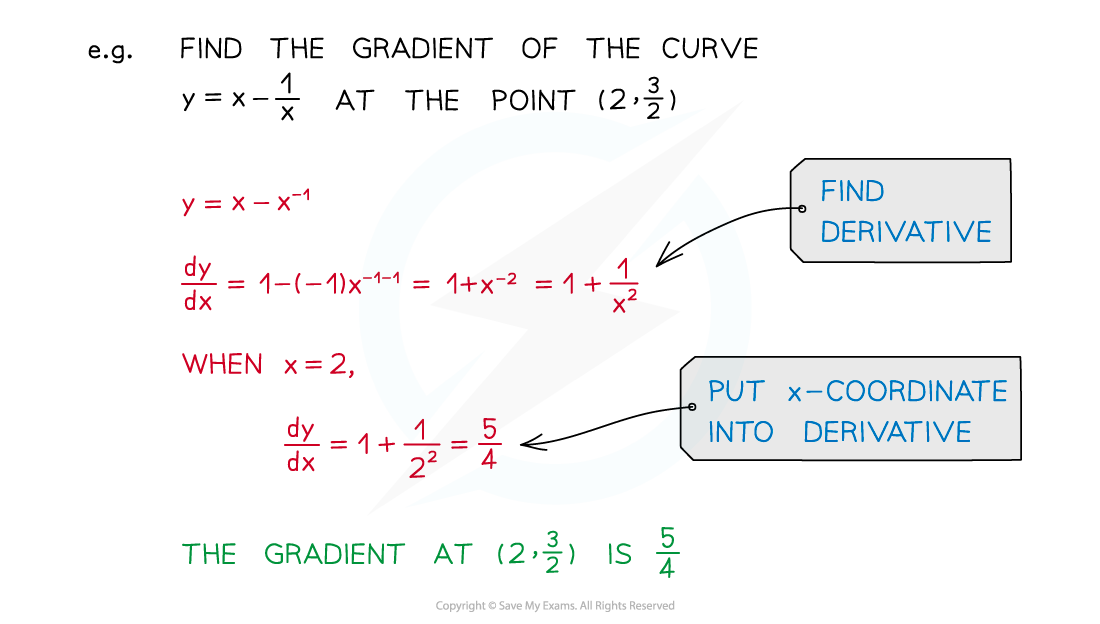
  • To find the gradient of a curve, at any point on the curve

    • differentiate to find dydx{"language":"en","fontFamily":"Times New Roman","fontSize":"18","autoformat":true} (unless dydx{"language":"en","fontFamily":"Times New Roman","fontSize":"18","autoformat":true}is already known)

    • substitute the x‑coordinate of the point into the derivative dydx{"language":"en","fontFamily":"Times New Roman","fontSize":"18","autoformat":true} and evaluate

Grad Tang Norm Illustr 1, A Level & AS Maths: Pure revision notes

How do I find the approximate change in y as x increases?

  • gradient=change in ychange in x{"language":"en","fontFamily":"Times New Roman","fontSize":"18","autoformat":true}so, for small changes you can write 

    • change in y=gradient × change in x{"language":"en","fontFamily":"Times New Roman","fontSize":"18","autoformat":true}

  • For example, if the gradient of y=x-1x{"language":"en","fontFamily":"Times New Roman","fontSize":"18","autoformat":true} at x=2{"language":"en","fontFamily":"Times New Roman","fontSize":"18","autoformat":true} is 54{"language":"en","fontFamily":"Times New Roman","fontSize":"18","autoformat":true} 

    • what is the approximate change in y{"language":"en","fontFamily":"Times New Roman","fontSize":"18","autoformat":true} as x{"language":"en","fontFamily":"Times New Roman","fontSize":"18","autoformat":true} increases from 2{"language":"en","fontFamily":"Times New Roman","fontSize":"18","autoformat":true} to 2+h{"language":"en","fontFamily":"Times New Roman","fontSize":"18","autoformat":true}, where h{"language":"en","fontFamily":"Times New Roman","fontSize":"18","autoformat":true} is small?

      • change in y=gradient × change in x=54h{"language":"en","fontFamily":"Times New Roman","fontSize":"18","autoformat":true} 

Increasing & Decreasing Functionsvideo

Increasing & Decreasing Functions

Increasing & decreasing functions

What are increasing and decreasing functions?

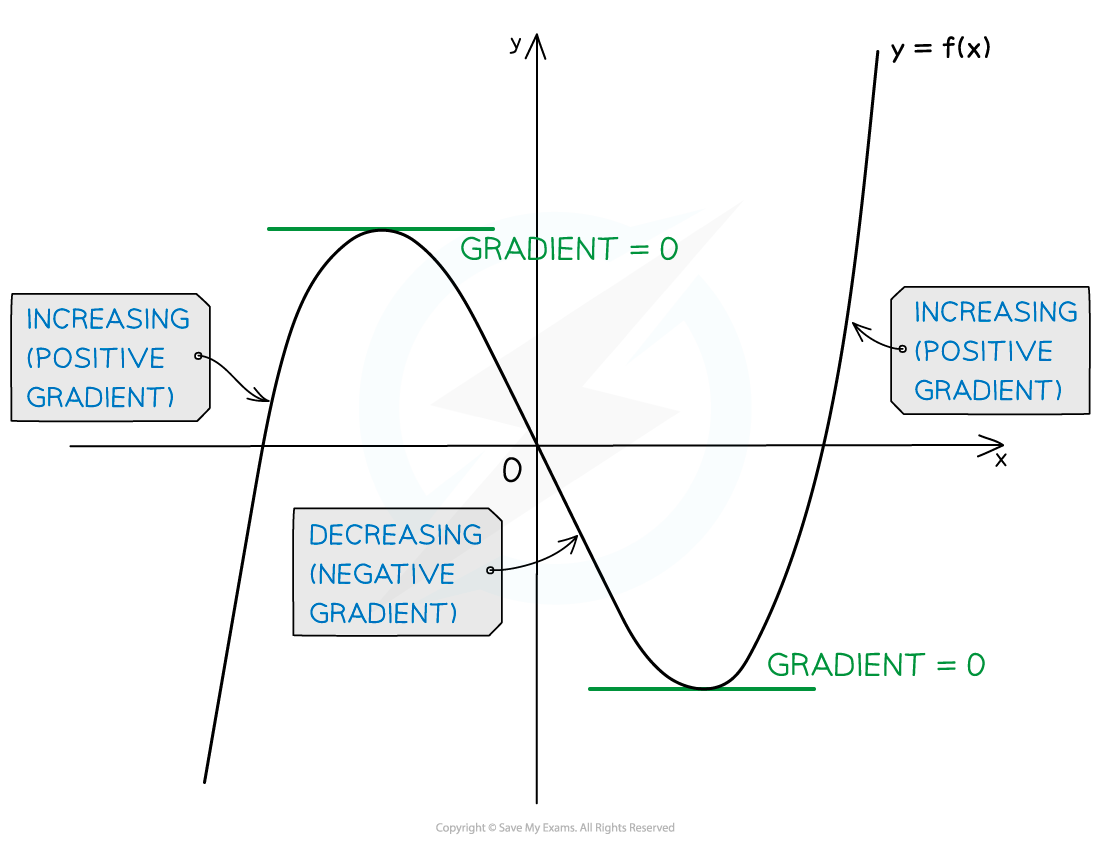
  • A function is increasing when dydx>0{"language":"en","fontFamily":"Times New Roman","fontSize":"18","autoformat":true} (the gradient is positive)

    • This means graph of a function goes up as x{"language":"en","fontFamily":"Times New Roman","fontSize":"18","autoformat":true} increases

  • A function is decreasing when dydx<0{"language":"en","fontFamily":"Times New Roman","fontSize":"18","autoformat":true} (the gradient is negative)

    • This means graph of a function goes down as x{"language":"en","fontFamily":"Times New Roman","fontSize":"18","autoformat":true} increases


Incr Decr Illustr 1, A Level & AS Maths: Pure revision notes


How do I find where functions are increasing or decreasing?

  • To identify the intervals on which a function is increasing or decreasing 

STEP 1

Find the derivative f'(x)

STEP 2

Solve the inequalities

 f'(x)>0{"language":"en","fontFamily":"Times New Roman","fontSize":"18"} (for increasing intervals) and/or

 f'(x)<0{"language":"en","fontFamily":"Times New Roman","fontSize":"18"} (for decreasing intervals)

  • Most functions are a combination of increasing, decreasing and stationary

    • a range of values of x{"language":"en","fontFamily":"Times New Roman","fontSize":"18"} (interval) is given where a function satisfies each condition

    • e.g.  The function f(x)=x2{"language":"en","fontFamily":"Times New Roman","fontSize":"18"} has derivative f'(x)=2x{"language":"en","fontFamily":"Times New Roman","fontSize":"18"} so

      •  f(x){"language":"en","fontFamily":"Times New Roman","fontSize":"18"} is decreasing for x<0{"language":"en","fontFamily":"Times New Roman","fontSize":"18"}

      •  f(x){"language":"en","fontFamily":"Times New Roman","fontSize":"18"} is stationary at x=0{"language":"en","fontFamily":"Times New Roman","fontSize":"18"}

      •  f(x){"language":"en","fontFamily":"Times New Roman","fontSize":"18"} is increasing for x>0{"language":"en","fontFamily":"Times New Roman","fontSize":"18"}

  • To identify the intervals (the range of x{"language":"en","fontFamily":"Times New Roman","fontSize":"18","autoformat":true} values) for which a curve is increasing or decreasing you need to:

  1. Find the derivative dydx{"language":"en","fontFamily":"Times New Roman","fontSize":"18","autoformat":true}

  2. Solve the inequalities dydx>0{"language":"en","fontFamily":"Times New Roman","fontSize":"18","autoformat":true} (for increasing intervals) or dydx<0{"language":"en","fontFamily":"Times New Roman","fontSize":"18","autoformat":true} (for decreasing intervals)

Tangents & Normalsvideo

Tangents & Normals

Tangents & normals

What is a tangent?

  • At any point on the graph of a (non-linear) function, the tangent is the straight line that touches the graph at a point without crossing through it

  • Its gradient is given by the derivative function
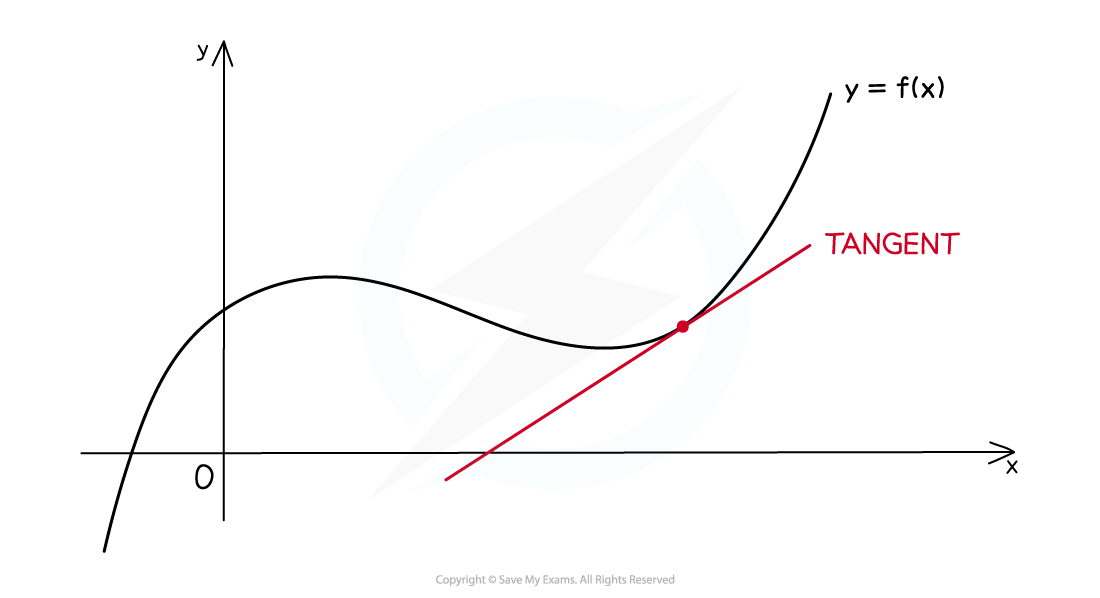
Grad Tang Norm Illustr 2

How do I find the equation of a tangent?

  • To find the equation of a straight line, a point and the gradient are needed

  • The gradient, m{"language":"en","fontFamily":"Times New Roman","fontSize":"18","autoformat":true}, of the tangent to the function y=fx{"language":"en","fontFamily":"Times New Roman","fontSize":"18","autoformat":true} at (x1, y1){"language":"en","fontFamily":"Times New Roman","fontSize":"18","autoformat":true} is f'(x1){"language":"en","fontFamily":"Times New Roman","fontSize":"18","autoformat":true}

    • You can find this by differentiating the function, and then substituting the x{"language":"en","fontFamily":"Times New Roman","fontSize":"18","autoformat":true}-coordinate of the point into the derivative

  • Therefore find the equation of the tangent to the function y=f(x){"language":"en","fontFamily":"Times New Roman","fontSize":"18","autoformat":true} at the point (x1, y1){"language":"en","fontFamily":"Times New Roman","fontSize":"18"} by substituting the gradient, f'x1{"language":"en","fontFamily":"Times New Roman","fontSize":"18","autoformat":true}, and point (x1, y1){"language":"en","fontFamily":"Times New Roman","fontSize":"18","autoformat":true} into y-y1=mx-x1{"language":"en","fontFamily":"Times New Roman","fontSize":"18","autoformat":true}, giving:

    •  y-y1=f'(x1)(x-x1){"language":"en","fontFamily":"Times New Roman","fontSize":"18","autoformat":true}

  • (You could also substitute into y=mx+c{"language":"en","fontFamily":"Times New Roman","fontSize":"18","autoformat":true})

What is a normal?

  • At any point on the graph of a (non-linear) function, the normal is the straight line that passes through that point and is perpendicular to the tangent
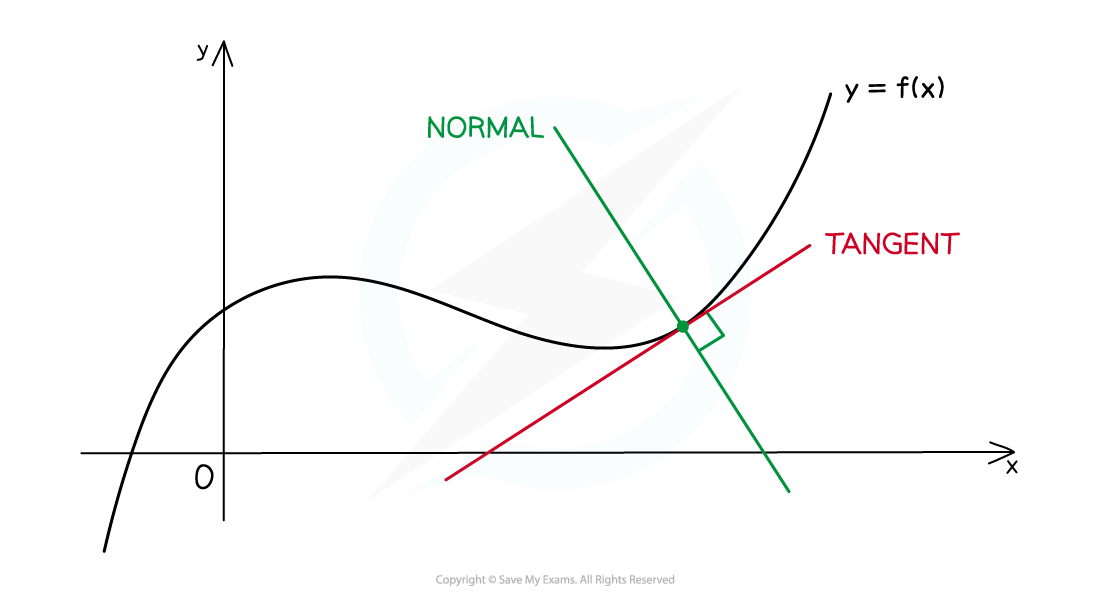
Grad Tang Norm Illustr 3

How do I find the equation of a normal?

  • The gradients of two perpendicular lines are negative reciprocals

    • This means that if m1{"language":"en","fontFamily":"Times New Roman","fontSize":"18","autoformat":true} is the gradient of the first line and m2{"language":"en","fontFamily":"Times New Roman","fontSize":"18","autoformat":true} is the gradient of a line perpendicular to the first line, then m2=-1m1{"language":"en","fontFamily":"Times New Roman","fontSize":"18","autoformat":true}

    • Rearranging the formula above, m1×m2=-1{"language":"en","fontFamily":"Times New Roman","fontSize":"18","autoformat":true} is a useful way to test whether two lines are perpendicular

  • Therefore gradient of the normal to the function y=fx{"language":"en","fontFamily":"Times New Roman","fontSize":"18","autoformat":true}at (x1, y1){"language":"en","fontFamily":"Times New Roman","fontSize":"18","autoformat":true} is -1f'(x1){"language":"en","fontFamily":"Times New Roman","fontSize":"18","autoformat":true}

  • Find the equation of the normal to the function y=f(x){"language":"en","fontFamily":"Times New Roman","fontSize":"18","autoformat":true} at the point (x1, y1){"language":"en","fontFamily":"Times New Roman","fontSize":"18"} by using y-y1=-1f'(x1)(x-x1){"language":"en","fontFamily":"Times New Roman","fontSize":"18","autoformat":true}

    • (or y=-1f'x1x+c{"language":"en","fontFamily":"Times New Roman","fontSize":"18","autoformat":true})