Second Order Derivatives
Second Order Derivativesvideo
Second order derivatives
What is the second order derivative of a function?
If you differentiate the derivative of a function (i.e. differentiate the function a second time) you get the second order derivative of the function
The second order derivative can be referred to simply as the second derivative
We can write the second derivative as
Note the position of the powers of 2
differentiating twice (so) with respect to twice (so)
A first derivative is the rate of change of a function (the gradient)
a second order derivative is the rate of change of the rate of change of a function
i.e. the rate of change of the function’s gradient
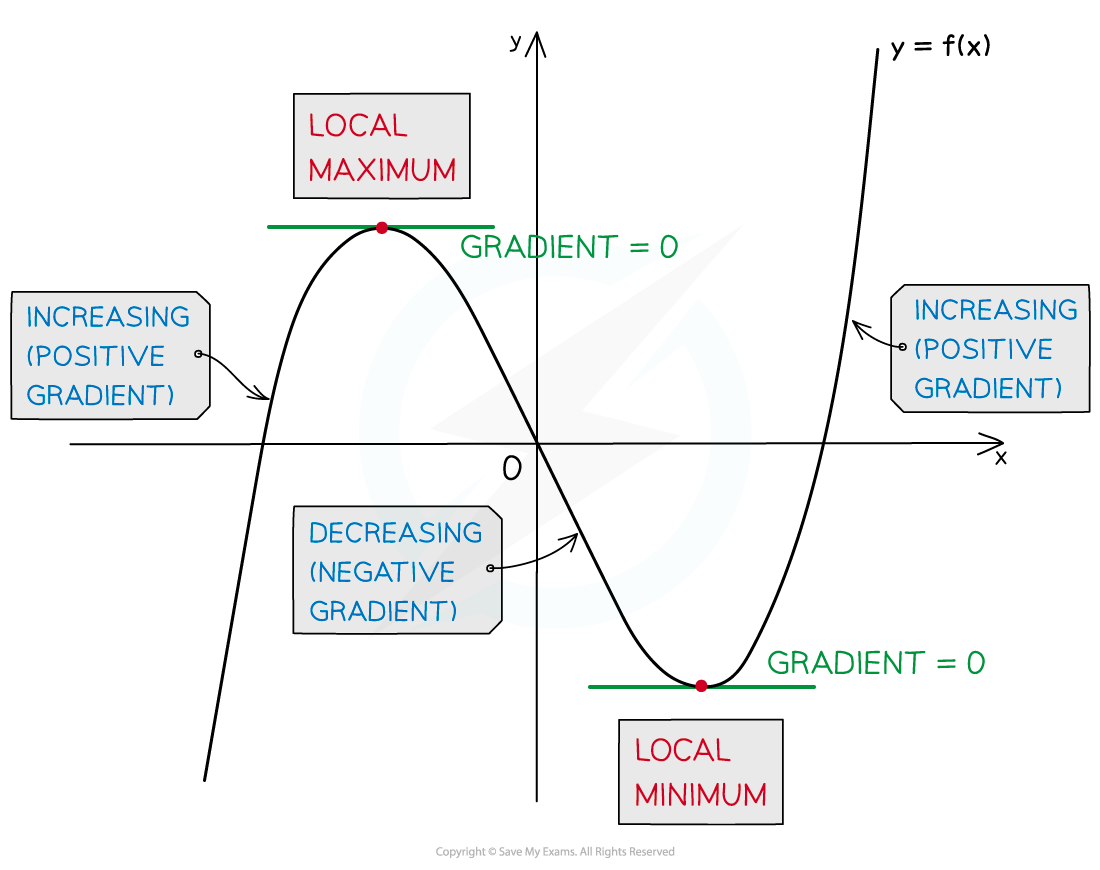
A positive second derivative means the gradient is increasing
For instance in a u-shape, the gradient is changing from negative to positive
A negative second derivative means the gradient is decreasing
For instance in an n-shape, the gradient is changing from positive to negative
Second order derivatives can be used to test whether a point is a minimum or maximum
To find a second derivative, you simply differentiate twice!
It is important to write down your working with the correct notation, so you know what each expression means
For example
Stationary Points & Turning Pointsvideo
Stationary points & turning points
What are stationary points?
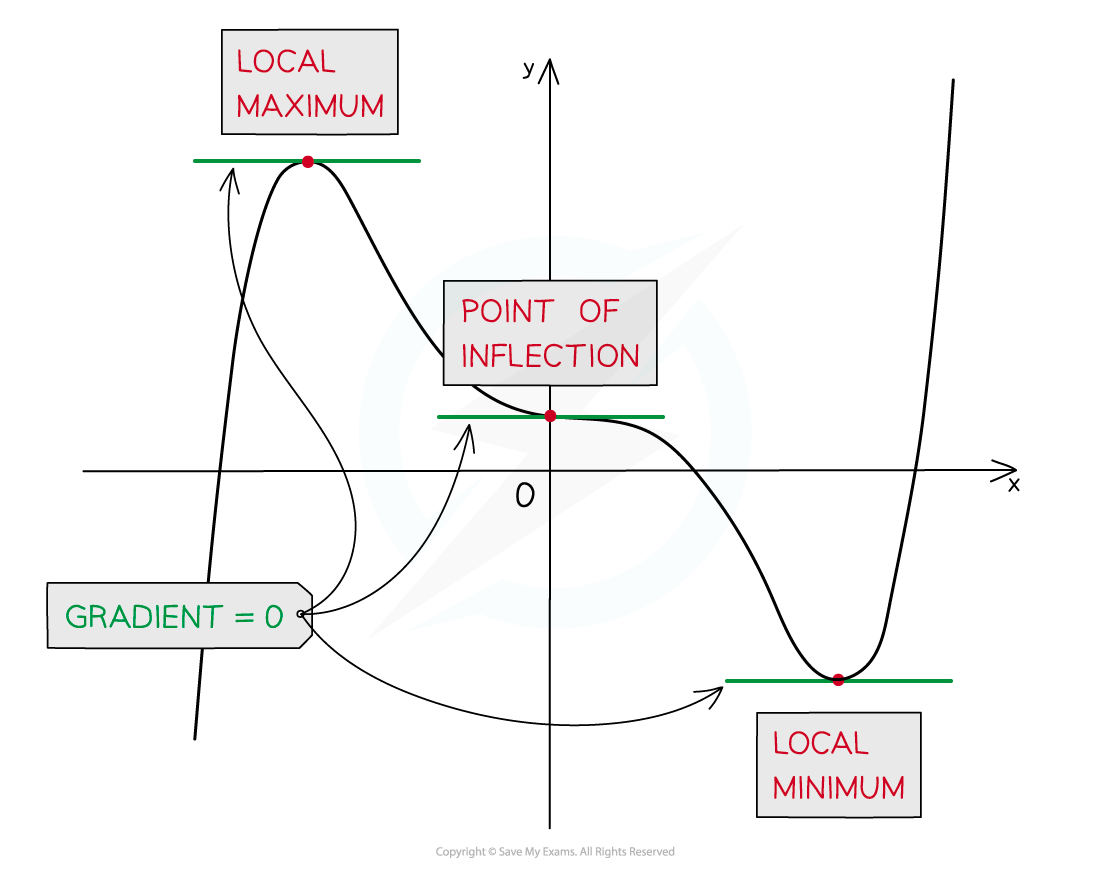
A stationary point is any point on a curve where the gradient is zero
To find stationary points of a curve
Step 1 Find the first derivative
Step 2 Solve to find the -coordinates of any stationary points
Step 3 Substitute those -coordinates into the equation of the curve to find the corresponding -coordinates
A stationary point may be either a local minimum, a local maximum, or a point of inflection
Stationary points on quadratics
The graph of a quadratic function only has a single stationary point
For a positive quadratic this is the minimum; for a negative quadratic it is the maximum
No need to talk about 'local' here, as it is the overall minimum/maximum for the whole curve
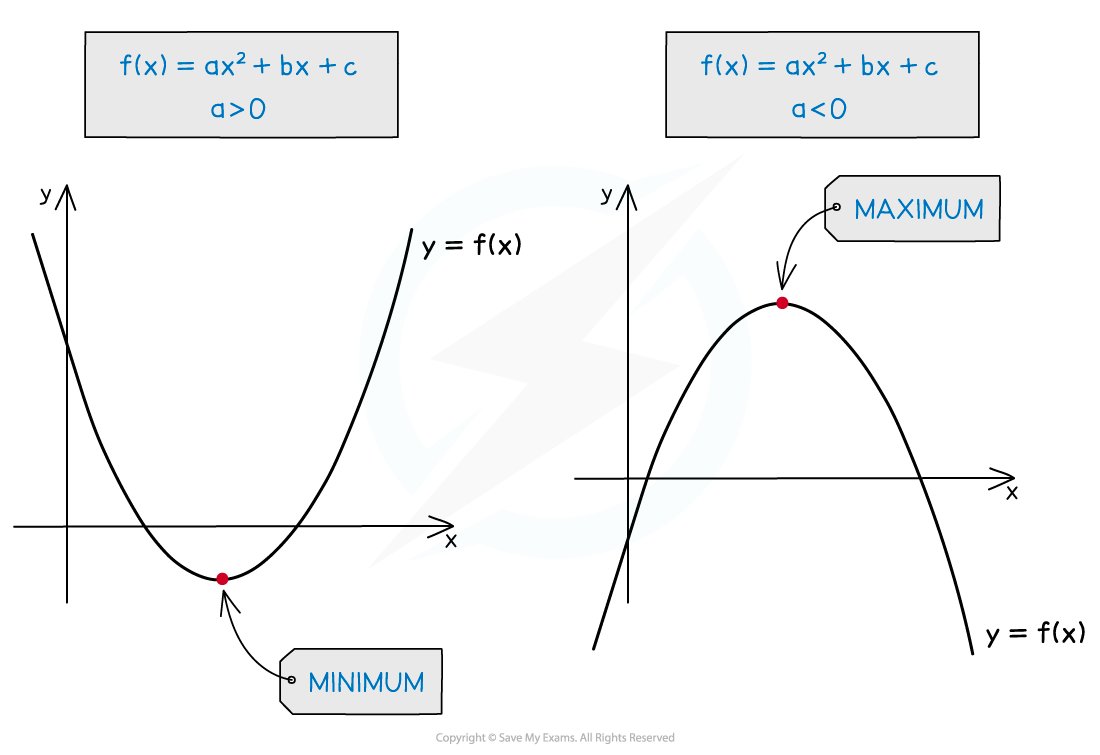
The y value/coordinate of the stationary point is therefore the minimum or maximum value of the quadratic function
For quadratics especially, minimum and maximum points are often referred to as turning points
Testing for Local Minimum & Maximum Points
Testing for local minimum & maximum points
How do I determine the nature of stationary points on a curve?
For a graph there are two ways to determine the nature of its stationary points
Method A
Compare the signs of the first derivative, , (positive or negative) a little bit to either side of the stationary point
e.g. if the stationary point is at x=2 then you could find the gradient at x=1.9 and x=2.1
Compare the signs (positive or negative) of the derivatives on the left and right of the stationary point
If the derivatives are negative on the left and positive on the right, the point is a local minimum (a u-shape)
If the derivatives are positive on the left and negative on the right, the point is a local maximum (an n-shape)
Method B
Look at the sign of the second derivative (positive or negative) at the stationary point
Find the second derivative
For each stationary point find the value of at the stationary point
i.e. substitute the x-coordinate of the stationary point into and evaluate
If is positive then the point is a local minimum
If is negative then the point is a local maximum
If is zero then the point could be a local minimum, a local maximum OR a point of inflection
In this case you will need to use method A instead