StudyDeck

Product Rule

Exam code: 4037
Written by: Ashika|Reviewed by: Caroline Carroll|Updated 2 July 2026

Product Rulevideo

Product Rule

Product rule

What is the product rule?

  • The product rule is a formula that allows you to differentiate a product of two functions

  • If y=u×v{"language":"en","fontFamily":"Times New Roman","fontSize":"18"} where u and v are functions of x then the product rule is:

dydx=udvdx+vdudx{"language":"en","fontFamily":"Times New Roman","fontSize":"18"}

  • In function notation, if f(x)=g(x)×h(x){"language":"en","fontFamily":"Times New Roman","fontSize":"18"} then the product rule can be written as:

f'(x)=g(x)h'(x)+h(x)g'(x){"language":"en","fontFamily":"Times New Roman","fontSize":"18"}


  • The easiest way to remember the product rule is, for y=u×v{"language":"en","fontFamily":"Times New Roman","fontSize":"18"} where u and v are functions of x:

y' = uv' + vu'{"language":"en","fontFamily":"Times New Roman","fontSize":"18"}


How do I know when to use the product rule?

  • The product rule is used when we are trying to differentiate the product of two functions

    • These can easily be confused with composite functions (see chain rule)

      •  sin(cos x){"language":"en","fontFamily":"Times New Roman","fontSize":"18"} is a composite function, “sin of cos of x{"language":"en","fontFamily":"Times New Roman","fontSize":"18"}”

      •   sin xcos x{"language":"en","fontFamily":"Times New Roman","fontSize":"18"} is a product, “sin x times cos x{"language":"en","fontFamily":"Times New Roman","fontSize":"18"}”

How do I use the product rule?

  • Make it clear what u, v, u'{"language":"en","fontFamily":"Times New Roman","fontSize":"18"} and v'{"language":"en","fontFamily":"Times New Roman","fontSize":"18"} are

    • arranging them in a square can help

      • opposite diagonals match up

 STEP 1

 Identify the two functions, u{"language":"en","fontFamily":"Times New Roman","fontSize":"18"} and v{"language":"en","fontFamily":"Times New Roman","fontSize":"18"}

 Differentiate both u{"language":"en","fontFamily":"Times New Roman","fontSize":"18"} and v{"language":"en","fontFamily":"Times New Roman","fontSize":"18"} with respect to x{"language":"en","fontFamily":"Times New Roman","fontSize":"18"} to find u'{"language":"en","fontFamily":"Times New Roman","fontSize":"18"} and v'{"language":"en","fontFamily":"Times New Roman","fontSize":"18"}

 STEP 2

Obtain dydx{"language":"en","fontFamily":"Times New Roman","fontSize":"18"} by applying the product rule formula dydx=udvdx+vdudx{"language":"en","fontFamily":"Times New Roman","fontSize":"18"} Simplify the answer if straightforward to do so or if the question requires a particular form
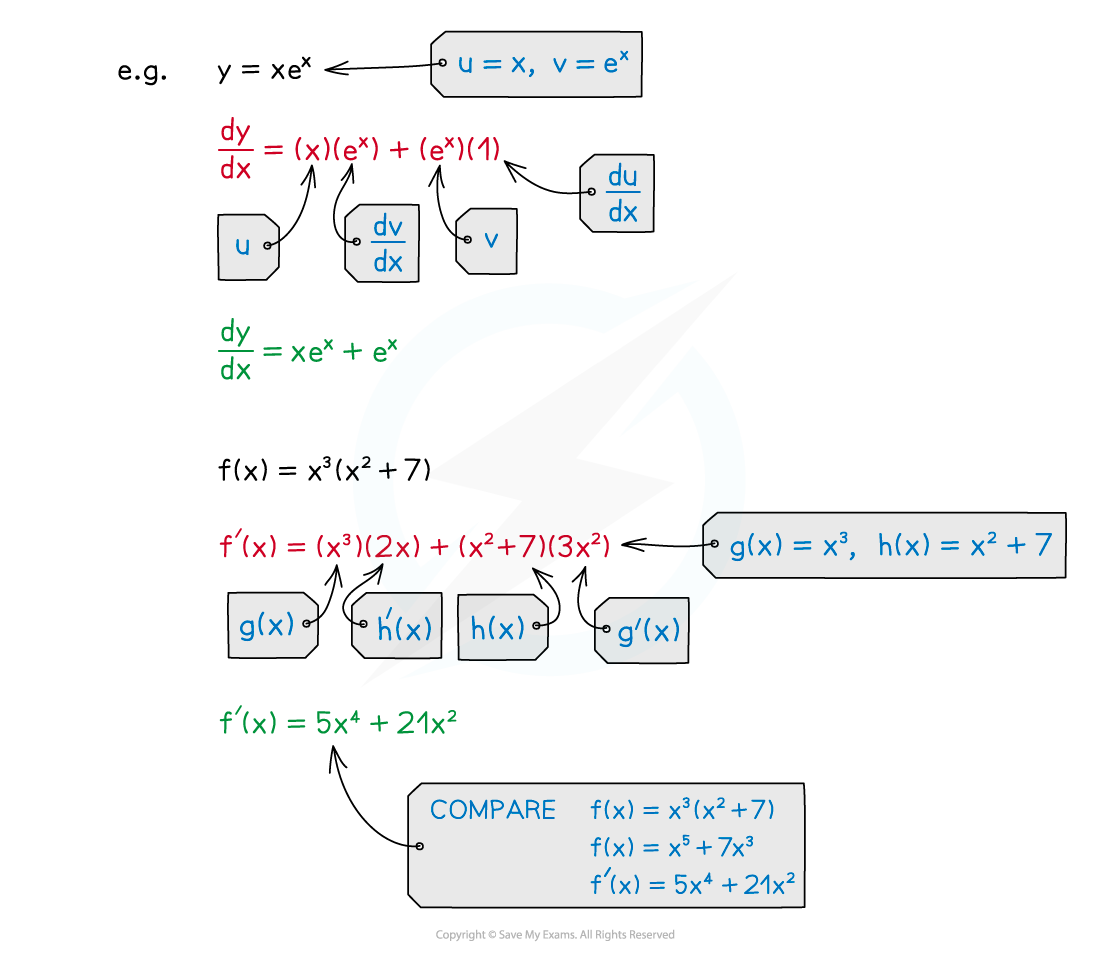
Product Rule Eg, AS & A Level Maths revision notes


Product Rule · Revision Notes · Further Maths · StudyDeck