Why Did the Bolsheviks Win the Civil War?
What Caused a Civil War in Russia? - Summary
When the Bolsheviks overthrew the Provisional Government in October 1917, they did not have control of Russia. In the ten months of 1917, there had been three changes in government. Many opponents of the Bolsheviks believed that this would be the first of many political groups that attempted to rule Russia.
The Bolsheviks created many enemies. In March 1918, Trotsky met with German delegates to negotiate Russia's withdrawal from the First World War. Many Russians wanted this but the Treaty of Brest-Litovsk was incredibly harsh. The treaty forced Russia to give up around 1 million square miles of land and over a third of its population.
Aspects of the Bolshevik rule were also unpopular. Lenin openly stated that his government was a "dictatorship of the proletariat". Non-Bolshevik newspapers were banned and the secret police, the Cheka, was created. Opposition groups could no longer express criticism of the government without facing arrest.
Opponents of different political backgrounds came together to fight the Bolsheviks. Their differences would contribute significantly to their defeat.
How Did Lenin Establish Power
How did Lenin Establish Power?
Lenin knew the importance of establishing power quickly in Petrograd
Lenin had some support from the workers and the army
From Petrograd, Lenin could extend his power eastwards across the Russian Empire
Tactics that Lenin Used to Gain Power
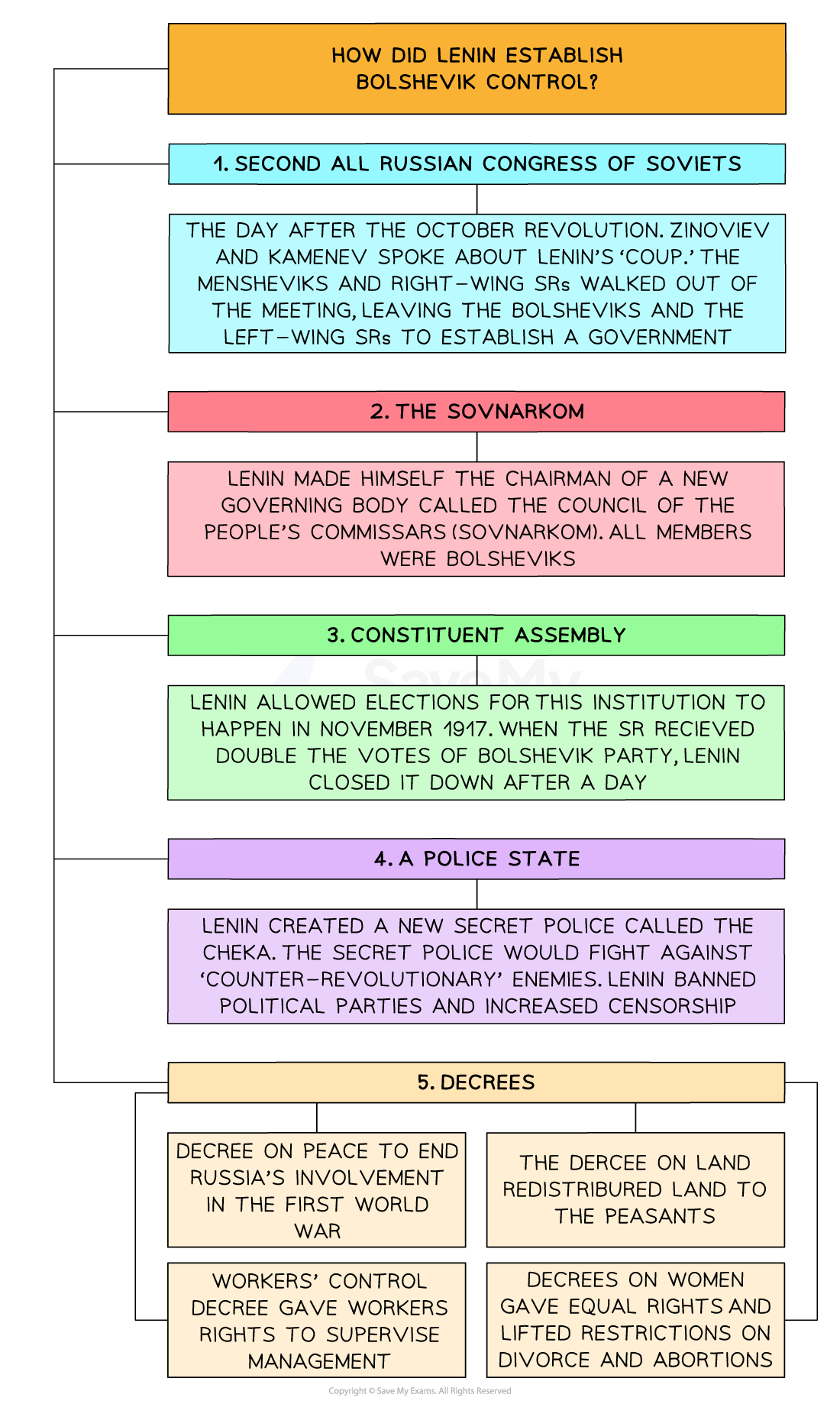
The methods above show that to gain control, Lenin used:
The element of surprise
The speed of the Bolshevik takeover forced Soviet representatives to either support the uprising or play no part in their government
Exclusion
The Mensheviks and right-wing SRs felt they had to walk out of the Congress of Soviets. Trotsky declared they would go into 'the dustbin of history'
The Sovnarkom only had Bolshevik members
The Constituent Assembly was immediately closed down due to their lack of Bolshevik representation
Fear
Similar to Tsarist Russia, Lenin used censorship and secret police to repress his enemies
Reform
The decrees tackled the key issues that the Provisional Government had avoided
The Bolsheviks progressed women's rights. Alexandra Kollontai became the Commissar for Social Welfare
Despite these actions, by the summer of 1918, enemies of the Bolsheviks had declared war
Leadership of the Reds
Leadership of the Reds
Lenin placed Trotsky in total control of the Red Army
This showed Lenin's trust in Trotsky's abilities
Trotsky quickly raised an army of 300,000 men
By 1921, Trotsky had created a strong military force of over three million men
Trotsky enlisted ex-tsarist officers to train the army
Political commissars monitored these officers closely and authorised all military orders
Red Army soldiers of all ranks were called 'Comrades'
This created a sense of unity between troops
Trotsky reinstated the death penalty for desertion or disloyalty to the Red Army
Trotsky was a charismatic leader of the Red Army
He travelled in an armoured train to inspire his troops
The Bolsheviks used a mixture of terror and propaganda to gain support
Terror tactics | Propaganda tactics |
|---|---|
Forcibly conscripting peasants from occupied territory | Trotsky used the slogan 'Everything for the Front' to recruit soldiers |
Red Army soldiers seized grain from the peasants. This is called grain requisition | The Bolsheviks stated that foreign troops wanted to invade Russia |
The Cheka intimidated people to support the Bolsheviks | Many soldiers believed in the Bolsheviks' aims. This gave the Red Army a sense of purpose |
Leadership of the Whites
Leadership of the Whites
The White Army was made up of different groups such as:
The SRs
The Mensheviks
Monarchists who wanted to reinstate the tsar
Nationalist groups
General Yudenich and General Denikin commanded these combined forces
By 1921, the White Army was weak
The various groups under the White Army fought separately from each other
In major attacks, the White Army did not have enough troops in reserve
This allowed Trotsky to defeat each army one by one
The members of the White Army did not have the same aim
The monarchists disagreed with the SRs and Mensheviks who did not want the return of the tsar
A hatred of Bolsheviks was not enough to unify these groups
Some generals treated their soldiers badly
This encouraged troops to defect to the Bolsheviks
The White Army's propaganda was not as effective
They could not persuade enough Russians to support their cause
Geography
Geography
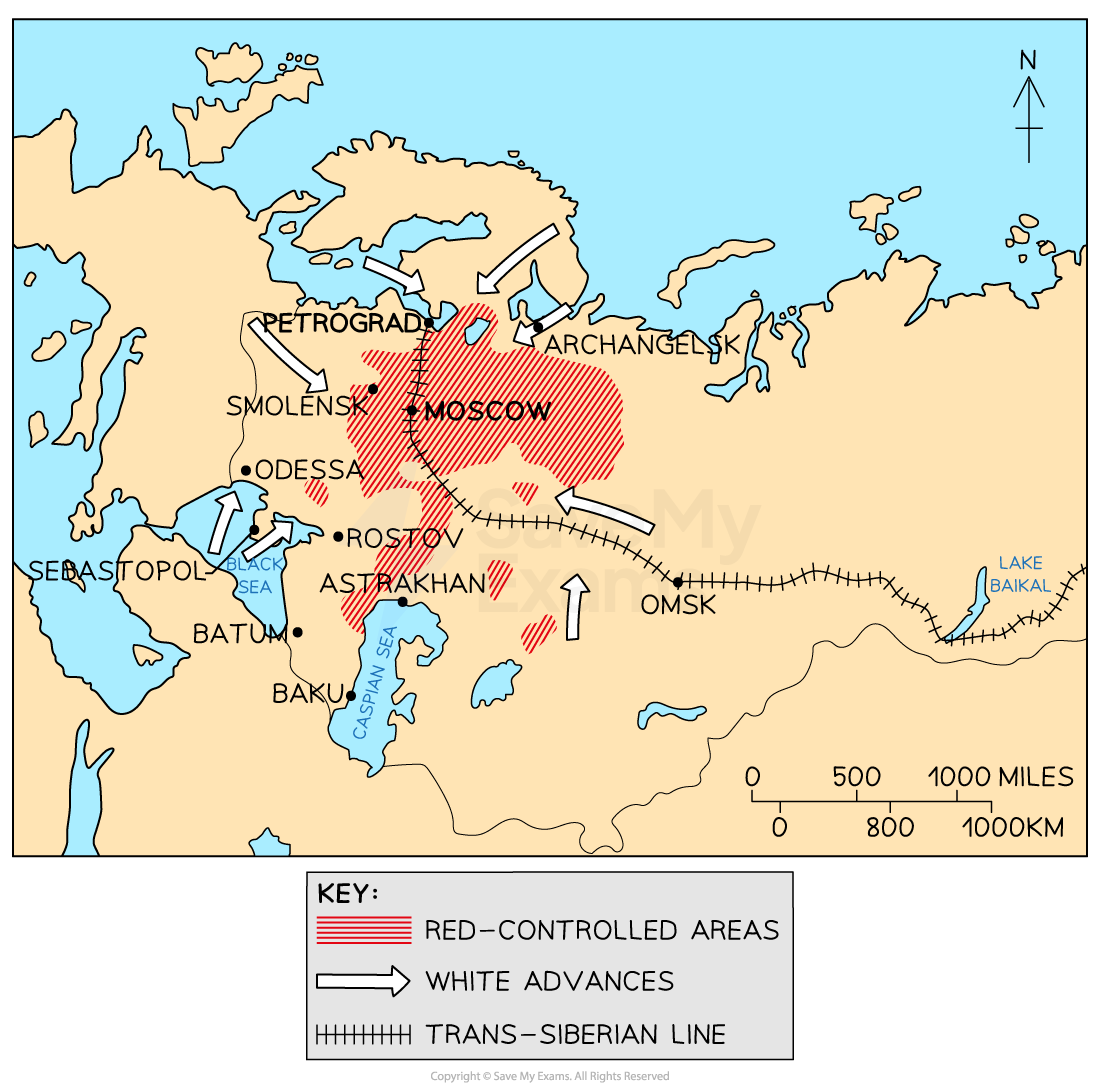
Why was Geography Important for the Bolsheviks?
The Red Army held significant areas of Western Russia
Moscow and Petrograd were key industrial centres
The Bolsheviks used this to gain troops and resources
The Bolsheviks controlled access to the Trans-Siberian railway
This allowed easy movement of troops and equipment across Russia
The White Army did not have a base
Their armies were spread across Russia
This made coordination between divisions difficult
They had limited access to trains and industry
Moving troops to where they were needed quickly was impossible
Generals had limited and slow communication with each other
Influence of Foreign Powers
Influence of Foreign Powers
The Allies supported the White Army
The Bolsheviks' Decree on Peace would pull Russia out of the First World War
The Allies hoped Russia would form a moderate government that would continue the war effort
The White Army suffered from their connection to Britain and France
Many Russians did not trust Europeans or Western powers
Bolshevik propaganda stated that Europe was invading Russia