Why was the Revolution of March 1917 Successful?
Was the March Revolution Inevitable? - Summary
Historians debate whether it was inevitable that the tsar would abdicate in March 1917. A significant factor was the First World War. The conflict created poor conditions in Russia. Food and fuel shortages caused mass protests in Moscow and Petrograd. With a proper government, these issues may have been solvable. However, Tsar Nicholas' command of the army left Russia without a leader. Tsarina Alexandra and Rasputin ran a chaotic government with multiple changes of ministers. Local needs were not being met. The zemstva took more responsibility than the government for the health and safety of the Russian people.
Some historians argue that the First World War only dictated the timing of the March Revolution. They argue that Tsarist Russia had unresolvable issues. The misuse of the army, the empire's economic backwardness and the mix of nationalities would cause a revolution eventually. The First World War sped up when this revolution would occur.
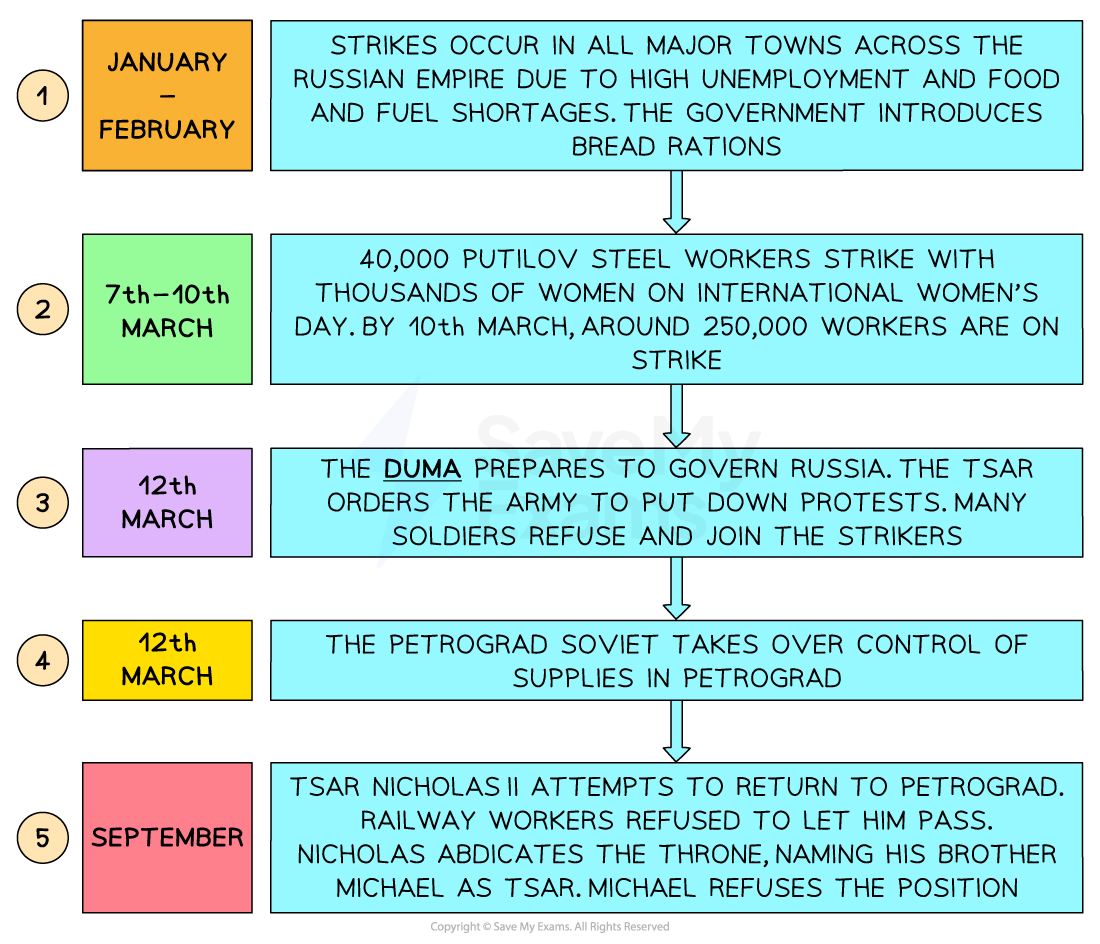
Events of the March 1917 Revolution
Events of the March 1917 Revolution
Popular Support
Popular Support
The March 1917 Revolution is known as a 'revolution from below'
This means that the workers caused the revolution to happen
The revolution had popular support because:
The First World War had caused fuel and food shortages
The people felt like they had no choice but to protest
Russia suffered huge casualties in the First World War
People felt less patriotic
They did not support the tsar's decisions as Head of the Army
People began to turn against the Romanovs
Tsarina Alexandra was called the 'German Princess'
Industrial workers were less religious
There was a lower belief in the Divine Rights of Kings. They were less afraid to challenge the tsar's authority
More workers turned to the Marxist parties
Twp groups could govern Russia instead of the tsar. These were:
The duma - supported by the middle classes
The Soviets - supported by the workers and the military
Military Support
Military Support
The Russian Army was a significant 'pillar' for the tsar
Nicholas II over-relied on the army to suppress protests as he had done in 1905
The First World War turned the army against Tsar Nicholas
They did not respect the tsar's military leadership
Without the army, the tsar lost his power
He could not use his autocratic power without the threat of violence
Any future government would need the support of the army to rule
Many soldiers joined the Soviets, increasing their power in Russia
Soviet Support
Soviet Support
After Nicholas' abdication, there was confusion about who would rule Russia
Nicholas' brother refused the position, ending 300 years of the Romanov dynasty
Both the duma and the Petrograd Soviet wanted power
After the March 1917 Revolution, a system of Dual Power replaced the Tsarist government
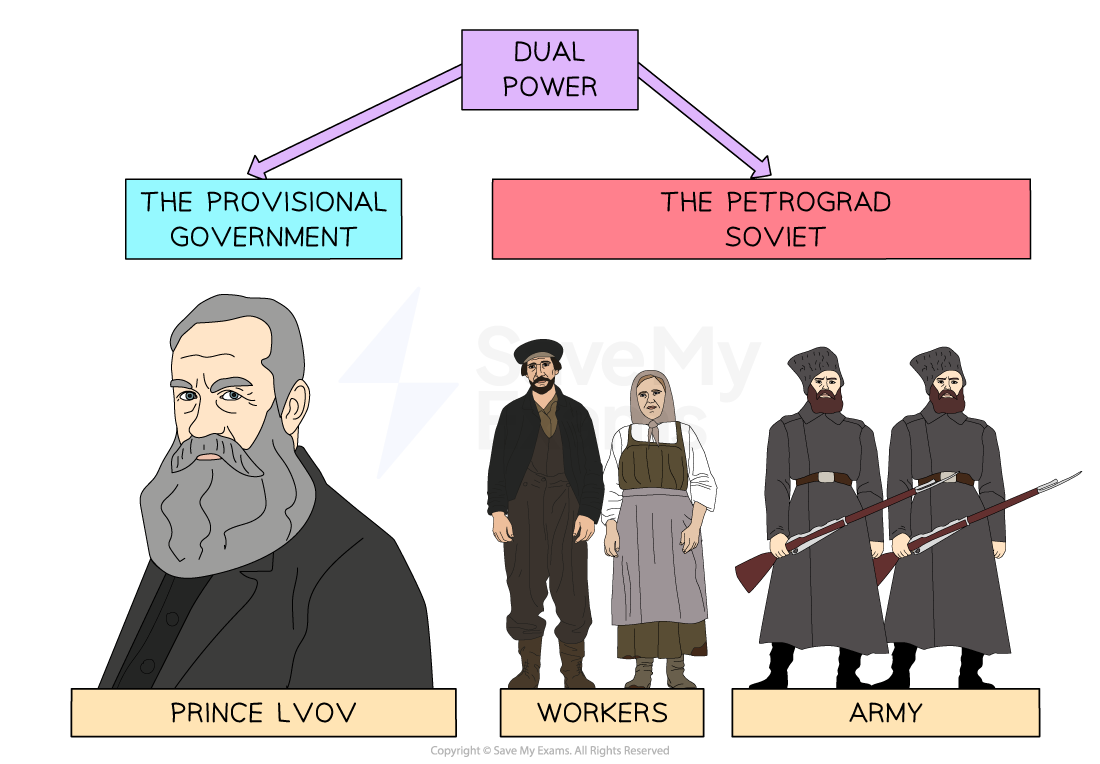
Both government bodies needed the other
The Provisional Government needed the Petrograd Soviet for their influence over the Army and workers
The Petrograd Soviet needed the Provisional Government for their influence over the middle classes