Tsarist Russia by 1905
What was Russian Society Like in 1905? - Summary
Russia in 1905 was a very unique country with a confusing identity. The West feared Russia’s size, ambition and isolationism for many centuries. Its borders spanning both Asia and Europe meant it did not fit into either Asian or European culture. As a result, the way that Russians viewed Europe was very different.
Some Russians called themselves Slavophiles. This meant that they saw Russia as a special country that needed protection. They distrusted Europe, believing that it wanted to change Russia’s national identity. An example of Russia’s unique identity was how Russia measured time. In 1905, Russia continued to use the Julian Calendar. Many other countries had adopted the Gregorian calendar almost 300 years earlier. The Julian Calendar was 13 days behind the Gregorian calendar. Keeping this way of measuring time showed Russia’s desire to be different and preserve its traditions.
Other Russians were known as Westernisers. They looked to Europe for inspiration and wanted to apply this to Russia. A key Westerniser was a king, or ‘tsar’, called Peter the Great. In 1703, Peter built the new capital city of St Petersburg in a Parisian style. This differed from the old capital city of Moscow with its Slavic style.
Russia had three ‘pillars’ that society stood upon - the tsar, the Orthodox Church and the Army. Russia relied on these three institutions to survive. By 1905, the people started to question and test these pillars.
What is a Tsar?
What is a Tsar?
Tsar is the Russian word for ‘King’
A queen was called a tsarina
By 1905, a tsar or tsarina had ruled Russia for nearly 300 years
The Romanov dynasty established control over Russia in 1613
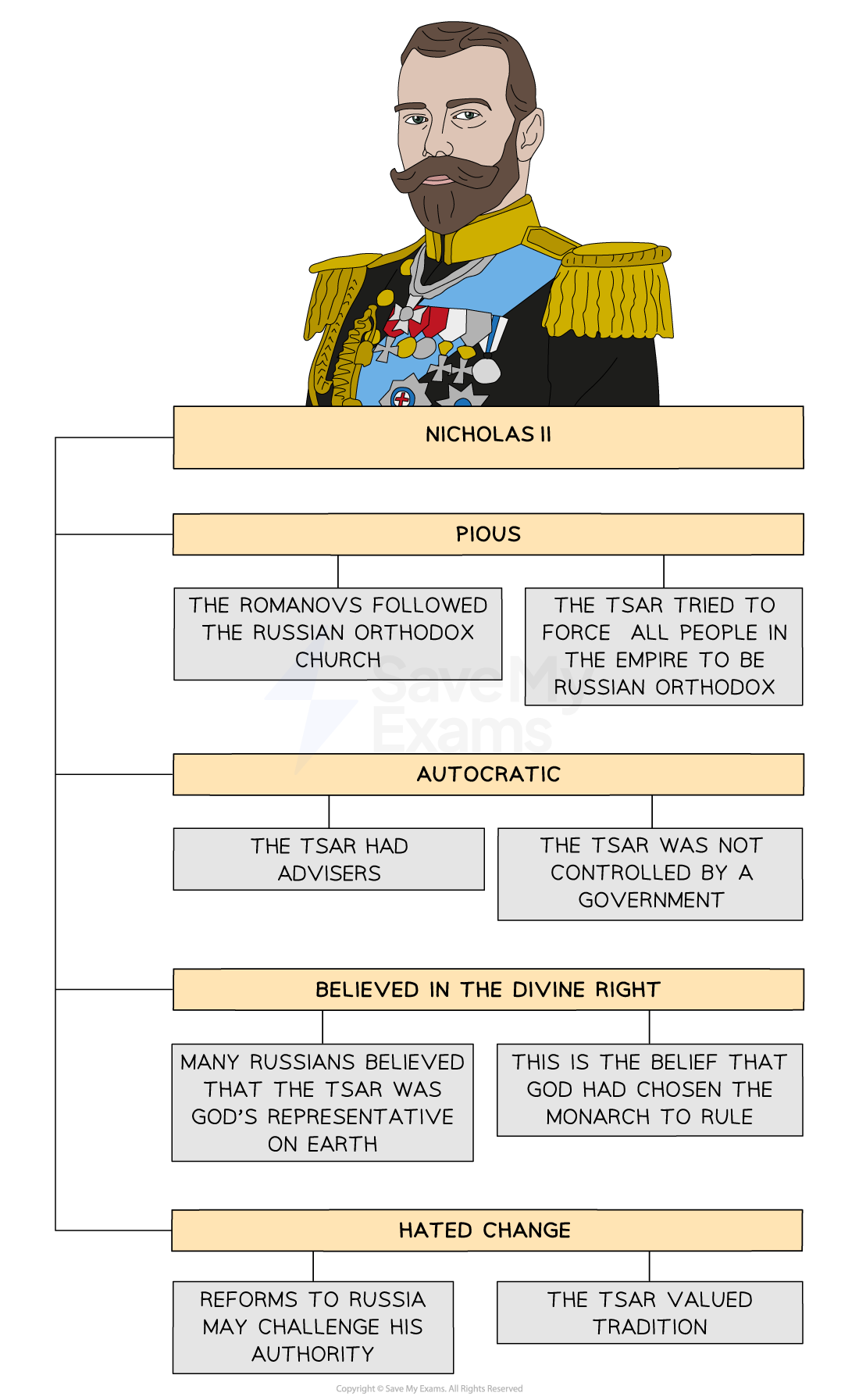
Tsars had many specific characteristics
Industrialisation
Industrialisation
For many countries, an industrial revolution occurred in the 18th century
By 1905, Britain had railways, motorised tractors and iron warships
Germany was the world’s leading steel producer, exceeding Britain by 1893
Russia had not experienced an industrial revolution
Russia’s limited industry developed in the west of the empire
Russian workers did not have the skills to keep up with production in Western Europe
Russia developed pig iron whereas Britain and Germany produced alloys like steel
Much of Russia did not have roads
Russia had begun to develop railways, having over 30,000 miles of railway tracks
The Geography of the Russian Empire
The Geography of the Russian Empire
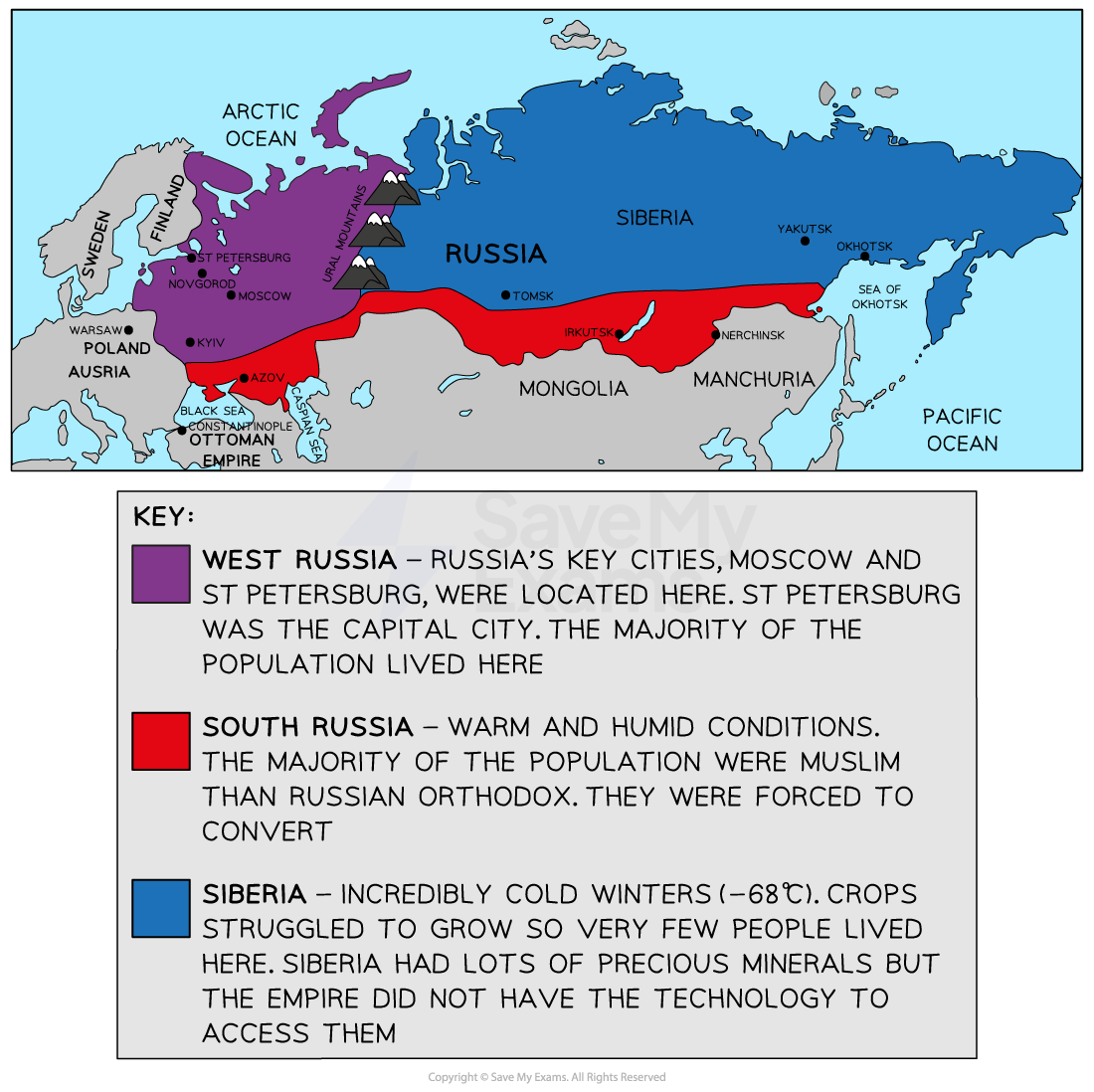
The Russian Empire was large
It was nearly 5,000 kilometres wide
It spanned Europe and Asia
Standards of living varied significantly across the empire
Social Backwardness
Social Backwardness
Historians describe Russia in 1905 as a backward country
Most Russians lived in villages or mirs
By 1905, 87% of Russia’s population lived in the countryside
The Russian Empire had very few towns and cities
The majority of people in Russia were peasant farmers
Peasant farmers worked in agriculture using traditional tools and methods
They had previously been serfs but Tsar Alexander II freed them through the Emancipation Edict in 1861
Despite this, many peasants still lacked freedom and rights by 1905
There were issues with land allocation
Land passed down through generations by inheritance
By 1905, family plots of land were too small or spread around the mir
Peasants could not use modern techniques or equipment to farm efficiently
If no one inherited the land, it remained vacant
More than 60% of Russia’s population were illiterate
In comparison, only 3% of Britain’s population could not read
The tsar had a limited impact on the government of mirs
Due to the size of Russia, citizens learnt of key policies from their local Russian Orthodox Church
The tsar made laws, which his officials distributed across the empire
Priests would read the law out to their congregation
Priests taught that the tsar was God’s representative on Earth and that everyone should obey him
As a result, the Church was essential for law enforcement