The Petty Cash Book
The Petty Cash Book
The petty cash book
What is a petty cash book?
A petty cash book is used to record transactions involving small amounts of cash
The business will decide what they classify as small amounts of cash
Exam questions commonly tell you to class transactions for anything up to $100 or $75 as petty cash transactions
A petty cash voucher is used to record the transaction when money is taken from the petty cash account
It should state the amount and details
What is the layout of a petty cash book?
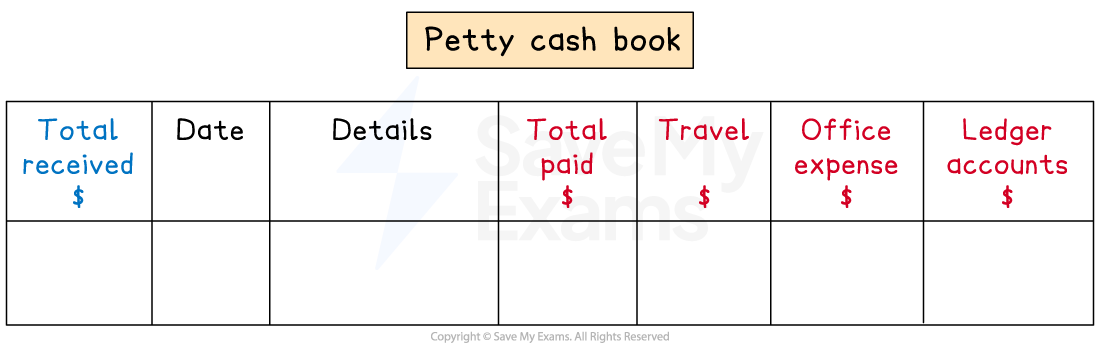
There is a date column and a details column
These commonly appear once in the middle
The total received column on the debit side states the total amount received for each transaction
The total paid column on the credit side states the total amount paid for each transaction
There are analysis columns on the credit side to separate payments into different categories
There are columns for the expense accounts and a column for the purchases ledger accounts
How do I enter transactions into the petty cash book?
The opening balance is on the debit side
The debit side shows the cash receipts
Small cash receipts from trade receivables
Money transferred from the cash or bank account to top up the petty cash account
The credit side shows the cash payments
Small cash payments for expenses
Small cash payments to trade payables
When you enter a transaction onto the credit side
You need to enter it in the appropriate analysis column(s)
Put the total for that transaction in the total paid column
How do I balance the petty cash book?
Find the total for each column on the credit side
Underline the totals for the analysis columns
These balances then get transferred to the relevant ledger accounts
You can transfer the total for each expense column rather than transfer each transaction separately
The entries for ledger accounts will need to be entered into the individual ledger accounts
Find the difference between the total paid and the total received
Put this entry as balance c/d on the side with the smaller total
This will usually be the credit side
Complete the balancing process for these two columns
Find the totals for the total received and total paid columns
Bring down the balance to the start of the next month
The balance brought down will always be on the debit side
The Imprest System
The imprest system
What is the imprest system?
The imprest system is used by businesses to ensure that the money in the petty cash account is equal to a set amount
This amount is known as the imprest amount
This is usually done at the start of each week or month
If the petty cash account is less than the imprest amount at the start of a period
Then it will be topped up using the cash or bank account
If the petty cash account is higher than the imprest amount at the start of a period
Then the excess can be deposited into the cash or bank account
The imprest amount will always be equal to:
The current balance of the petty cash account
Plus the total value of petty cash vouchers for the current period
Minus the total amount of petty cash received
What are the advantages of using an imprest system?
It sets a limit on the amount of cash which can be spent
It helps managers monitor the amount of petty cash that is being spent
It limits the amount of cash that could be mislaid or stolen