Homologous Series
Homologous Series
Homologous Series
This is a series or family of organic compounds that have similar features and chemical properties due to them having the same functional group
The functional group is a group of atoms which are bonded in a specific arrangement that is responsible for the characteristic reactions of each member of a homologous series
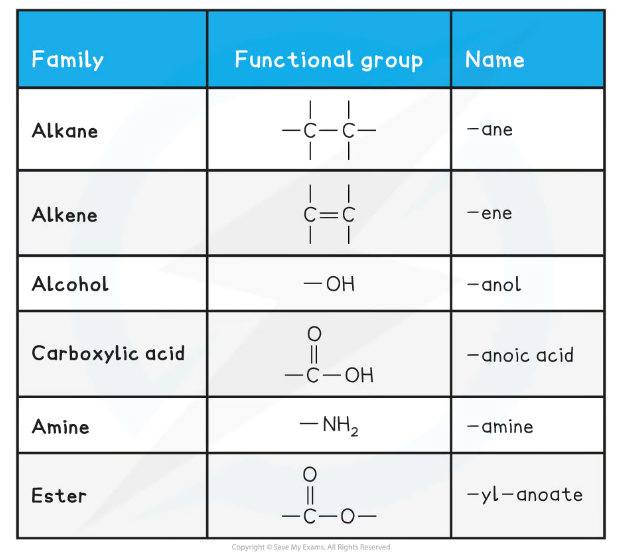
Table of Compounds & their Functional Groups
General Formulae
General Formulae
This type of formula tells you the composition of any member of a whole homologous series of organic compound
For example, all of the alkanes have the general formula CnH2n+2, where n represents the number of carbon atoms
This tells you that however many carbon atoms there are in the alkane, doubling this number and adding two will give you the number of hydrogen atoms present in the alkane
General formulae can be used to work out the formula of a compound from different homologous series if the number of carbon atoms present is known
General Formula of Common Homologous Series
Homologous Series | General Formula |
|---|---|
Alkanes | CnH2n+2 |
Alkenes | CnH2n |
Alcohols | CnH2n+1OH |
Carboxylic Acids | CnH2n+1COOH |
General Characteristic of Homologous Series
General Characteristic of Homologous Series
All members of a homologous series have:
The same general formula
Same functional group
Similar chemical properties
Gradation in their physical properties, such as melting and boiling point
The difference in the molecular formula between one member and the next is CH2
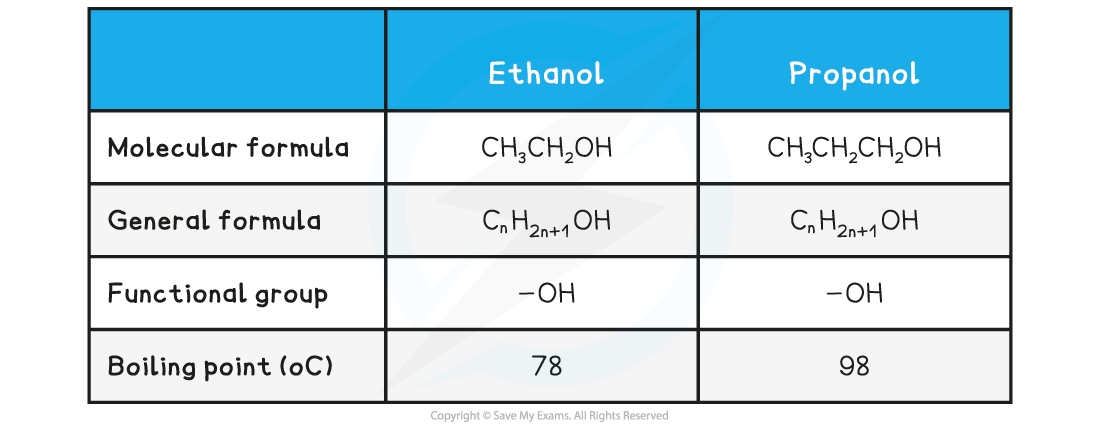
These characteristics are shown below for ethanol and propanol, which belong to homologous series, alcohols
Table of Characteristics of Ethanol and Propanol