Alkanes
Alkanes: Properties & Bondingvideo
Alkanes: Properties & Bonding
Alkanes are a group of saturated hydrocarbons
The term saturated means that they only have single carbon-carbon bonds, there are no double bonds
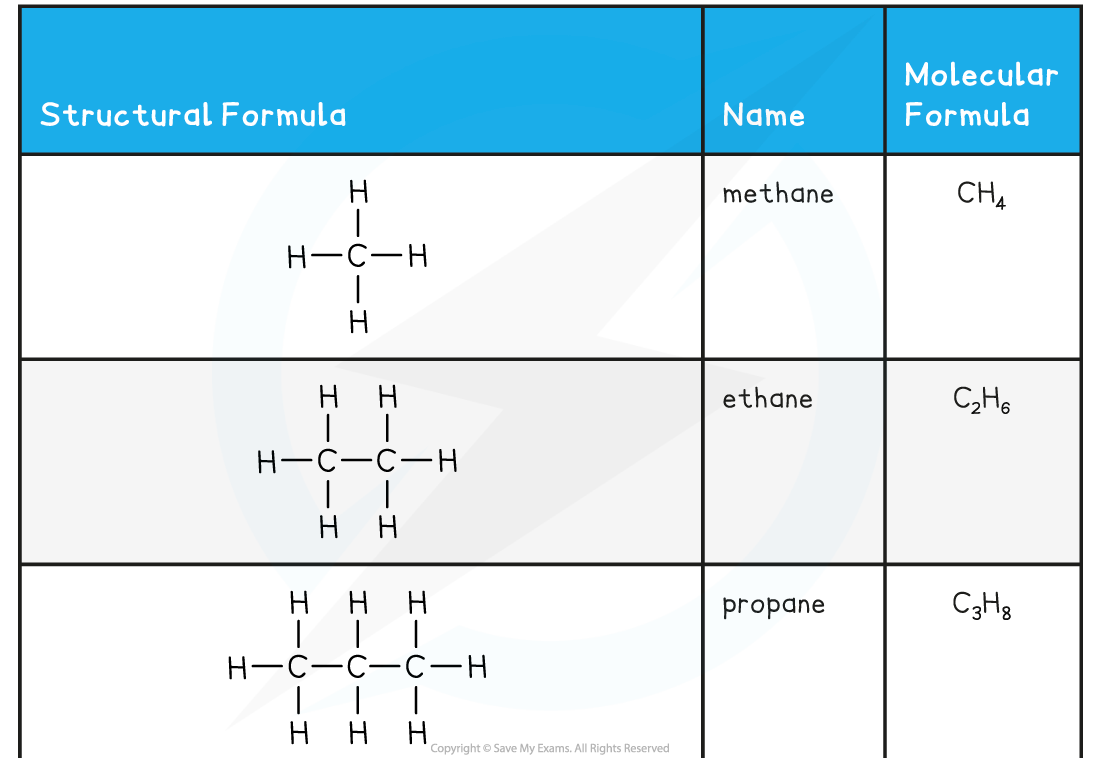
The general formula of the alkanes is CnH2n+2
They are colourless compounds which have a gradual change in their physical properties as the number of carbon atoms in the chain increases
Alkanes are generally unreactive compounds but they do undergo combustion reactions, can be cracked into smaller molecules and can react with halogens in the presence of light in substitution reactions
Methane is an alkane and is the major component of natural gas
Methane undergoes complete combustion forming carbon dioxide and water:
CH4 (g) + 2O2 (g) → CO2 (g) + 2H2O (l)
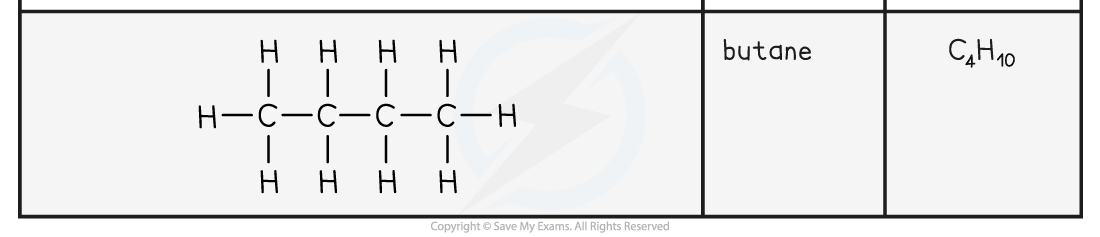
This Table shows the Displayed Formula of the First Four Members of the Alkane Homologous Series
Substitution Reaction of Alkanes with Halogens
Substitution Reaction of Alkanes with Halogens
In a substitution reaction, one atom (or group of atoms) is swapped with another atom (or group of atoms)
Alkanes undergo a substitution reaction with halogens in the presence of ultraviolet radiation (sunlight is a source of UV radiation)
This is called a photochemical reaction
The UV light provides the activation energy, Ea, for the reaction
A hydrogen atom is replaced with the halogen atom
More than one hydrogen atom can be substituted depending on the amount of ultraviolet radiation there is

In the presence of ultraviolet (UV) radiation, methane reacts with chlorine to form chloromethane and hydrogen chloride