Alcohols
Alcoholsvideo
Alcohols
All alcohols contain the hydroxyl (-OH) functional group which is the part of alcohol molecules that is responsible for their characteristic reactions
Alcohols are a homologous series of compounds that have the general formula CnH2n+1OH
They differ by one -CH2 in the molecular formulae from one member to the next
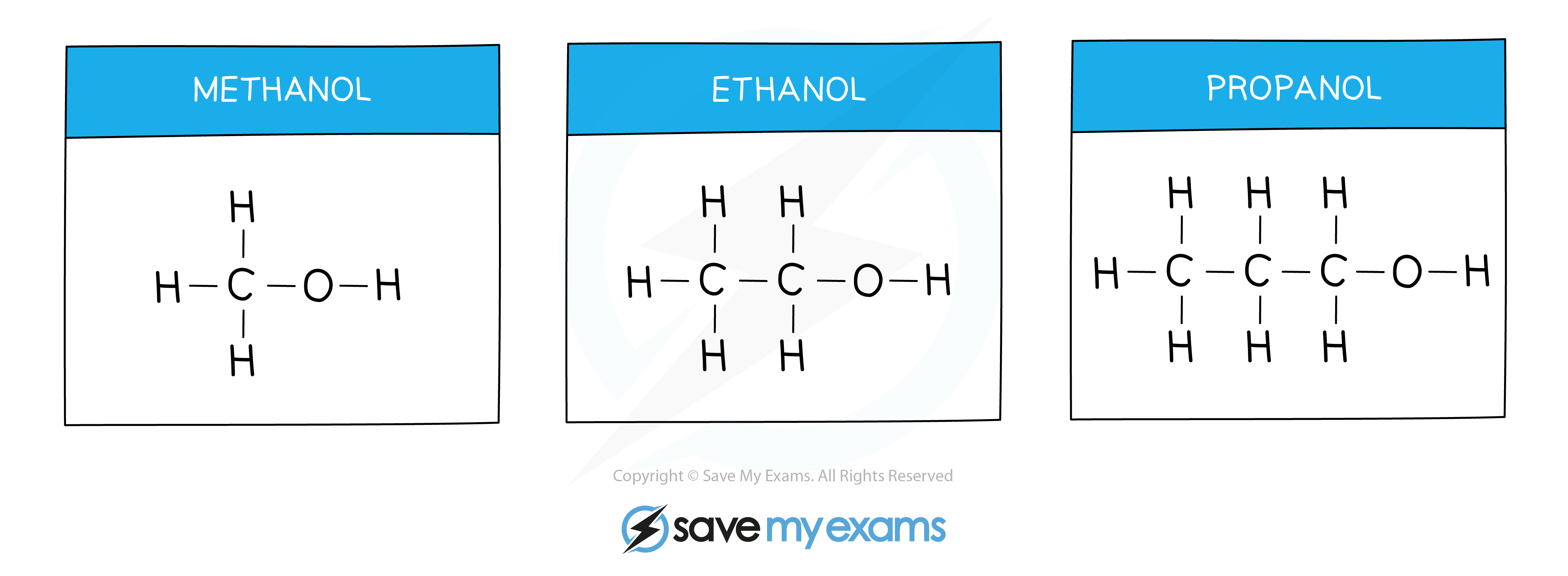
Diagram showing the first three alcohols
Ethanol (C2H5OH) is one of the most important alcohols
Ethanol can also be represented by its structural formula CH3CH2OH
It is the type of alcohol found in alcoholic drinks such as wine and beer
It is also used as fuel for cars and as a solvent
Alcohols burn in excess oxygen and produce CO2 and H2O
Ethanol undergoes complete combustion:
C2H5OH (l) + 3O2 (g) → 2CO2 (g) + 3H20 (l)
The Manufacture of Ethanol
There are two methods used to manufacture ethanol:
The hydration of ethene with steam
The fermentation of glucose
Both methods have advantages and disadvantages which are considered
Hydration of ethene
A mixture of ethene and steam is passed over a hot catalyst of phosphoric acid at a temperature of approximately 300 °C
The pressure used is 60 atmospheres (6000 kPa)
The gaseous ethanol is then condensed into a liquid for use
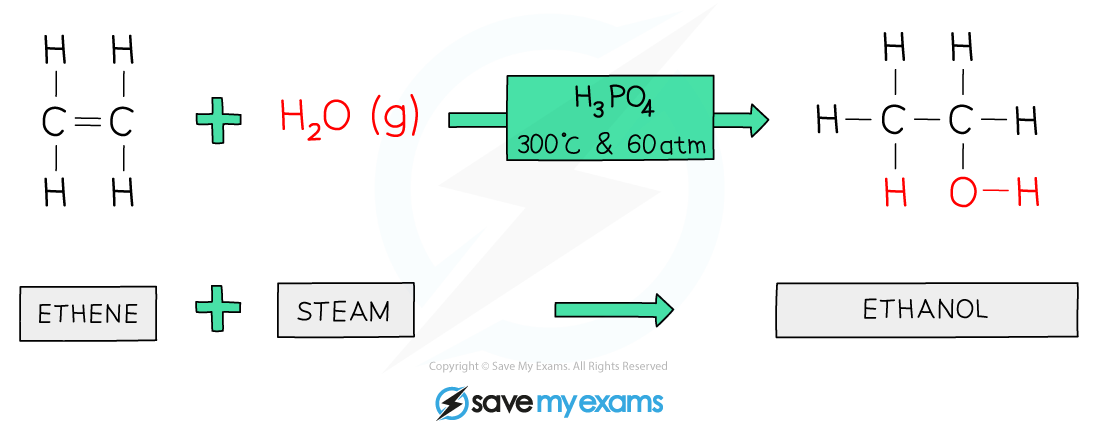
A water molecule adds across the C=C in the hydration of ethene to produce ethanol
Fermentation of glucose
Sugar or starch is dissolved in water and yeast is added
The mixture is then fermented between 25 and 35 °C with the absence of oxygen for a few days
Yeast contains enzymes that catalyse the break down of starch or sugar to glucose
If the temperature is too low the reaction rate will be too slow and if it is too high the enzymes will become denatured
The yeast respire anaerobically using the glucose to form ethanol and carbon dioxide:
C6H12O6 → 2CO2 + 2C2H5OH
The yeast are killed off once the concentration of alcohol reaches around 15%, hence the reaction vessel is emptied and the process is started again
This is the reason that ethanol production by fermentation is a batch process
Comparing methods of ethanol production
| Hydration of ethene | Fermentation |
|---|---|---|
Equipment | complex set up required | simple equipment needed |
Raw materials | uses non- renewable resources (crude oil) | uses renewable resources (sugar cane) |
Type of process | continuous process- a steam of reactants is constantly passed over a catalyst | batch process- everything is mixed together in a reaction vessel and left for several days and the process repeated again |
Rate of reaction | fast | very slow (several days) |
Quality of product | produces pure ethanol | produces a dilute solution requiring further processing |
Atmospheric effects | no greenhouse gases produced but pollutants are formed from the burning of fossil fuels to maintain high temperatures | carbon dioxide produced which is a greenhouse gas |
Reaction conditions | high temperatures and pressures required increasing the energy input and cost | low temperatures required |