Capital & Current Accounts
Partners' capital accounts
Partners' capital accounts
What is a partner's capital account?
The capital account shows the amounts that were originally invested in the partnership by each partner
Plus any amounts of money they may put in at a later date
Loans to the business from a partner are not entered into the capital account
The capital account of each partner is only used for recording the partners’ capital contribution and partners’ withdrawal of capital
Withdrawal of capital is different to taking drawings
Drawings are not entered into the capital account
What is the layout of a partner's capital account?
Each partner might have a separate capital account or there might be one combined capital account for the partnership
If a combined account is used then there are columns for each partner on both sides
The capital account has a credit balance and shows the amount owed by the business to the partner(s)
Entries are only made when the amount of capital invested by the partners changes
The entry is on the credit side if it is an increase
The entry is on the debit side if it is a decrease
Partners' current accounts
Partners' current accounts
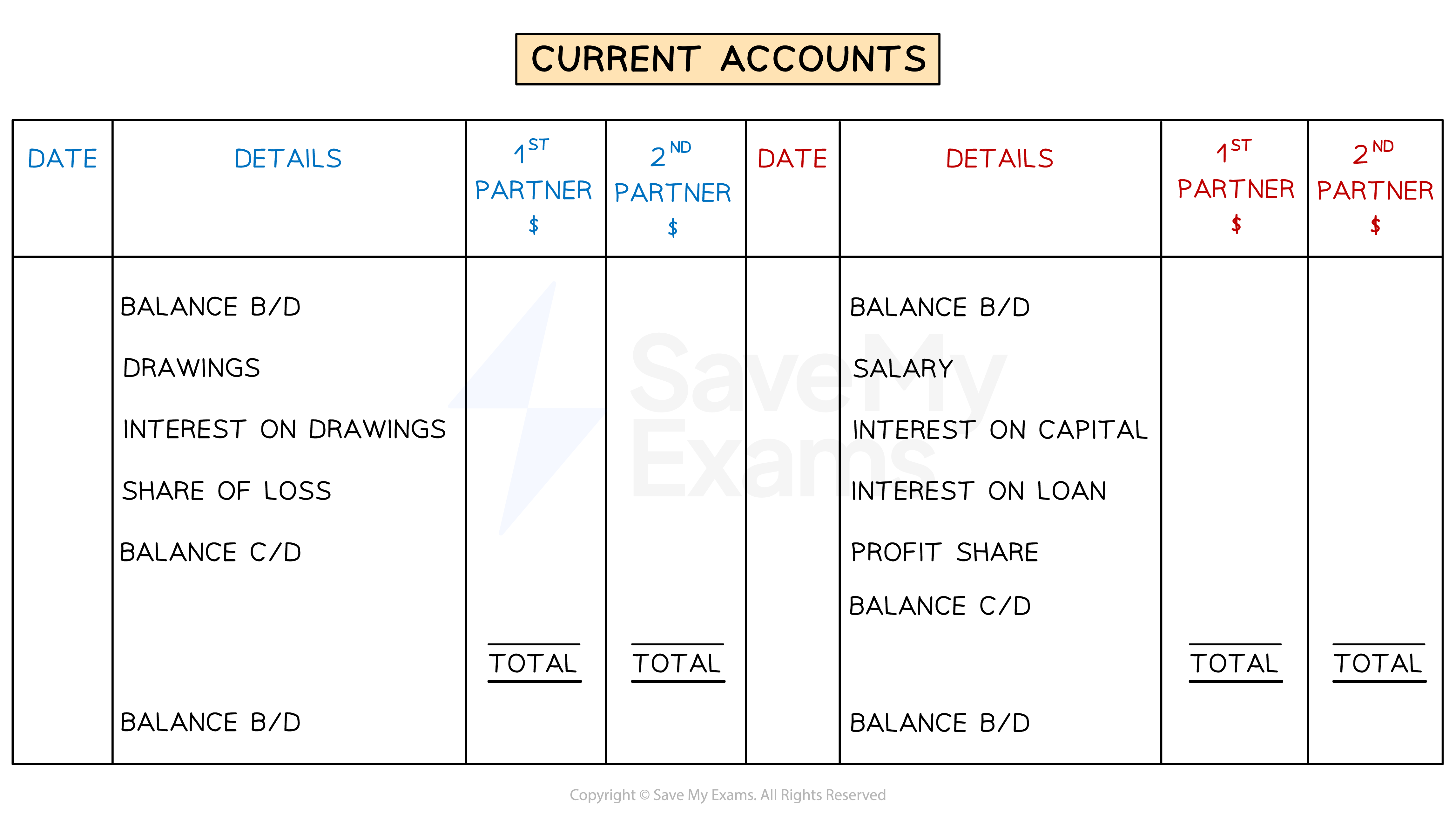
What is a partner's current account?
The current accounts are prepared after the appropriation account
The current accounts are treated as working accounts to show the change in the amount owed to each partner by the business
Permanent changes go into the capital accounts
Such as further investments into the business
Temporary changes go into the current accounts
Such as profit shares, salaries and interest on capital, drawings and loans
What is the layout of a partner's current account?
Each partner might have a separate current account or there might be one combined current account for the partnership
This is same as for a capital account
Entries are made on the debit side if the amount the business owes the partner(s) decreases
Loss for the year
Partner's drawings
Interest on a partner's drawings
Entries are made on the credit side if the amount the business owes the partner(s) increases
Profit for the year
Interest on a partner's capital
Interest on a partner's loan
A partner's salary
The closing balance of the current account shows how much undrawn or overdrawn profits the partner has
A debit balance indicates that the partner has taken too much money from the partnership in anticipation of profits
A credit balance indicates that the partner has not taken all of their share of the profits
Why do partnerships use both a current account and a capital account?
Partnerships use both a current account and a capital account to keep different types of entries separate
The capital account only contains the amounts invested by each partner
This means that partners can easily see how much everyone has invested
This makes it easier to calculate the interest on capital
The current account shows annual changes made to the amounts owed to the partners by the business
This allows the partners to see which partners are withdrawing more money than their profit share
How are loans from partners treated in the accounts of a partnership?
Loans from partners are treated in a similar way to other loans
They are not treated as part of the partner’s capital account
A loan account is created
The loan is a liability on the statement of financial position
The interest is added to the partner's current account
The partner can withdraw the interest from the business bank account as drawings
What are the journal entries for the partners' current account?
At the end of the year journal entries are made for the items in the partner's current accounts
To remember the journal entries:
Identify whether the entry is on the debit or credit side of the partner's current account
Identify where the amount has come from
Account to be debited | Account to be credited | |
|---|---|---|
Awarding interest on partners' capital | Appropriation account | Partners' current account |
Transferring a partner's drawings to the current account at the end of the year | Partner's current account | Partner's drawings account |
Awarding interest on partners' drawings | Partners' current account | Appropriation account |
Paying a partner's salary | Appropriation account | Partners' current account |
Awarding interest on a partner's loan | Income statement | Partners' current account |
Transferring shares of the residual profit to the current account | Appropriation account | Partners' current account |
Transferring shares of the residual loss to the current account | Partners' current account | Appropriation account |
Why are there no entries made in the cash or bank account for salaries and interest?
A partner does not receive cash when they are awarded interest on their capital or a salary
Interest and salaries are a way of sharing the profit
They are added to the partners' current accounts
The balances that the business owes them increases
The partners may choose to withdraw these amounts as drawings
The cash and bank accounts are used at this stage