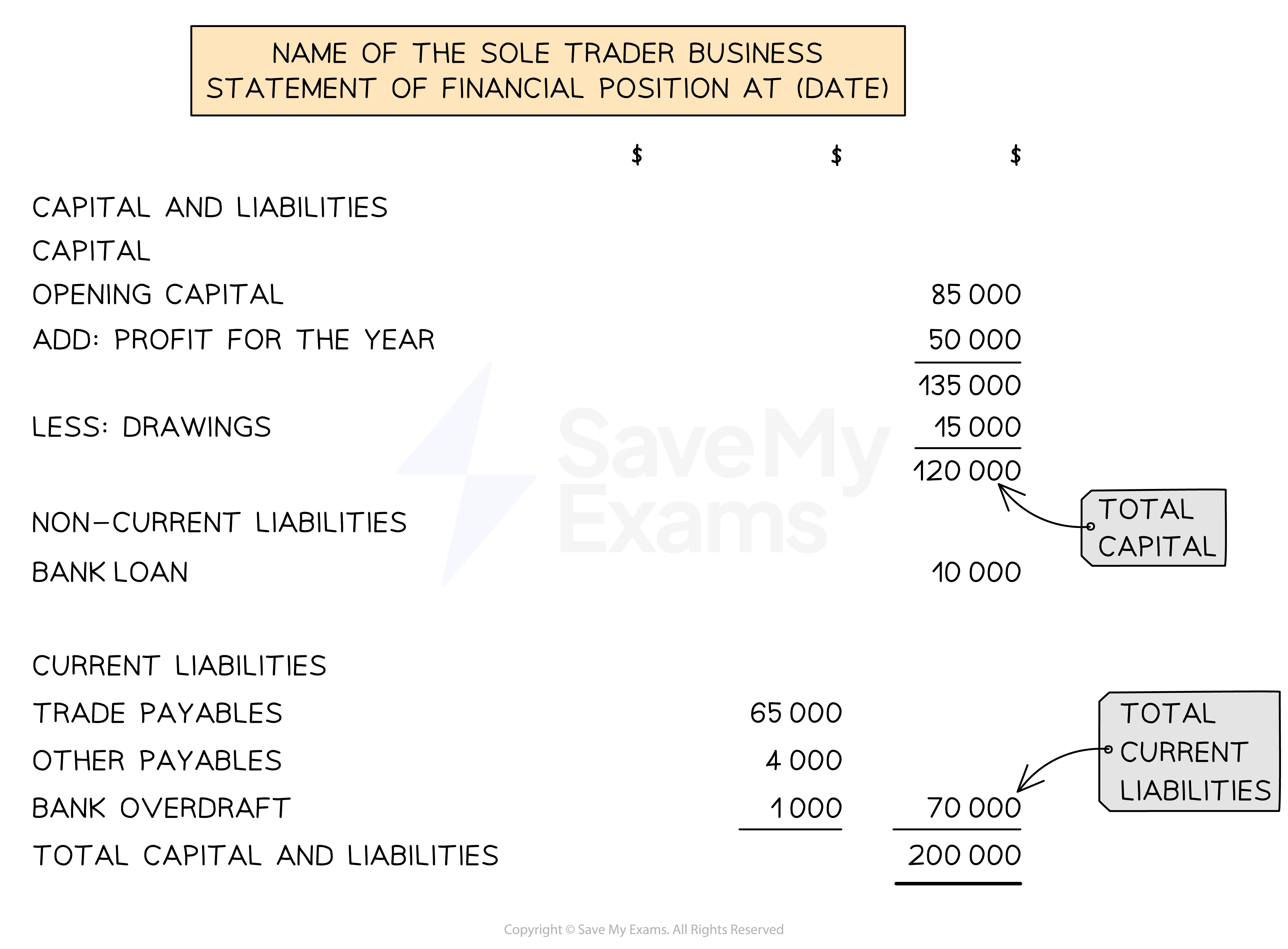
Statement of Financial Position
Statements of financial position for sole traders
Statement of financial position for sole traders
What is the statement of financial position?
The statement of financial position is one of the financial statements of a sole trader business
It shows the position of the business in terms of its assets, liabilities and capital at a particular date
It provides a snapshot of the business on a particular date
The statement of financial position is split into two halves
The assets are listed in the first half
The capital and liabilities are listed in the second half
The totals for each half will be equal
The statement of financial position is prepared in exactly the same way for a trading and a service business
The figures used to prepare the statement of financial position will be taken from the trial balance or list of balances
Additional information will be given after the trial balance
This is where the valuation of the closing inventory is given
The statement of the financial position is prepared after the income statement
The profit or loss for the year will increase or decrease the capital
The statement of financial position is not part of the double entry system
The balances of the accounts are stated on the statement
They are not transferred to the statement
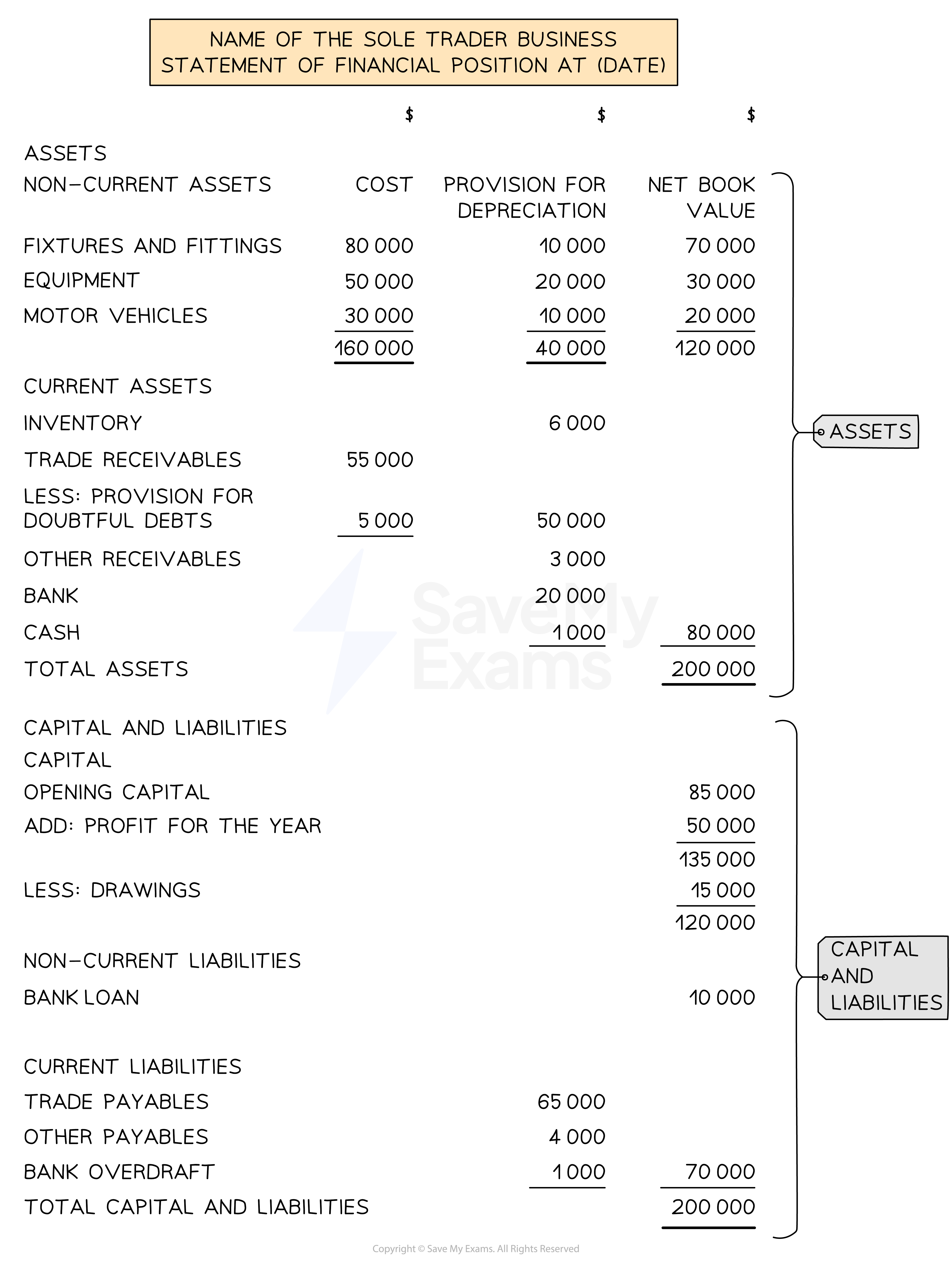
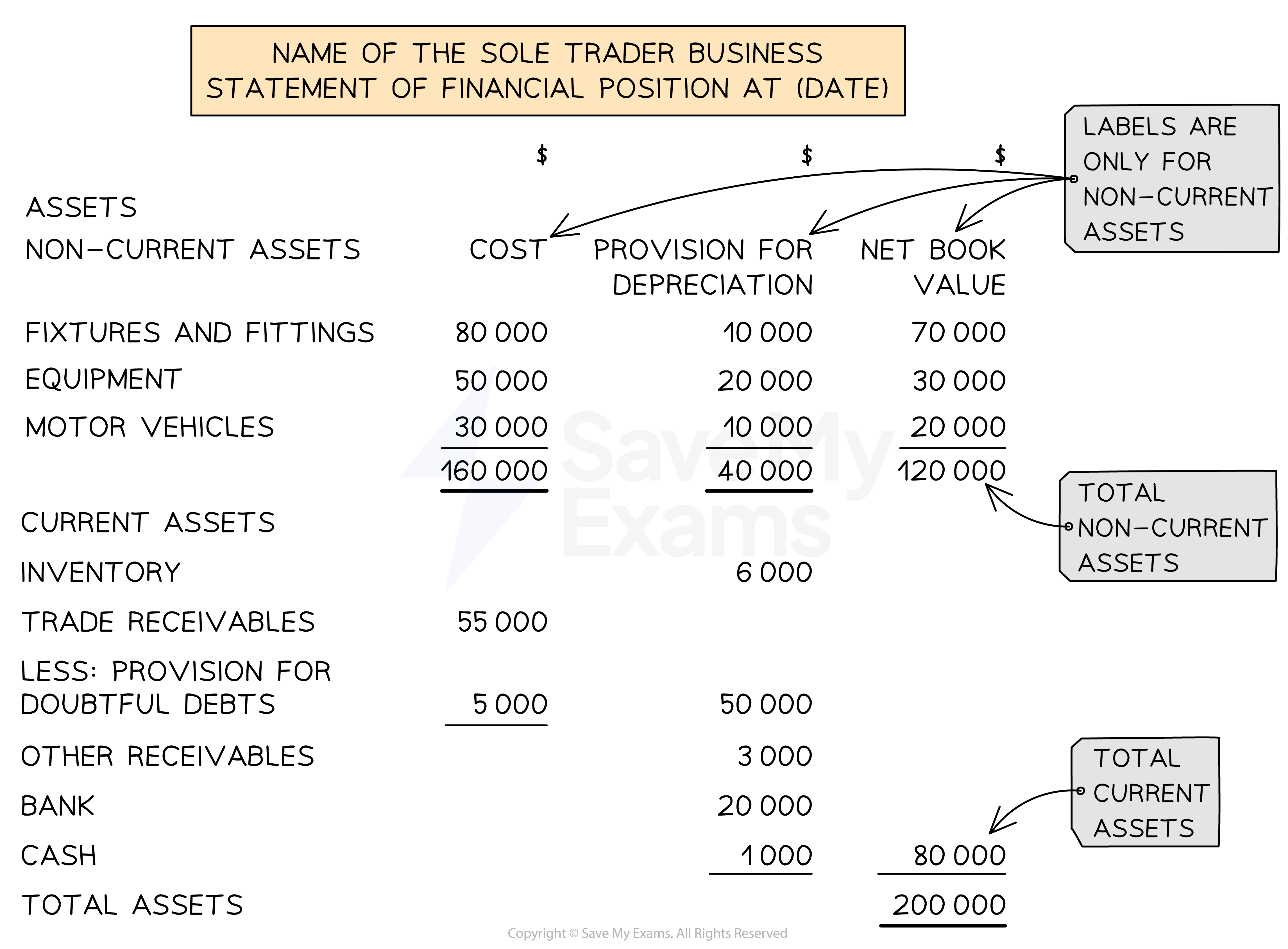
What is the layout for the assets section?
The non-current assets are listed first
Any intangible non-current assets are listed first
These are the non-current assets that do not have a physical form but still add value to the business
Such as intellectual property, goodwill and brand names
Followed by tangible non-current assets
These are the non-current assets that have a physical form and are obtained to help the business generate profit rather than for resale
Such as equipment, machinery, motor vehicles, land and buildings etc
Three values are stated for each non-current asset in separate columns in the following order:
Cost
Provision for depreciation
Net book value
The total for each column is calculated
The total for the net book value column is the total value for the non-current assets
The current assets are listed after the non-current assets
The values for the current assets are listed in the middle column
If there is a provision for doubtful debt then the far left column is used to subtract its balance from the trade receivables
The total is put in the far right column
The total assets value is found by adding the total non-current assets and the total current assets
It is conventional to list the assets within each section in order of their liquidity
Starting with the least liquid assets
How do I complete the capital and liabilities section?
Firstly, calculate the capital in the far right column
Start with the opening capital from the beginning of the financial year
Add (or subtract) the profit (or loss) for the year
Subtract any drawings
This gives the capital at that date
Secondly, list the non-current liabilities
If there is just one item then put it in the far right column
Otherwise, list them in the middle column and put the total in the far right column
Thirdly, list the current liabilities
List them in the middle column and put the total in the far right column
Finally, calculate the total capital and liabilities by adding together:
The capital
The total non-current liabilities
The total current liabilities