3.1.4 Employment Sectors
Employment in Economic Sectors
Employment in Economic Sectors
Economic sectors are an indicator of a country's economic development using either:
The amount each sector contributes to the Gross Domestic Product (GDP)
The percentage of the population they employ
The proportions of each economic sector GDP and employment changes over time:
In the pre-industrial period, the primary sector dominates with steady increases in the secondary and tertiary sectors
As countries develop the reliance on the primary sector for GDP and employment rapidly decreases
During the industrial period the amount of GDP and employment in the secondary sector increases to become dominant and then decreases. The primary sector continues to decrease and tertiary sector increases
In the post-industrial phase, the tertiary and quaternary sectors increase whilst the secondary and primary sectors decrease.
The tertiary sector dominates employment and GDP in the post-industrial period
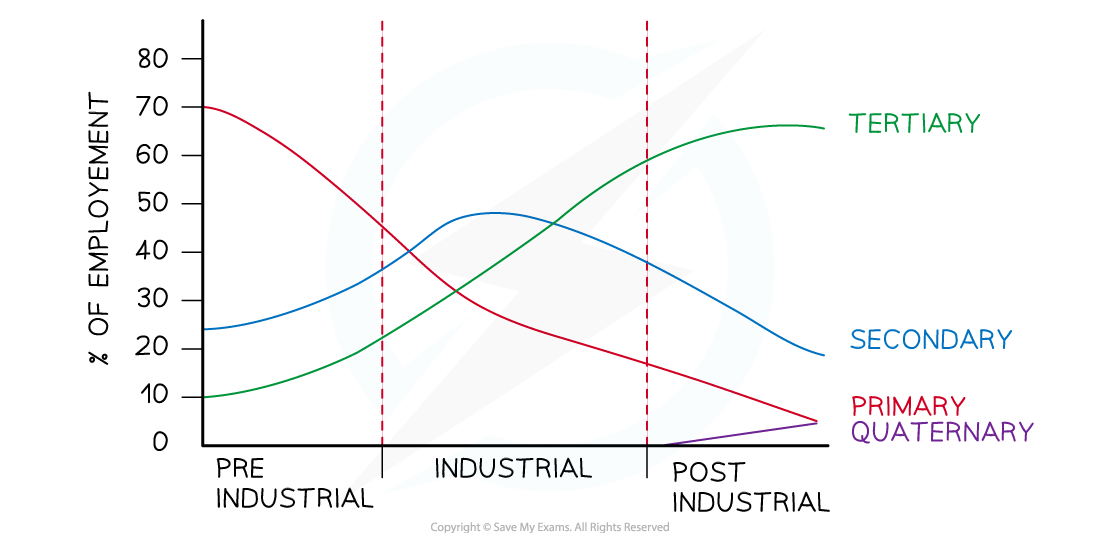
Clark-Fisher Sector Model
As countries develop the numbers of people employed in each economic sector changes
This can be seen in the Clark Fisher Sector Model above and in the examples below:

Causes of changes over time
There are a number of reasons for the change in percentages employed in each sector:
Increasing mechanisation in agriculture led to a decrease in the jobs available
People moved to urban areas to find jobs in secondary and tertiary sectors
Increasing mechanisation and global changes led to a decrease in secondary employment in some countries
Technological improvements have led to an increase in tertiary and quaternary employment
There is a clear link between employment structure and indicators of development