3.3.2 Distribution of Industrial Zones
Distribution & Location of Factories & Industrial Zones
Distribution & Location of Factories & Industrial Zones
Every day companies make decisions about where to locate their industries
Different industries require different inputs,
But they also require them to be readily and cheaply available
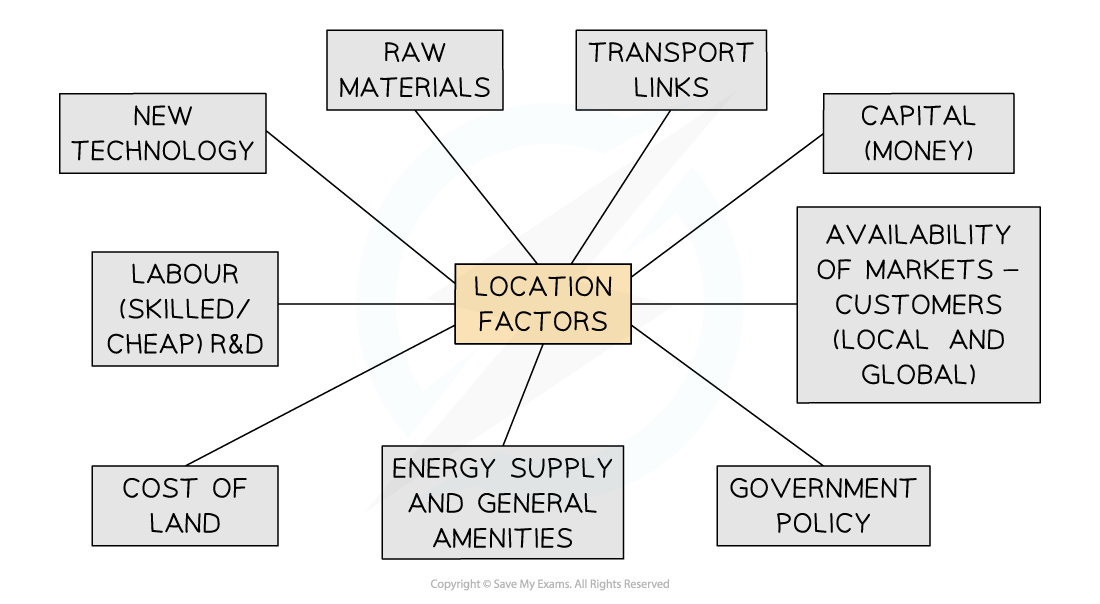
Most companies look for the least cost but highest profit location
Manufacturers need to find the optimum location that will produce maximum profit
This depends on a number of factors - physical, human and economic
Physical factors
Raw materials - industries that need heavy or bulky materials, will locate as near as possible to these materials
Site - availability and cost of land is important. Large factories need flat, well-drained land with or without the potential for expansion later on
Climate - industries such as aerospace and film benefit from sunnier climates. Good climate also reduces energy bills and a better quality of life
Energy - energy demanding industries may relocate to countries/areas with readily available or cheaper energy
Natural routeways - harbours, motorways, airports and railways provide good locations for ports and industrial complexes, which create good access points for inputs but also outputs
Water supplies - some industries (paper and cotton processing etc.) require a lot of water in their manufacturing and so need to be near a reliable water supply such as lakes, rivers etc.
Human and economic factors
Capital - some areas naturally attract inward investment as the returns will be higher
Markets - location and size of the potential market is a major influence for some industries
Government influence - incentives, grants and policies can make areas attractive for industries to invest in
Transport - cost of transport is expensive and accessibility for easy access helps to reduce those costs. Central to motorways, railways, ports and airports can influence where industry locates
Communications - being able to communicate effectively and quickly with customers and suppliers is vital to successful manufacturing
Labour force - quality and cost of labour is central to effective manufacturing, having a reliable workforce is necessary, but also mobility, turnover and reputation is also a factor
Quality of life - highly skilled workers will prefer areas where the work/life balance is good
High-tech industry
High-tech companies are involved in research and development, aerospace technology, weapons guidance systems, medical robotics, software, computer hardware, and other technically advanced products
High-tech industries are usually group together in science parks
Usually close to the university or a research centre with good security systems
Purpose built to encourage research and development (R&D), high-tech industries and other quaternary activities
Close to transport networks (including airports) to allow for knowledge transfer
Further away from housing estates and retail parks to reduce sound, air and visual pollution
Changes to manufacturing and location over time
Raw Materials = sources of raw materials often run out
Manufactures will move in response
Infrastructure means business not tied to energy centres –coalfields etc.
Rising costs = wage levels / laws etc, means costs go up in MICs so work moves elsewhere (e.g. manufacturing)
Transport = commuting & migrating easier because there are now fewer barriers to travel
Competition = fewer people are needed to complete work now, e.g. banking uses ICT
Technology = advances in ICT means more work from home, air travel, etc.
Outsourcing = saves money, work sent elsewhere to save costs (e.g. call centres)
As an economy advances, the proportion of people employed in each sector changes
Places like the UK and the USA are ‘post-industrial societies’, where most work in the tertiary or quaternary sectors
Places such as China and India are ‘industrial societies’, where many people work in the secondary sector
Bolivia and Mozambique are ‘pre-industrial societies’, where most people work in the primary sector
Case Study - Manufacturing Industry: Pakistan’s Iron & Steel Industry
Case Study - Manufacturing Industry: Pakistan’s Iron & Steel Industry
Location | Pipri, near Gharo Creek, Flat, cheap land near Port Qasim, which has a natural harbour to import raw materials and export steel Close to market: steel-using industries in Karachi, such as tool making Along a railway: Karachi-Pipri-Kotri and metalled road |
Input | Iron ore Coke Limestone Scrap iron Water required for making steel Economic assistance from Russia: technical expertise and capital Availability of cheap labour from Karachi Energy source from Pipri thermal power station and Karachi nuclear power station |
Processes | Heating of ore to separate iron Burning coke Rolling into sheets and cutting into lengths |
Output | Cast iron and pig iron Slag Gases: sulphur dioxide, carbon dioxide, nitrous oxide, hydrogen sulphide |
Impact | Noise pollution from machinery Visual pollution due to large, ugly factory buildings Air pollution from burning iron ore
Depleted fresh water supplies
|