3.6.1 Water Supply in MEDCs
Global Water Supplies
Global Water Supplies
Global water supply
Only 2.5% of the water on Earth is freshwater
68.7% of freshwater is stored in glaciers and ice sheets and 30% is groundwater
The remaining 1.3% of freshwater is in rivers, soil moisture, lakes and the atmosphere
This is not evenly distributed across the globe - Canada contains more lakes than the rest of the world combined
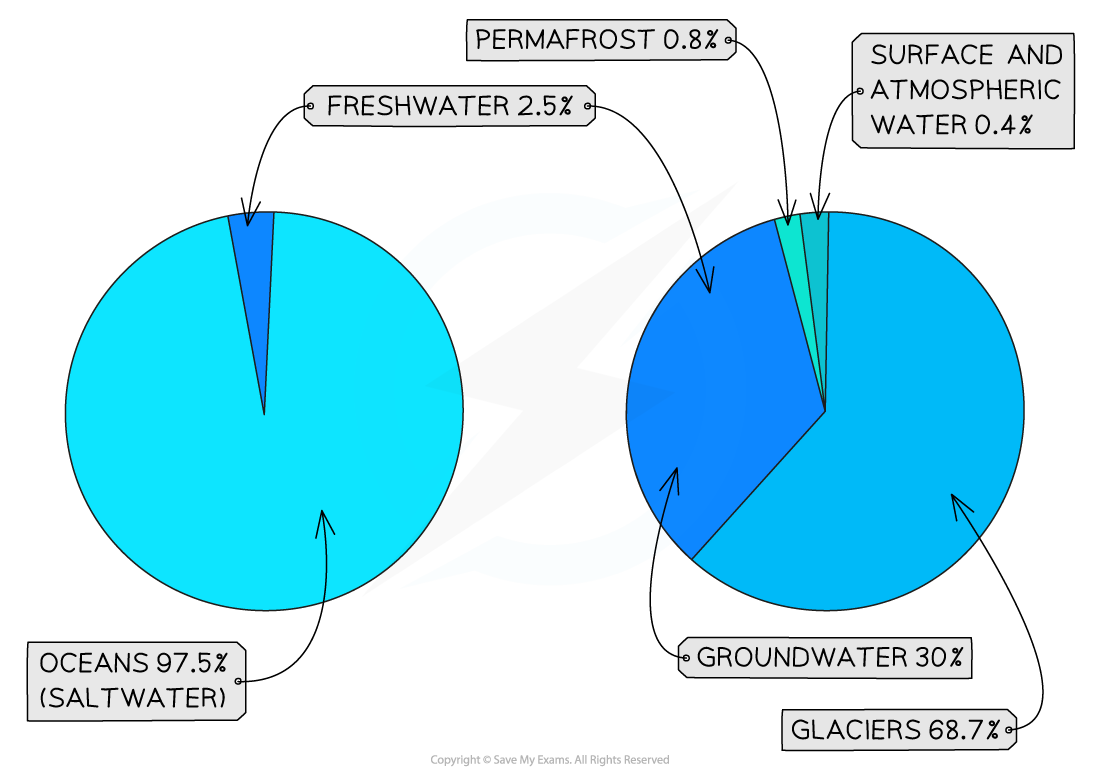
Sources of Water
(note: due to rounding of figures the % on the pie chart to the right add up to 99.9%)
Water supply
The supply of water humans use comes from three main sources:
Lakes and rivers
Aquifers
Reservoirs
Other sources of water supply include:
Desalinisation
Rainwater harvesting - collecting water that falls as precipitation
Source of water supply | Information | Issues |
|---|---|---|
Groundwater/Aquifer | Water stored underground that has filtered through soil and rocks. It is obtained by drilling boreholes or digging wells. When all the rock is fully saturated with water it is an aquifer. Groundwater may also come to the surface as a spring | Overuse or over abstraction of water in some areas means that aquifers do not have time to recharge through precipitation Pollution from industry, agriculture and domestic waste can leach into the groundwater |
Surface water | Water which is stored in the lakes, reservoirs and rivers. | Pollution from industry, agriculture and domestic waste can enter the water system through surface run off Dams are used to store water in reservoirs, but the construction of dams has slowed due to lack of suitable sites and concerns regarding the environmental impact |
Desalinisation | The removal of salt from sea water to mean that it can be used for domestic, agricultural and industrial purposes | Expensive to set up and run - they use a lot of energy |
Global water use by sector is:
70% agriculture - irrigation of crops and water for livestock
20% industry - producing goods and generating energy
10% domestic - toilets, cooking, cleaning, washing
The use by sector varies across countries depending on whether they are MEDCs or LEDCs
Water demand
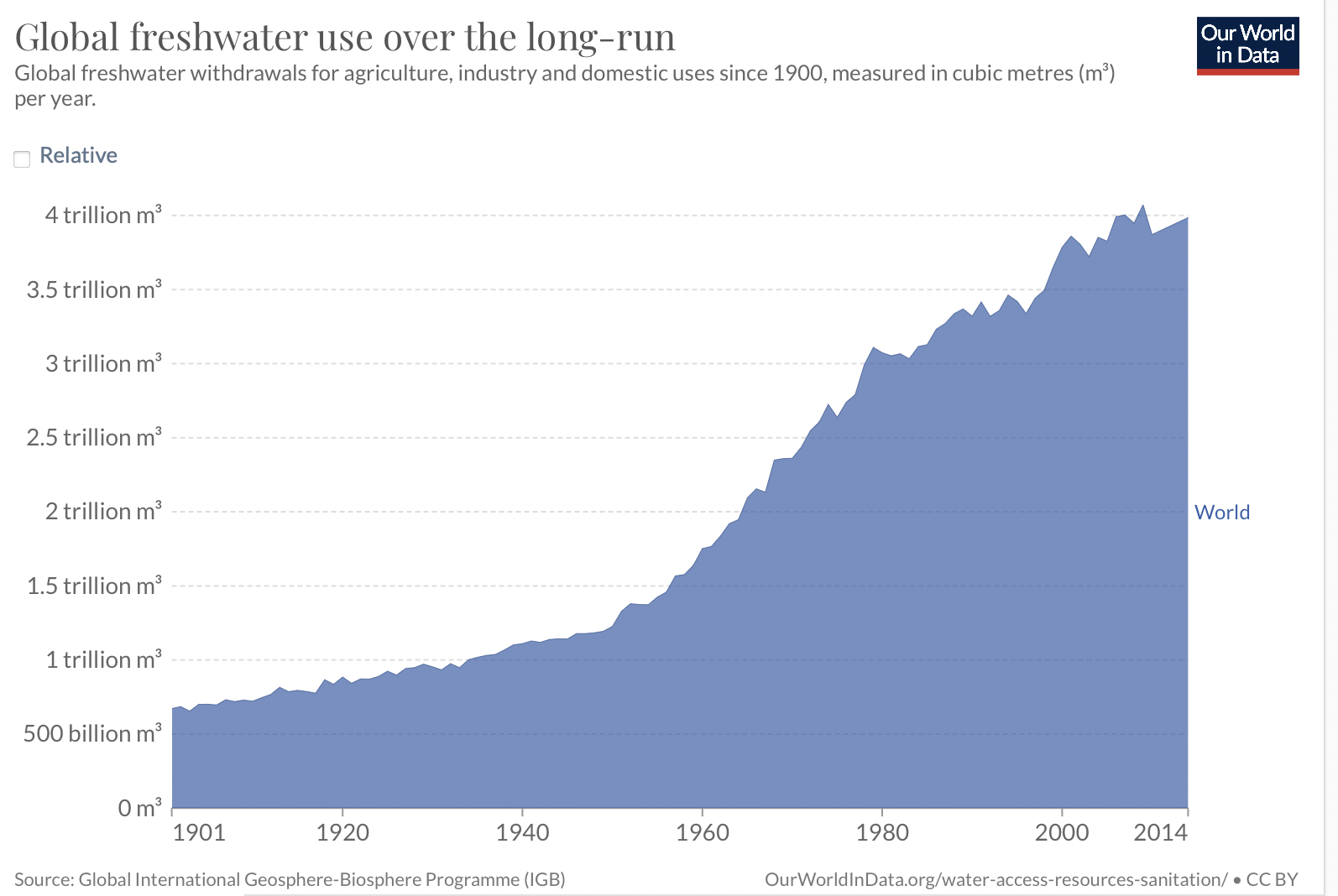
The global demand for water is increasing
Between 1934 and 2014 demand increased from 1 trillion m3 to 4 trillion m3
Water use in MEDCs
11% Domestic
30% Agriculture
59% Industry
Water demand in MEDCs
Water demand is higher in MEDCs than LEDCs as a result of:
Improving living standards - people have more appliances/sanitation which use water
Increased use of water in leisure and tourism - water parks, golf courses
Increased urbanisation
Increasing industry - water is needed for the production of goods and energy production
Increasing use in agriculture - more water is needed for livestock
The largest use of water in MEDCs tends to be industry
Water use in LEDCs
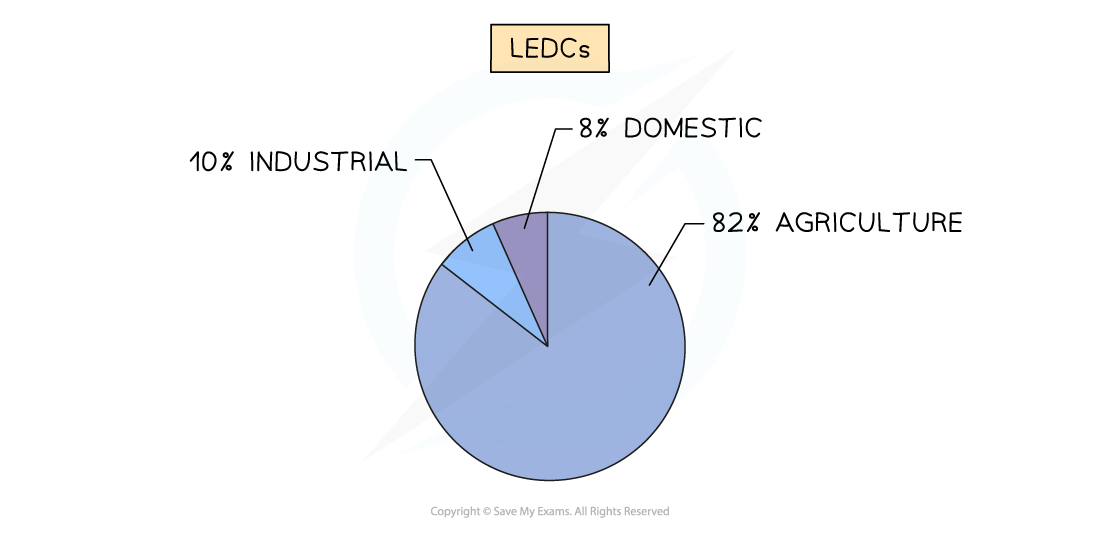
Water Use in LEDCs
Water demand in LEDCs
Unlike MEDCs the water use in LEDCs is mostly used for agriculture
Many people are still dependent on agriculture
There is far less industry in many LEDCs so the demand for water for industrial processes is low
Many people in LEDCs do not have access to piped water and as a result are more cautious with water use