3.7.2 Global Warming
Global Warming
Global Warming
Changes in the global climate
The global climate conditions of the Earth range over time leading to colder and warmer periods
The last 2.6 million years are the Quaternary period when there have been 60 cold periods and warmer interglacial periods
The last ice age ended approximately 25,000 years ago
The evidence for these changes comes from:
Ice cores which trap ash, air bubbles and microbes
Preserved pollen
Historical sources such as diaries and art
Tree rings
Causes of Natural Climate Change
Cause | Impact |
|---|---|
Milankovitch Cycles |
|
Volcanic eruptions |
|
Sunspot activity |
|
Atmospheric dust |
|
The greenhouse effect
The greenhouse effect is essential to the survival of life on Earth:
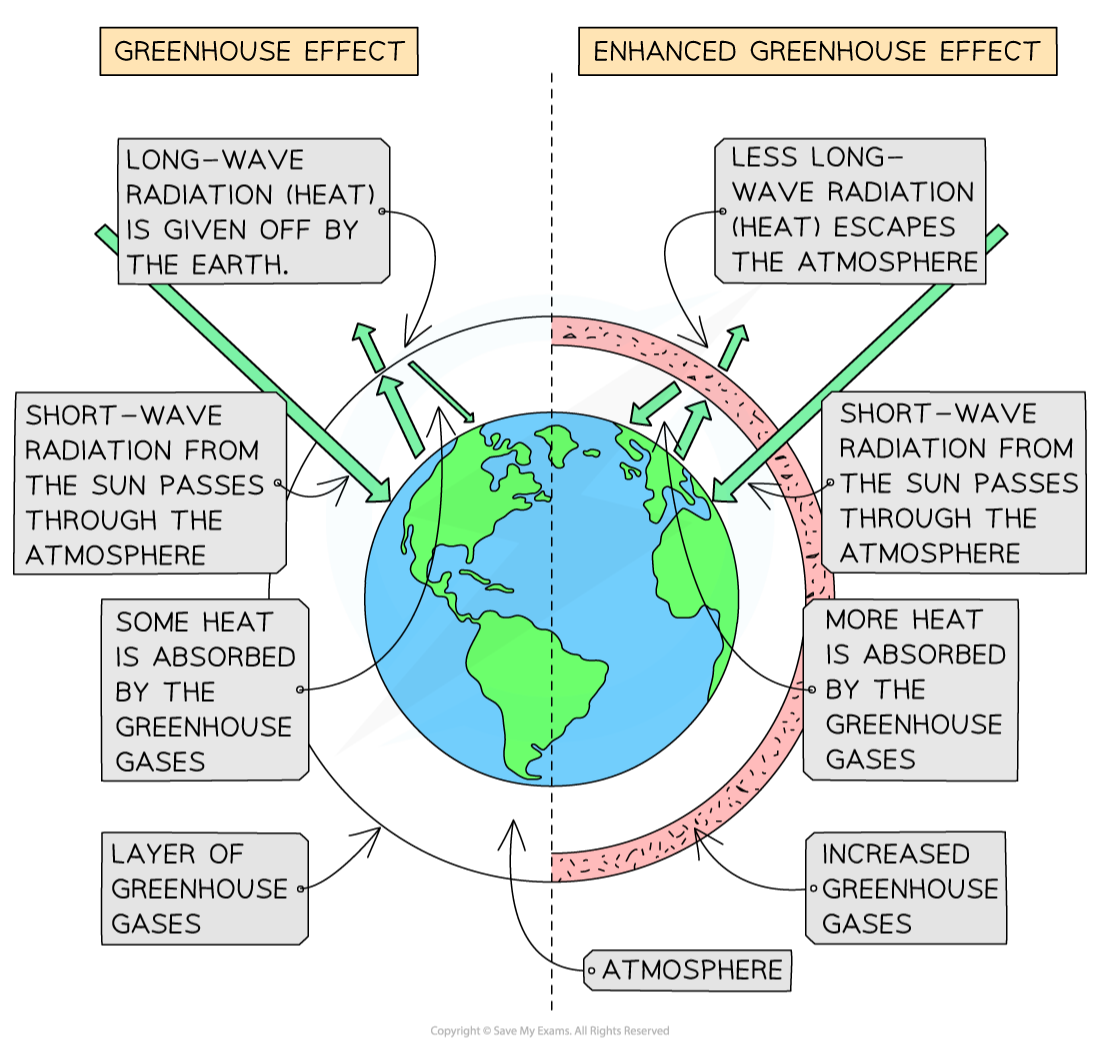
Greenhouse gases in the atmosphere allow short-wave radiation from the sun through to the Earth's surface
The greenhouse gases absorb some of the long-wave radiation (heat) and stop it radiating out into space
This maintains the Earth's average temperature
Without the greenhouse effect the average temperature would be -18oC
Greenhouse gases from natural sources
Water vapour - evaporation from the oceans/seas and plants
Carbon dioxide - volcanic eruptions, wildfires and respiration
Methane - emitted from oceans and soils as part of decomposition, termites also emit methane
Nitrous oxide - soils and oceans
The enhanced greenhouse effect
Human activity is increasing the number of greenhouse gases in the atmosphere:
Carbon dioxide (CO2) levels in the atmosphere have increased by more than 100 parts per million (ppm) to 420ppm in 2020
Increased amounts of greenhouse gases have led to the enhanced greenhouse effect:
Less long-wave radiation (heat) can escape the atmosphere
Average global temperatures have increased over 1oC since pre-industrial times
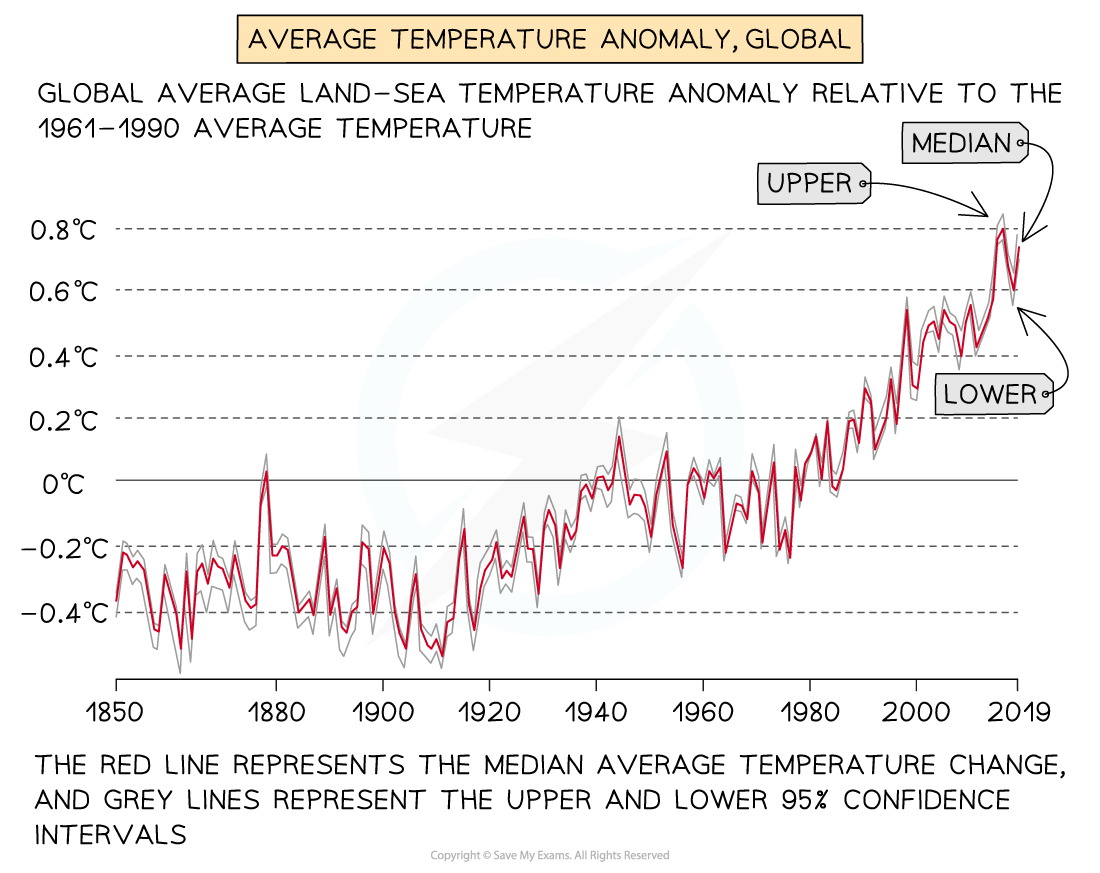
Average Global Temperatures
Human Sources of Greenhouse Gases
Greenhouse Gas | Sources from Human Activity |
|---|---|
Carbon Dioxide (CO2) |
|
Methane (CH4) |
|
Nitrous Oxide (N2O) |
|
Chlorofluorocarbons (CFCs) |
|
Impacts of the enhanced greenhouse effect
Health
Increased temperatures and lack of precipitation may lead to the spread of diseases:
Italy has experienced cases of malaria since 2017 when it was previously a malaria free area
An additional 280 million people may be affected by malaria
Water-borne diseases are more likely to spread
Heat waves may become more frequent
Heat stroke, dehydration and sunburn increase during heat waves
Stagnant air during heat waves increases air pollution levels:
Respiratory diseases increase and those suffering from respiratory illnesses such as asthma may be more affected
Increased temperatures negatively affect people with cardiopulmonary diseases
Diets may be restricted by food shortages leading to malnutrition and famine
Homes and settlements
Increased flooding due to sea level rise and increased frequency and severity of storms will lead to displacement of large numbers of people
Settlements in low-lying areas may have to be abandoned or need additional defences against sea level rise:
Moving settlements or improving flood defences will be costly
Agriculture
Farmers may need to change the crop they grow if climate conditions become unsuitable
Coastal flooding may lead to salt intrusion
Reduced availability of water will mean that irrigation is limited or impossible
Food shortages will lead to malnutrition and famine
Employment
Job opportunities may change or decrease because:
Tourism may decline in some areas for example ski resorts may close due to the lack of reliable snow
Coastal resorts may be at risk of flooding leading to the closure
Farmers may have to change the crop they grow or livestock they raise or leave farming
In some areas agriculture may decline due to rising temperatures or changing rainfall patterns
Sea level rise
Warmer temperatures cause the water in seas and oceans to expand, increasing the sea level
Melting ice is adding to the increasing volume of water:
Average sea levels have risen 23cm since 1880
Sea levels are forecast to increase a further 30cm by 2050
Low-lying coastal areas and islands are at higher risk of flooding:
The Maldives may be uninhabitable by 2050
Beach erosion will increase leading to greater coastal erosion
Coastal ecosystems including coral reefs and mangrove swamps will be affected
Saltwater is contaminating freshwater supplies and affecting coastal agriculture
Ecosystem change
The location of biomes may shift to the north (Northern Hemisphere) and south (Southern Hemisphere) as they rely on specific climate conditions:
Polar and tundra biomes are at risk of becoming extinct as they cannot shift any further north/south
Increasing sea temperatures and ocean acidification have resulted in coral bleaching
Migration and behaviour patterns of animals affected by changing temperatures:
Fish species are moving north and south of their usual habitats to seek cooler water
Reduced hibernation due to warmer winters
Melting of ice caps/glaciers leading changing ocean currents
Mangrove swamps and coral reefs are threatened by rising sea levels
Loss of habitats through flooding, drought and wildfires
Food webs breaking as species numbers are reduced and food sources are decreased
Loss of plants and vegetation
Natural hazards
Changes in climate patterns are likely to increase the frequency and severity of storms:
The 2020 Atlantic hurricane seas were the first most active on record and 2021 was the third most active
The frequency and length of droughts are increasing
Dry conditions lead to the increased risk of wildfires:
In 2021 Australia, Greece, South Africa, Brazil and USA were just some of the places to experience severe wildfires
In September 2021 the USA National Fire Centre reported 44.647 wildfires which had burned 5.6 million acres
Rising sea levels together with increased storms lead to increased flooding risk
Responses to climate change
Global warming and climate change require an international response because it affects the entire globe
Responses can involve either adaptation or mitigation
In 1988 the Intergovernmental Panel on Climate Change (IPCC) was set up to assess the 'risks of human-induced climate change
This was followed by several international agreements
Earth Summit, Rio 1992
Set out aims to stabilise greenhouse gas levels
Kyoto Protocol 1997
Delegates from 150 countries agreed to reduce greenhouse gas emissions
It stated that industrialised countries would reduce emissions to below the levels in 1990
Developing countries including China and India were exempt from the agreement
The USA did not sign up for the treaty
Canada withdrew in 2011 stating that without China and USA the treaty would not work
Paris Agreement 2015
Global agreement to limit global warming to 2oC (preferably 1.5oC) above pre-industrial levels
Agreement also includes reducing CO2 emissions by at least 60% by 2050
Signed by 196 countries including the USA and China (the USA withdrew in 2020 and rejoined in 2021)
Conference of the Parties (COP)
The United Nations (UN) holds an annual (every year) meeting to discuss climate change.
COP26 was held in Glasgow in 2021
All nations agreed to take actions to further reduce greenhouse gas emissions
Reducing emissions
Emissions can be reduced in a number of ways including;
Reducing deforestation
Increasing afforestation
Improving energy efficiency in industry and domestic appliances
Reducing emissions from industry
Improving public transport
Electric vehicles
Use of renewable energy and nuclear power