3.7.1 Soil Erosion & Desertification
Soil Erosion & Desertification
Soil Erosion & Desertification
Soil Erosion
Soil erosion is the wearing away of the topsoil by the action of wind or water
It is a natural process which is made worse by human activities which leave the soil exposed to wind and water
Cause | How it leads to soil erosion |
|---|---|
Deforestation |
|
Overgrazing |
|
Overcultivation |
|
Population Increase |
|
Over abstraction of groundwater |
|
Human induced climate change |
|
Salinisation is also an increasing issue in many semi-arid areas
Occurs when high rates of evaporation lead to groundwater being drawn to the surface
When the groundwater evaporates salts are left in or on the topsoil
These salts make the land toxic to many crops and so the land can no longer be used
Soil erosion may over time lead to desertification
Desertification
Desertification is caused by both natural factors and human activities
Many of the natural causes may be made worse by climate change
Natural causes | Human causes |
|---|---|
Soil erosion leads to the loss of nutrients. Plants are unable to establish and grow | Overgrazing means the vegetation has all gone due to the numbers of animals or the land does not have chance to recover |
Rainfall patterns have become less predictable leading to drought and any vegetation dying due to lack of water | Over-cultivation leads to all the nutrients being taken up by crops leaving none for future vegetation to grow |
Reduced vegetation means that nutrients are not added to the soil through the decomposition of dead organic matter | Deforestation removes shade for the soil and means there are no roots which bind the soil together. This increases soil erosion, whilst decreasing infiltration and interception |
Any rain that does fall is often in short, intense bursts, leading to increased surface run off and soil erosion | Population growth puts increased pressure on the land as people raise more animals and grow more crops |
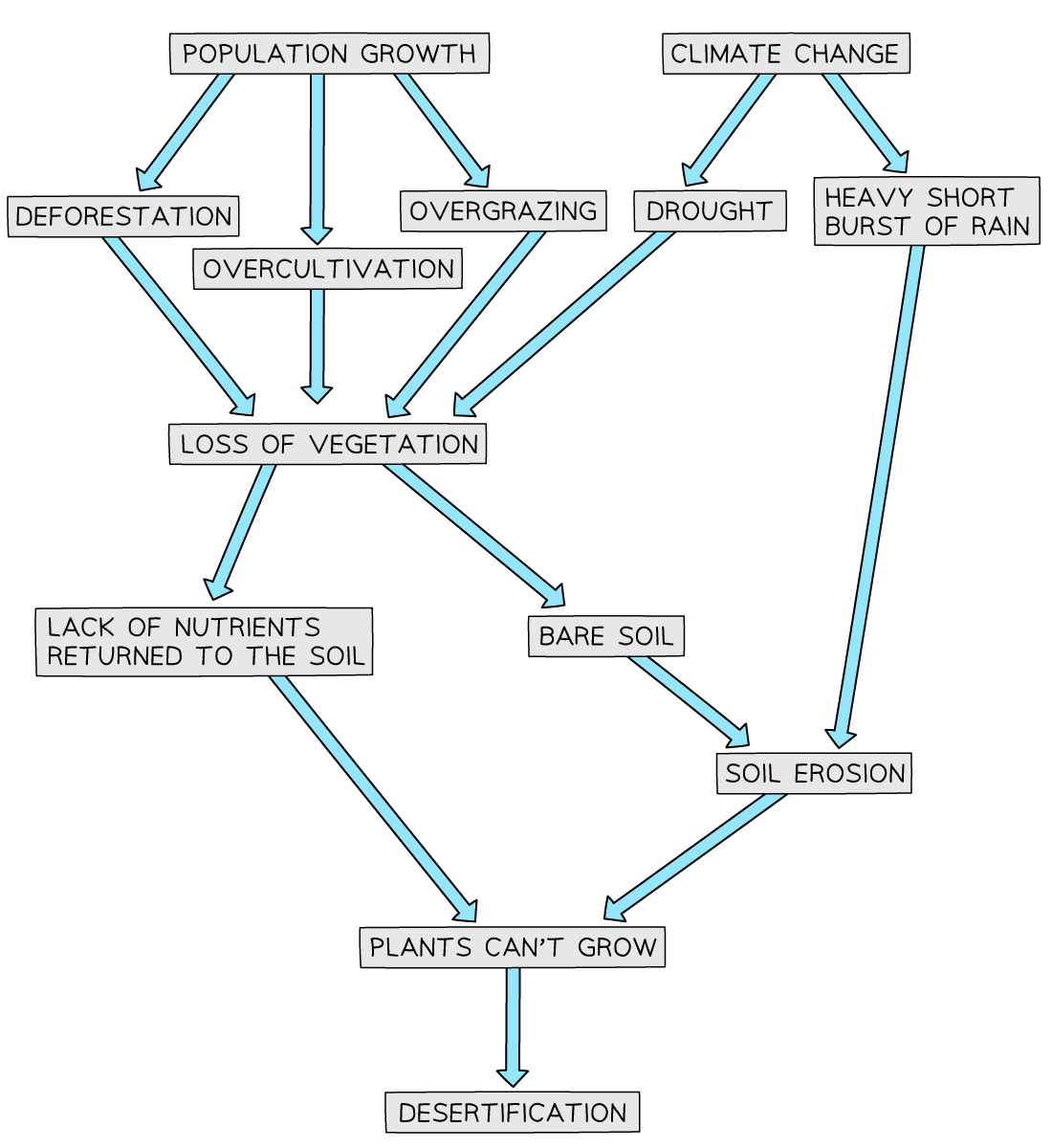
Causes of Desertification
Sustainable Management of Soil Erosion and Desertification
Halting and reversing soil erosion and desertification means tackling the causes
There are a variety of political and social responses
Education
Education including:
Sustainable farming methods including agroforestry and crop rotation, which help to keep the soil healthy
Family planning to reduce population growth
Agroforestry
This combines agriculture with forestry, which means some trees remain, which:
Decreases deforestation
Provides shade as well as increasing infiltration and interception, which reduces soil erosion
Provides organic matter from the trees and adds nutrients to the soil
Afforestation
Tree planting, such as the Great Green Wall across the Sahel, helps to reverse desertification in several ways:
The roots help to bind the soil together reducing soil erosion
The canopy offers shade helping to prevent the soil from drying out and also reducing soil erosion from rainfall landing directly on the soil
Nutrients in the soil are replaced by falling leaves and branches
The trees increase animal and insect activity which helps improve soil quality
Contour Stones and Terraces
These help to reduce soil erosion by:
Preventing the soil from being blown or washed away
Increasing infiltration of water and reducing overland flow
Ensuring that dead organic matter stays in one place and can decompose adding nutrients to the soil
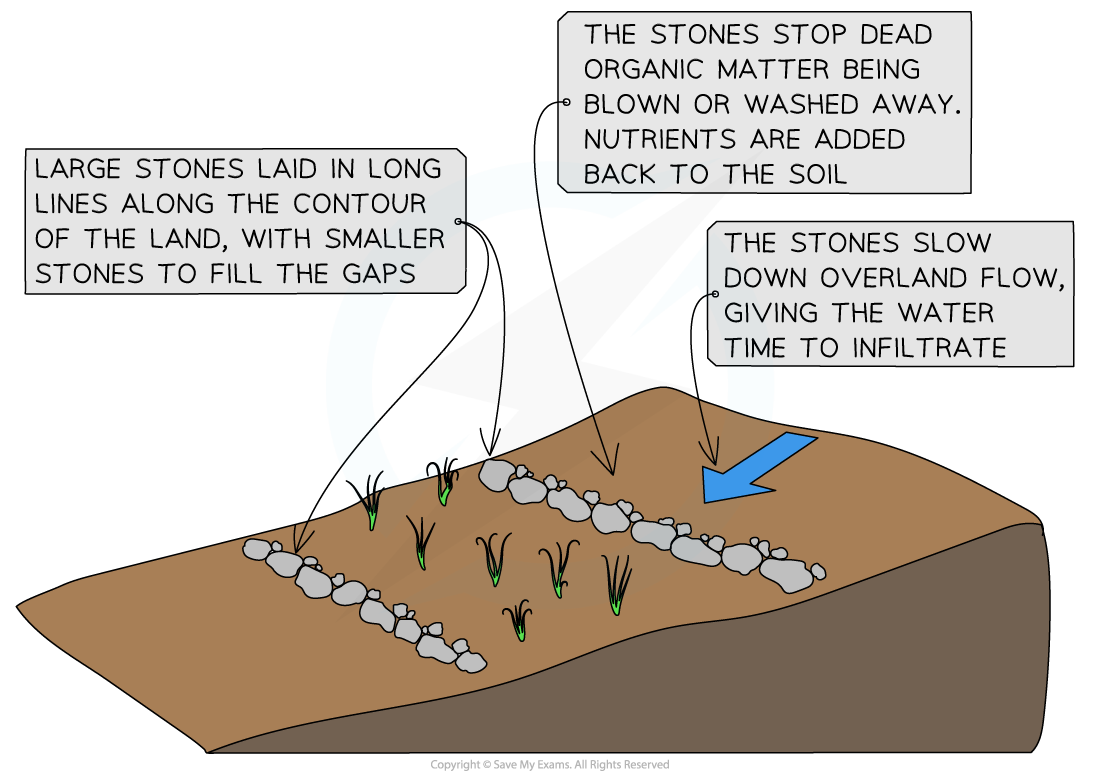
Contour Stones